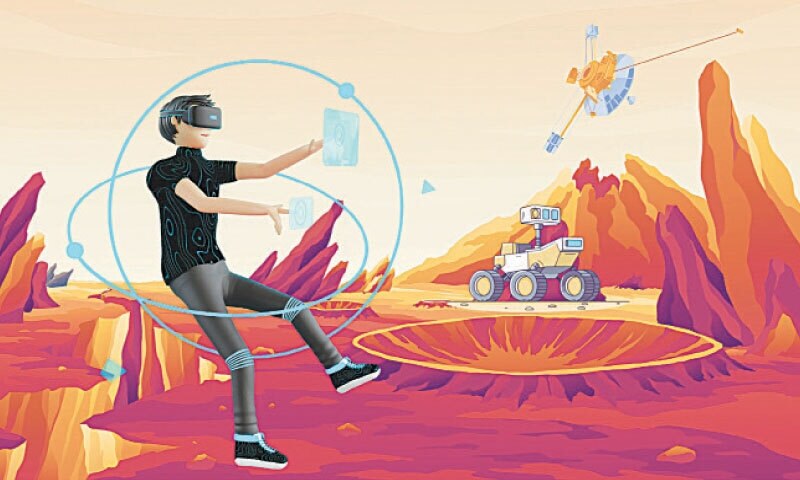

I have been hearing the word “metaverse” a lot lately. Some of us have heard it in superhero movies or sci-fi talk. While I say this, there are always those “pro kids” winking proudly, because they’ve already Googled it and know all the buzz. So I thought, why not solve this mystery of the metaverse in my mind and perhaps make it easy for those who are also entangled in this universe with the metaverse.
A lot of us think the word “metaverse” came from Marvel or DC movies. And to me also, it really does sound like it belongs in those superhero worlds. Upon researching, I came to know that it was actually used first in a 1992 sci-fi novel called Snow Crash by Neal Stephenson. The writer explained the word as a virtual world where people lived and worked through avatars. And quite surprisingly, today, tech giants like Meta (Facebook), Microsoft and even games like Roblox and Fortnite are already trying to bring that old sci-fi idea into reality. That’s why we keep hearing the word everywhere these days, not just in movies but in real life too.
So, what is it really?
Most of us are already familiar with VR (virtual reality) headsets. Some of you might even own one. For those who don’t know much, a VR set includes a headset with lenses and tiny screens inside, motion sensors and controllers for your hands. Together, these let you enter a computer-generated world. This system with sensors tracks your head and hand movements as you look around, move and interact with objects inside the digital space. Sometimes, you even get haptic feedback (a sense of touch) through vibrations.
Now here’s where the metaverse comes in. In simple words, VR becomes a door and the metaverse becomes the “world behind it”. When you put on a headset, you enter the world you want to. It could be a café chatting with friends, attending a concert or sitting in a class with fellows from across the globe.
The metaverse isn’t just a buzzword — it’s a new way of living online. Here’s what you need to know about this digital universe
In short: VR alone is like playing a game by yourself.The metaverse is like a huge digital city where everyone can join in.VR + metaverse together means you don’t just play; you actually live, study, work and explore inside that digital city.
How does it work?
The metaverse is not built on one technology but on a mix of many: Virtual Reality (VR): headsets that take you inside a digital space. Augmented Reality (AR): adding digital objects to your real world, such as Pokémon GO. On Instagram or Snapchat filters, when you add dog ears, sunglasses or makeup to your face on camera, that’s also AR. Digital avatars: your online version, either like you or however you want to look. Virtual economy: buying clothes for avatars, owning digital land and attending events, all with real money.
Why does it matter?
The internet feels flat compared to the metaverse. We scroll, click, type and watch. While in the metaverse, we can actually “enter” spaces instead of just looking at them. And this could mean, for instance, in education: imagine you are having your science class about planets while you are standing on virtual Mars with your teacher. Isn’t it amazing?
Or you can experience Taylor Swift’s concert, standing in the front row, without even leaving your room. Not just this, but you can join fans in huge stadiums like Camp Nou or Wembley, cheering for your favourite football team in the metaverse with people from every corner of the world.
Do you always need a headset?
Perhaps you are thinking of those bulky VR headsets to enter the “metaverse.” But here’s the truth: you don’t always need them. Of course, with a headset, the experience is full, as if you enter another world. Without a headset, you can still enter the metaverse through a computer, gaming console or phone, but the experience is less immersive.
It’s like watching a movie on your phone compared to the experience in the cinema with 3D glasses; doesn’t it feel more real?
Identity in the metaverse
Here, you’re not bound to your real-world looks. You can choose to look exactly like yourself or totally different — maybe a superhero, a robot or an anime character.
This concept isn’t new. Many of you already do this in games like Minecraft, Fortnite or Roblox, where you pick skins and outfits and change how your character looks. Even on Snapchat or TikTok filters, you’re already trying out new versions of yourself. The metaverse is just a bigger, more alive version of this idea.
Study and work in the metaverse
Studying in the metaverse will involve experiencing what you are learning. And this is where I think things get really interesting. For instance, the metaverse will allow medical students to practise surgeries in VR before operating on real patients. History students could walk through ancient Rome instead of just reading about it.Medical students could explore the human body from the inside.Perhaps geography would become a more adventurous and loved subject when you stand atop Mount Everest or right at the Equator, with one foot in the Northern Hemisphere and the other in the Southern.
So, is it the future?
Although companies like Meta and Microsoft are spending billions on this, we only have glimpses of it through various games — yet it’s still early. Not everyone has the devices yet and there are real concerns too, like privacy, screen addiction and how much of our lives should go online.
That’s why people are divided. Some think it’s beneficial and a big step in development, while others see it as a technology that’s taking humans away from real life.
In my opinion, like every technology, the metaverse will have its good and bad sides. It’s about new ways to connect, learn and create, things that once lived only in sci-fi. But let’s not forget, the metaverse is just a tool. What really matters is how we use it — whether to escape from life or to make life more meaningful. The future depends on the way we choose!
Published in Dawn, Young World, September 13th, 2025