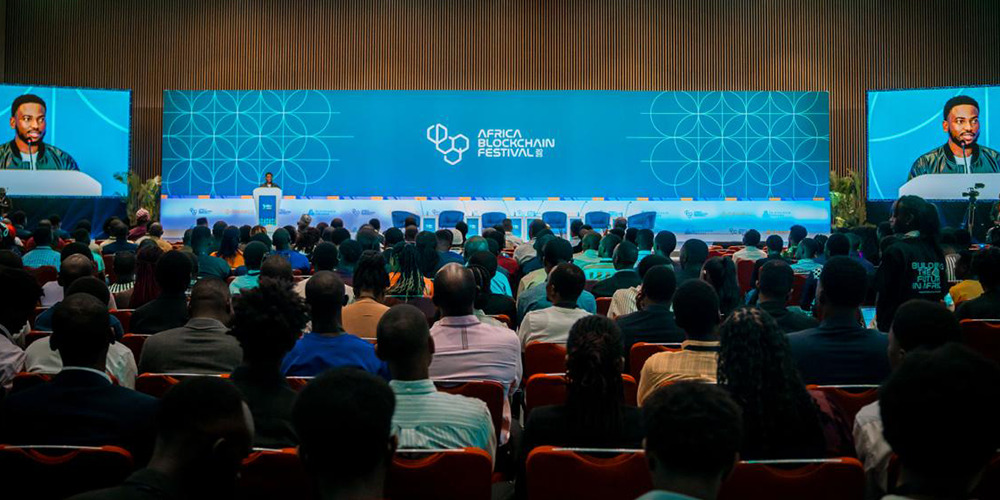

While much of the western financial world remains preoccupied with blockchain as a vehicle for cryptocurrency trading and speculative assets, a more consequential narrative is emerging from Africa. In November, the 2025 Africa Blockchain Festival in Kigali, Rwanda served as a testament to the continent’s ambition to reposition blockchain technology from a financial instrument to a foundational tool for social and economic integrity.
The festival convened over 1,600 policy-makers, regulators, innovators and investors, and moved decisively beyond theoretical discussions to showcase tangible applications addressing systemic challenges.
The vision presented was clear: Africa is leveraging blockchain not to replicate existing financial systems, but to build new frameworks of trust, transparency and inclusion. These frameworks span key sectors such as public service delivery, trade facilitation, digital identity and creative industries, where gaps in credibility, verification and coordination continue to constrain economic activity. Critically, ABF did not rely solely on talk.
The festival’s live hackathon – Project Ubuntu Hackathon (powered by Web3Bridge) – offered a practical pathway for translating ideas into prototypes. Developers from across Africa competed to build real-world blockchain (and artificial intelligence-integrated) solutions, with final demonstrations taking place during the festival. This end-to-end approach – from ideation, build, demo and potential funding – reflects a shift in both technical maturity and policy expectations. Blockchain is no longer just a concept: it is code, deployable now to address problems in production, trade and creation beyond finance.
Reimagining supply chains
The dialogue in Kigali highlighted how blockchain’s capacity for immutable, verifiable record-keeping is being harnessed far beyond finance. In the fashion industry, where ethical sourcing and authenticity are increasingly important to global consumers, African innovators are deploying blockchain technology to track materials from raw commodity to finished garment. This provides an unforgeable product pedigree, allowing brands to prove sustainable and ethical practices while combatting counterfeit goods – a compelling value proposition for both conscious consumers and international investors.
A similar logic is being applied to agriculture, a cornerstone of many African economies. Here, blockchain is being piloted to revolutionise commodity trading and food safety. By recording every step of a crop’s journey – from the smallholder farmer’s plot through processing to export – the technology creates an unbroken chain of custody. This not only ensures farmers receive fair payment by verifying their contribution but also provides international buyers and investors with unprecedented transparency, mitigating risk and building confidence in African supply chains.
Empowering creators and protecting patients
The festival also illuminated blockchain’s role in rebalancing power in favour of artists and individuals. In the music and creative industries, smart contracts on blockchain platforms are being designed to automatically distribute royalties to artists, composers and producers. This system disintermediates traditional, often opaque, rights management structures, ensuring creators are paid fairly and promptly. For Africa’s vibrant cultural exports, this could represent a shift away from long-standing power asymmetries between creators on the continent and labels and producers typically based in Europe or the US.
Perhaps one of the most socially impactful applications discussed was in healthcare. In regions where centralised health data systems can be fragile or susceptible to breaches, blockchain offers a structural alternative for patient information management. A decentralised model gives patients control over their own health records, granting permissioned access to different providers. This not only secures sensitive data from tampering but also creates a continuous, accurate medical history, improving diagnosis and treatment outcomes while maintaining rigorous patient privacy.
Building systems over speculation
The focus on applied problem-solving marks a distinct departure from the dominant narrative in many advanced economies. While the West often concentrates on blockchain technology for refining high-frequency trading, complex derivatives or digital currencies, Africa is advancing blockchain as a tool to solve foundational global problems: monitoring food supply chains, ensuring ethical production, or protecting intellectual property.
The launch of research group ABF Labs at the festival institutionalises this mission. It aims to function as a year-round policy think tank and venture studio, specifically designed to bridge the gap between public sector challenges, regulators and private sector technical solutions in these critical, non-financial domains.
The imperative for global co-operation
The most promising applications of blockchain in Africa are not merely local fixes but blueprints for global challenges. Investing in and partnering with these ventures offers a dual benefit: achieving substantial impact for mutualising transformative work that challenges existing power dynamics and secondly, advancing technological innovation that builds verifiable trust and transparency.
The festival spotlighted a continent that is not just catching up with technological trends but is actively pioneering a more holistic and human-centric application of blockchain. By focusing on agriculture, health, creative rights and supply-chain integrity, Africa is positioning distributed ledger technology as the bedrock for a more equitable and transparent global economy – a lesson in innovation that resonates far beyond its borders.
Carla Coburger is Blockchain Researcher and Monetary Economist at the University of Bayreuth, Germany.
Interested in this topic? Subscribe to OMFIF’s newsletter for more.