
Europe NFT Art Market Size
The Europe NFT art market size was valued at USD 1.78 billion in 2025 and is anticipated to reach USD 2.37 billion in 2026 and from USD 17.82 billion by 2034, growing at a CAGR of 32.97% during the forecast period from 2026 to 2034.
NFT art refers to the digital ecosystem where unique, blockchain verified artworks are created, bought, sold, and collected using non fungible tokens primarily on Ethereum and emerging eco-friendly blockchains. Unlike traditional art markets, this space merges cryptographic provenance with creative expression, enabling artists to embed royalties and collectors to own verifiable digital scarcity. The market’s evolution in Europe is shaped less by speculative trading and more by institutional validation and cultural integration. According to Eurostat, Europeans are increasingly using the internet daily, which provides a vast digitally literate audience. As per the European Museum Association, Europe hosts a significant number of contemporary art museums and commercial galleries, which is creating a fertile ground for bridging physical and digital art worlds. Regulatory developments also play a pivotal role, as per the European Union, the Markets in Crypto Assets regulation that came into full application in 2024 provides a clear legal framework for digital asset issuers, which is enhancing investor confidence. This confluence of cultural infrastructure, digital readiness, and regulatory clarity positions Europe as a maturing hub for artist centric, sustainable NFT art innovation.
MARKET DRIVERS
Institutional Endorsement by Established Art Galleries and Museums
The strategic embrace of non-fungible tokens by legacy cultural institutions that lends artistic legitimacy and broadens mainstream acceptance is majorly propelling the NFT art market growth in Europe. Major European galleries and museums are no longer treating NFTs as a fringe phenomenon but as a legitimate medium for contemporary expression. In 2024, the Uffizi Gallery in Florence tokenized masterpieces from its collection, while London’s Serpentine Galleries launched dedicated NFT commissions with leading digital artists. According to the European Museum Association, art institutions across Western Europe have initiated NFT related exhibitions or acquisitions in recent years. This institutional validation transforms NFTs from speculative assets into culturally sanctioned artworks, attracting traditional collectors who previously viewed digital art with skepticism. Furthermore, partnerships between auction houses like Sotheby’s Europe and blockchain platforms have created curated sales that emphasize artistic merit over price volatility. By anchoring NFTs within established art historical discourse, these institutions de risk entry for new collectors and provide artists with prestigious platforms, thereby stabilizing and professionalizing the European NFT art ecosystem.
Implementation of the EU’s MiCA Regulatory Framework
The European Union’s comprehensive Markets in Crypto Assets regulation that establishes a clear and harmonized legal framework for digital asset issuers and service providers across all 27 member states is further supporting the Europe NFT art market expansion. As per the European Commission, MiCA came into full effect in December 2024, requiring NFT platforms that offer financial services such as custody or trading to obtain authorization and adhere to strict consumer protection and anti-money laundering standards. While pure art NFTs are largely exempt, the regulation instills broader market confidence by eliminating regulatory ambiguity that previously deterred institutional investors and high net worth collectors. According to the European Securities and Markets Authority, professional art investors now consider European NFT platforms more trustworthy than those in unregulated jurisdictions. This legal certainty encourages platform investment in compliance, security, and user experience, fostering a safer environment for both creators and buyers. By distinguishing between utility and speculative tokens, MiCA allows the art focused segment to thrive without being conflated with volatile crypto assets, thus nurturing a sustainable and artist centric market.
MARKET RESTRAINTS
Ambiguity in Intellectual Property Rights and Artist Royalties
A significant restraint on the Europe NFT art market is the persistent legal uncertainty surrounding intellectual property rights and the enforceability of creator royalties. While NFTs establish ownership of a token, they do not automatically confer copyright or reproduction rights to the underlying artwork, leading to frequent disputes and unauthorized commercial use. According to the European Union Intellectual Property Office, NFT art listings often contain unclear or misleading terms regarding IP transfer, creating confusion among buyers. Moreover, despite many platforms embedding royalty mechanisms in smart contracts, these are not legally binding under current EU copyright law and can be bypassed through secondary market workarounds. As per the Max Planck Institute for Innovation and Competition, existing EU copyright directives do not adequately address the nuances of blockchain based art distribution. This gap discourages professional artists from fully committing to the medium, as they cannot reliably monetize future resales, thereby limiting the influx of high-quality artistic content essential for long term market credibility.
High Environmental Perception Despite Blockchain Shifts
The Europe NFT art market continues to face reputational resistance due to lingering perceptions of excessive energy consumption, despite the industry’s shift toward eco-friendly blockchains. Many European consumers and cultural institutions remain influenced by early reports linking NFTs to Ethereum’s proof of work consensus, which was indeed energy intensive. Although Ethereum completed its transition to proof of stake in 2022, reducing its energy use significantly as confirmed by the Crypto Carbon Ratings Institute, public awareness lags. According to Eurobarometer, many Europeans still believe NFTs are environmentally harmful, a perception that deters ethically conscious collectors and public institutions from participation. This misalignment between technical reality and public opinion creates a barrier to adoption, particularly in Northern Europe where sustainability is a core cultural value. Until platforms and artists proactively educate audiences about low carbon blockchains like Polygon and Tezos, this stigma will constrain market growth and limit engagement from Europe’s large base of environmentally aware art patrons.
MARKET OPPORTUNITIES
Integration of NFTs into Physical Art Exhibitions and Collecting
A major opportunity for the Europe NFT art market lies in the hybridization of digital and physical art experiences, where NFTs serve as gateways to tangible cultural engagement. Forward looking galleries and museums are increasingly pairing NFT purchases with real world benefits, such as exclusive exhibition access, limited edition prints, or artist meetups. For instance, Paris’s Palais de Tokyo hosted an NFT gated show in 2024 where token holders received physical catalogs and studio visit invitations. According to the European Contemporary Art Federation, commercial galleries in France and Germany are now offering hybrid NFT physical packages to bridge collector demographics. This model appeals to traditional art buyers who value tactile and social dimensions of collecting while introducing them to digital ownership. It also creates recurring touchpoints that foster long term relationships between artists and patrons. By embedding NFTs within Europe’s rich physical art infrastructure, the market can transcend screen-based isolation and position digital art as an integrated component of contemporary cultural life.
Development of Artist Residencies and Public Funding for Digital Creators
Europe’s robust public arts funding ecosystem, which is beginning to formally recognize NFT artists as legitimate cultural producers is another opportunity for the Europe NFT art market. National arts councils and regional cultural agencies are launching grants, residencies, and commissioning programs specifically for blockchain based art. In 2024, Sweden’s Iaspis awarded its first NFT art residency, while the Netherlands’ Mondriaan Fund allocated funding to support digital native creators exploring Web3. According to the European Cultural Foundation, national arts bodies now include NFTs in their eligibility criteria for project funding. This institutional support provides artists with financial stability and creative freedom, reducing reliance on volatile market speculation. It also signals official recognition of NFTs as a valid artistic medium, encouraging academic institutions to develop curricula in digital art creation. By leveraging Europe’s tradition of public arts patronage, the NFT market can cultivate a sustainable pipeline of high caliber talent to ensure long term cultural relevance beyond commercial trends.
MARKET CHALLENGES
Fragmented Tax Treatment Across Member States
A primary challenge confronting the Europe NFT art market is the lack of harmonized tax policy for digital asset transactions, creating complexity and uncertainty for creators and collectors. While the EU has unified VAT rules for digital services, capital gains taxation on NFT sales varies dramatically between member states. In Germany, NFTs held for less than one year are taxed as income at rates up to 45%, whereas in Portugal, capital gains on personal art sales including NFTs are entirely exempt. According to the European Central Bank’s Financial Innovation Report, this patchwork of national regulations discourages cross border trading and complicates portfolio management for collectors operating in multiple jurisdictions. Artists face similar burdens when selling internationally, as they must navigate differing reporting requirements and withholding obligations. This fiscal fragmentation undermines the EU’s goal of a single digital market and forces participants to seek costly legal advice, disproportionately affecting emerging artists and small collectors who lack resources. Until a coordinated EU wide approach to NFT taxation is established, this administrative friction will inhibit market fluidity and scalability.
Vulnerability to Platform Centralization and Censorship
The Europe NFT art market faces a critical structural challenge in the form of platform centralization, which contradicts the decentralized ethos of blockchain technology and exposes creators to censorship and operational risk. Despite being built on distributed ledgers, most NFTs rely on centralized platforms like OpenSea or Rarible for discovery, display, and transaction, and store artwork metadata on centralized servers such as Amazon Web Services. According to the European Blockchain Observatory, European NFT art is largely hosted on centralized infrastructure, meaning that if a platform delists a work or shuts down, the artwork may become inaccessible even though the token remains on chain. This concentration of power enables platforms to unilaterally enforce content policies that may conflict with artistic expression, as seen in several cases where politically sensitive works were removed without appeal. For European artists committed to free expression and data sovereignty, this paradox undermines trust in the medium. True decentralization requires widespread adoption of on chain storage and peer to peer marketplaces, a transition that remains technically and economically challenging.
REPORT COVARAGE
|
REPORT METRIC |
DETAILS |
|
Market Size Available |
2025 to 2034 |
|
Base Year |
2025 |
|
Forecast Period |
2026 to 2034 |
|
CAGR |
32.97% |
|
Segments Covered |
By Application, Type, End-User, and By Country |
|
Various Analyses Covered |
Global, Regional & Country Level Analysis, Segment-Level Analysis, DROC, PESTLE Analysis, Porter’s Five Forces Analysis, Competitive Landscape, Analyst Overview on Investment Opportunities |
|
Regions Covered |
UK, France, Spain, Germany, Italy, Russia, Sweden, Denmark, Switzerland, Netherlands, Turkey, the Czech Republic, and the Rest of Europe |
|
Market Leaders Profiled |
Ozone Networks Inc., Onchain Labs Inc., Gemini Trust Company LLC., Dapper Labs Inc., Cloudflare Inc., Funko, PLBY Group Inc., Dolphin Entertainment Inc., YellowHeart LLC., Takung Art Co. Ltd., Solana |
SEGMENTAL ANALYSIS
By Application Insights
The art segment dominated the Europe NFT art market by capturing 46.5% of the European market share in 2025. The leading position of art segment in the European market is driven by Europe’s deep-rooted cultural heritage and institutional art infrastructure that has embraced NFTs as a legitimate extension of contemporary artistic practice rather than a speculative instrument. Unlike other regions where collectibles or gaming drive volume, European creators and collectors prioritize aesthetic innovation, conceptual depth, and gallery validation. According to the European Contemporary Art Federation, NFT sales by established European artists have been largely acquired by traditional art collectors who also own physical works. Major institutions like London’s Tate Modern and Berlin’s Hamburger Bahnhof have integrated NFTs into their acquisition strategies, signaling artistic legitimacy. Furthermore, artist-led platforms such as KnownOrigin and Hic et Nunc emphasize curation and provenance over hype, aligning with Europe’s collector ethos. This focus on artistic merit, supported by public funding, museum partnerships, and critical discourse, ensures that the Art segment remains the cultural and economic core of the European NFT ecosystem.
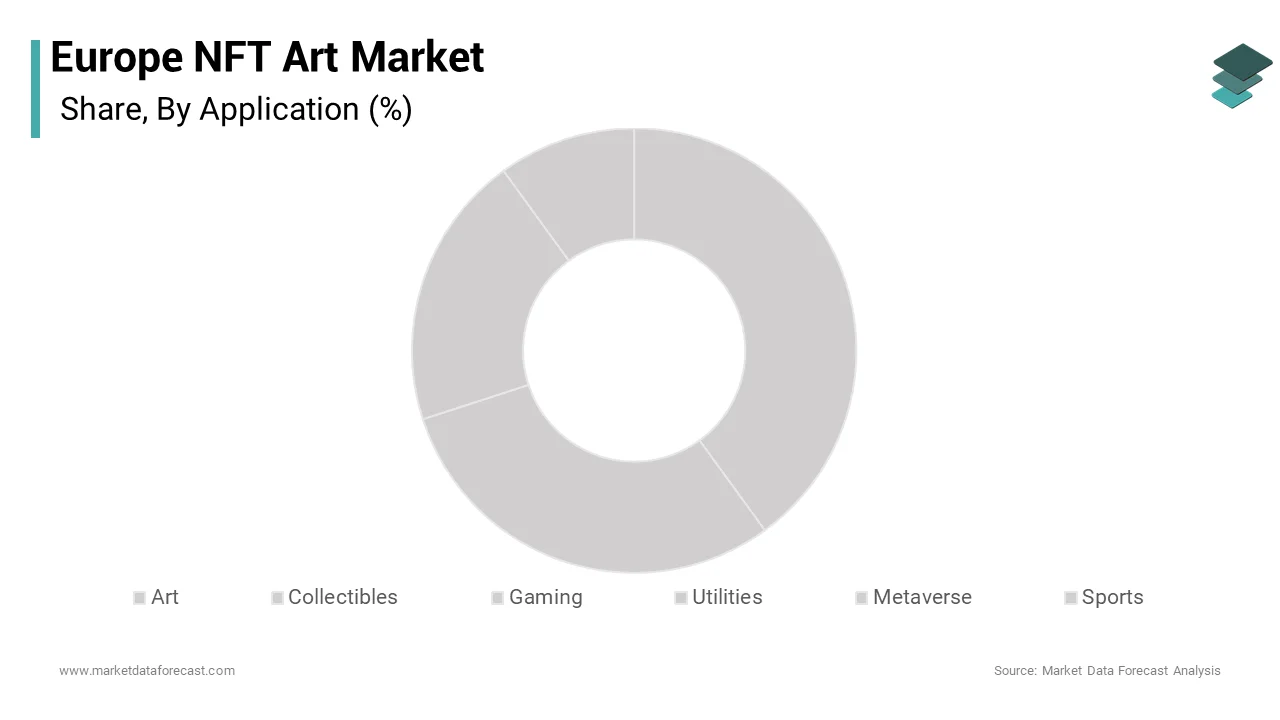
The metaverse segment is the fastest-growing category in the Europe NFT art market and is estimated to register a CAGR of 33.6% in the European market during the forecast period owing to the convergence of digital identity, virtual real estate, and immersive cultural experiences in persistent online worlds. European artists and designers are increasingly creating NFT-based avatars, wearables, and spatial installations for platforms like Decentraland and Spatial, which are gaining traction among fashion houses and cultural institutions. According to the European Digital Culture Observatory, virtual art exhibitions in metaverse environments have attracted millions of unique European visitors in recent years. Luxury brands such as Balenciaga and Gucci have launched NFT collections specifically for metaverse use, blurring the lines between art, fashion, and digital utility. Moreover, EU-funded initiatives like the European Virtual Heritage Network are commissioning NFT art to reconstruct historical sites in virtual spaces, creating new patronage models. As broadband access and VR adoption rise, with many EU households owning VR headsets as per Eurostat, the demand for expressive, identity-defining NFT art in the metaverse is poised for exponential growth.
By Type Insights
The digital assets segment constituted the overwhelming majority of the Europe NFT art market by holding 95.5% of the regional market share in 2025. This dominance reflects the intrinsic nature of NFTs as native digital objects, designed to represent ownership of intangible creative works such as generative art, animated pieces, and interactive media. European artists, particularly those from digital and new media backgrounds, leverage blockchain to assert authorship and monetize work that previously lacked clear commercial pathways. According to the European Cultural Foundation, NFT artists in Europe predominantly create digital works, citing the medium’s alignment with computational aesthetics and internet-native distribution. Platforms like Foundation and Objkt cater specifically to this cohort, offering tools for on-chain generative art and audiovisual experimentation. The absence of physical production costs allows for rapid iteration and global reach, while smart contracts enable automatic royalty enforcement, a key incentive for creators. This digital-first paradigm resonates deeply with Europe’s strong tradition of media art and electronic culture, ensuring that purely digital NFTs remain the market’s foundational category.
The physical assets segment is the fastest-growing type in the Europe NFT art market with a CAGR of 30.3% over the forecast period. The efforts to bridge the traditional art world with blockchain technology that offer collectors dual ownership of both a physical piece and its digital twin is majorly propelling the growth of the physical assets segment in the European market. European galleries are pioneering this hybrid model, with institutions issuing NFT certificates of authenticity alongside select paintings to enable provenance tracking and resale royalties. According to the European Art Market Report, high net worth collectors in Western Europe have expressed interest in purchasing art accompanied by NFTs, citing enhanced provenance security and future resale transparency as key motivators. Auction houses like Sotheby’s Europe have launched “phygital” sales, where winning bidders receive both the canvas and a unique NFT. This convergence appeals to legacy collectors wary of purely digital assets while introducing blockchain benefits to the European fine art market, creating a powerful synergy that drives rapid adoption of tokenized physical art.
By End-Use Insights
The personal segment commanded for the highest share of 70.5% of the regional market share in 2025. The dominance of personal segment in the European market is driven by the primary motivation of European collectors, acquiring NFTs for aesthetic appreciation, personal identity expression, and cultural participation rather than financial speculation. Unlike markets driven by flipping, European buyers often hold NFTs long term, displaying them in digital frames, virtual galleries, or social media profiles as extensions of their taste and values. According to Eurobarometer, European NFT owners have reported purchasing art because it resonated with their personal identity rather than purely for investment purposes. This collector behavior is reinforced by Europe’s strong public arts education and emphasis on cultural citizenship. Additionally, gifting NFTs for birthdays or milestones has become common among digitally native demographics, further embedding NFT art into personal rituals. This emotionally driven, non-speculative foundation provides the market with remarkable resilience against crypto volatility.
The commercial segment is projected to register a CAGR of 32.2% over the forecast period in this regional market. This expansion is propelled by brands, galleries, and cultural institutions leveraging NFT art for marketing, customer engagement, and new revenue streams. Fashion houses like Prada and LVMH use limited edition NFT artworks to reward loyalty program members, while music festivals issue NFT tickets paired with exclusive digital art. According to the European Brand Association, luxury and lifestyle brands in Europe have increasingly launched NFT art campaigns to enhance digital storytelling and foster community. Museums are also entering the space commercially, selling NFT interpretations of masterpieces to fund conservation efforts. These commercial applications transform NFTs from collectibles into experiential assets, driving volume through institutional budgets rather than individual whims. As more organizations recognize NFT art as a tool for digital engagement, this segment is set to redefine the market’s economic dynamics.
COUNTRY ANALYSIS
United Kingdom NFT Art Market Analysis
The United Kingdom dominated the NFT art market in Europe in 2025 by capturing 20.9% of the regional market share. The UK serves as a dynamic nexus of digital creativity, financial infrastructure, and cultural innovation. London’s status as a global art capital, home to Frieze Art Fair, Tate Modern, and hundreds of commercial galleries, provides a fertile ecosystem for NFT adoption. According to the UK’s Department for Digital Culture Media and Sport, NFT art startups were founded in Britain between 2022 and 2024, supported by favorable fintech regulations and venture capital access. The city hosts major Web3 events like NFT.London, which attracted significant attendance in 2024. British artists such as Damien Hirst have pioneered large scale NFT projects, legitimizing the medium for traditional collectors. Furthermore, the UK’s post Brexit regulatory autonomy allows agile policy development, such as HMRC’s clear guidance on NFT taxation, reducing uncertainty for creators. This blend of artistic prestige, entrepreneurial energy, and regulatory clarity ensures the UK remains Europe’s most vibrant and influential NFT art hub.
Germany NFT Art Market Analysis
Germany had the second largest share of the European NFT art market in 2025 due to its strong engineering culture, privacy consciousness, and institutional support for digital art. Berlin, in particular, has emerged as a leading European center for crypto art, with a thriving community of generative artists and decentralized platform developers. According to the German Federal Cultural Foundation, public grants were awarded to NFT art projects in 2024, reflecting official recognition of the medium’s cultural value. German collectors prioritize technical innovation and conceptual rigor, favoring on-chain generative art over speculative JPEGs. The country’s strict data protection laws have also spurred the adoption of privacy focused blockchains like Gnosis Chain, aligning with local values. Additionally, museums such as the Museum of Digital Art in Dresden actively collect and exhibit NFTs, bridging the gap between institutional validation and grassroots creation. Germany’s combination of public funding, technical expertise, and cultural seriousness positions it as a cornerstone of Europe’s sustainable NFT art ecosystem.
France NFT Art Market Analysis
France is anticipated to command for a promising share of the European market during the forecast period owing to its unparalleled legacy in visual arts and proactive government support for digital creation. Paris remains a global fashion and art epicentre, and institutions like the Centre Pompidou and Palais de Tokyo have been early adopters of NFT art, hosting dedicated exhibitions and launching their own tokenized collections. According to the French Ministry of Culture, funding was allocated in 2024 through its “Creative Europe Digital” program to support French artists exploring blockchain. French luxury brands including Louis Vuitton and Dior have integrated NFT art into product launches, blending heritage craftsmanship with digital innovation. As per the Institut Français, French art students are increasingly creating NFTs as part of their practice, indicating deep generational integration. France’s unique ability to fuse haute culture with technological experimentation makes it a trendsetting force in shaping the aesthetic and ethical contours of the European NFT art landscape.
Netherlands NFT Art Market Analysis
The Netherlands is expected to exhibit a healthy CAGR in the European NFT art market over the forecast period owing to its progressive digital policies, world class design education, and collaborative art-tech scene. Amsterdam and Rotterdam host a dense network of digital art studios, blockchain cooperatives, and experimental galleries that champion open source and community owned NFT models. According to the Dutch Cultural Participation Fund, NFT art residencies were funded in 2024, emphasizing sustainability and social impact. Dutch artists frequently collaborate with scientists and activists, producing NFTs that address climate change and digital rights, themes that resonate with the country’s civic-minded collector base. The Netherlands was also the first EU member to issue clear tax guidance for NFT creators, reducing administrative barriers. Furthermore, institutions like the Stedelijk Museum actively acquire NFTs, ensuring long term preservation. This ecosystem of public support, ethical innovation, and institutional engagement makes the Netherlands a laboratory for socially conscious NFT art in Europe.
Sweden NFT Art Market Analysis
Sweden is projected to grow at a steady CAGR in the European NFT art market during the forecast period due to its advanced digital infrastructure, strong public arts funding, and emphasis on sustainability. Stockholm and Malmö have become hubs for eco conscious NFT creation, with artists predominantly using low energy blockchains like Tezos and Energy Web. According to the Swedish Arts Council, national art grants for digital projects in 2024 required proof of carbon neutrality, pushing the ecosystem toward green blockchain solutions. Swedish collectors value transparency and social purpose, and as per Statens Konstråd, many prefer NFTs that fund environmental or humanitarian causes. Institutions like Moderna Museet have launched NFT programs that donate proceeds to climate initiatives, aligning art with national values. With widespread internet usage and English proficiency, the country offers a highly receptive audience for global NFT art. Sweden’s fusion of digital maturity, environmental ethics, and egalitarian cultural policy positions it as a leader in responsible and impactful NFT art innovation.
COMPETITIVE LANDSCAPE
The competition in the Europe NFT art market is defined by a clear divergence between global platforms and Europe native ecosystems, each vying for cultural legitimacy and artist loyalty. Global giants like OpenSea offer scale but lack curation, while European focused platforms such as KnownOrigin and Hic et Nunc emphasize sustainability, artistic integrity, and regulatory compliance. The market is not driven by transaction volume alone but by institutional validation, with museums, galleries, and public funders acting as critical gatekeepers. This creates a two-tiered landscape: one centered on speculative collectibles dominated by international players, and another rooted in fine art principles led by European startups. Competition is less about fees and more about trust, provenance, and alignment with European values like data privacy, environmental responsibility, and cultural heritage. As a result, success hinges on building deep relationships with artists, integrating with physical art spaces, and demonstrating long term commitment to the region’s unique cultural and regulatory context.
KEY MARKET PLAYERS
A few of the dominating players that are in the Europe NFT art market are
- Ozone Networks Inc.
- KnownOrigin
- Onchain Labs Inc.
- Foundation
- SuperRare
- Gemini Trust Company LLC.
- Dapper Labs Inc.
- Cloudflare Inc.
- Funko
- PLBY Group Inc.
- Dolphin Entertainment Inc.
- YellowHeart LLC.
- Takung Art Co. Ltd.
- Solana
Top Players In The Market
- SuperRare is a premier curated NFT art platform with a strong presence in Europe, known for its artist centric model and emphasis on high quality digital fine art. The company operates as a decentralized autonomous organization and has cultivated a global community of collectors who value provenance, scarcity, and artistic merit over speculation. SuperRare contributes to the global market by setting standards for curation, royalty enforcement, and gallery style presentation of digital works. To strengthen its European position, SuperRare launched localized support in French and German in early 2025 and partnered with Berlin based digital art galleries to host hybrid physical digital exhibitions. It also integrated with EU compliant identity verification systems to align with MiCA regulations, enhancing trust among institutional buyers and reinforcing its reputation as a premium destination for serious NFT art collectors.
- Foundation is a leading NFT marketplace that has gained significant traction among European digital artists through its accessible yet selective onboarding process and strong community ethos. The platform enables creators to mint, auction, and sell digital artworks while retaining perpetual royalties through smart contracts. Foundation plays a vital role globally by democratizing access to the primary NFT art market and fostering direct patronage between collectors and artists. In 2025, Foundation deepened its European footprint by establishing a creator residency program in Lisbon in collaboration with local arts councils and launching educational workshops across Paris, Amsterdam, and Stockholm. These initiatives empower emerging European artists with technical and legal guidance on blockchain creation, positioning Foundation as a cultural catalyst rather than just a transactional platform.
- KnownOrigin is a UK based NFT art platform built on eco-friendly blockchain technology, specifically designed to serve the European digital art community with a focus on sustainability and artist empowerment. The platform emphasizes on chain generative art and provides tools for creators to embed interactive and dynamic elements into their NFTs. KnownOrigin contributes globally by championing low carbon blockchains like Polygon and advocating for ethical Web3 practices. To reinforce its leadership, KnownOrigin introduced a verified artist badge system compliant with EU digital services regulations in January 2025 and co organized the European Digital Art Summit in London, bringing together museums, galleries, and policymakers. These actions solidify its role as a trusted bridge between Europe’s traditional art world and the evolving NFT ecosystem.
Top Strategies Used By The Key Market Participants
Key players in the Europe NFT art market are pursuing distinct strategies to build sustainable and culturally relevant platforms. First, they are prioritizing curation and artist verification to differentiate from speculative marketplaces and attract serious collectors. Second, they are adopting eco-friendly blockchains such as Polygon and Tezos to align with Europe’s strong environmental values and regulatory expectations. Third, they are forming strategic partnerships with museums, galleries, and public arts institutions to legitimize NFTs within established cultural frameworks. Fourth, they are implementing localized language support and compliance with the EU’s Markets in Crypto Assets regulation to enhance user trust and accessibility. Finally, they are investing in educational initiatives and artist residencies to nurture talent and foster long term community engagement rather than short term trading volume.
MARKET SEGMENTATION
This research report on the Europe NFT art market has been segmented and sub-segmented based on the application, type, end-use, and region.
By Application
- Art
- Collectibles
- Gaming
- Utilities
- Metaverse
- Sports
By Type
- Physical Assets
- Digital Assets
By End-Use
By Country
- UK
- France
- Spain
- Germany
- Italy
- Russia
- Sweden
- Denmark
- Switzerland
- Netherlands
- Turkey
- Czech Republic
- Rest of Europe