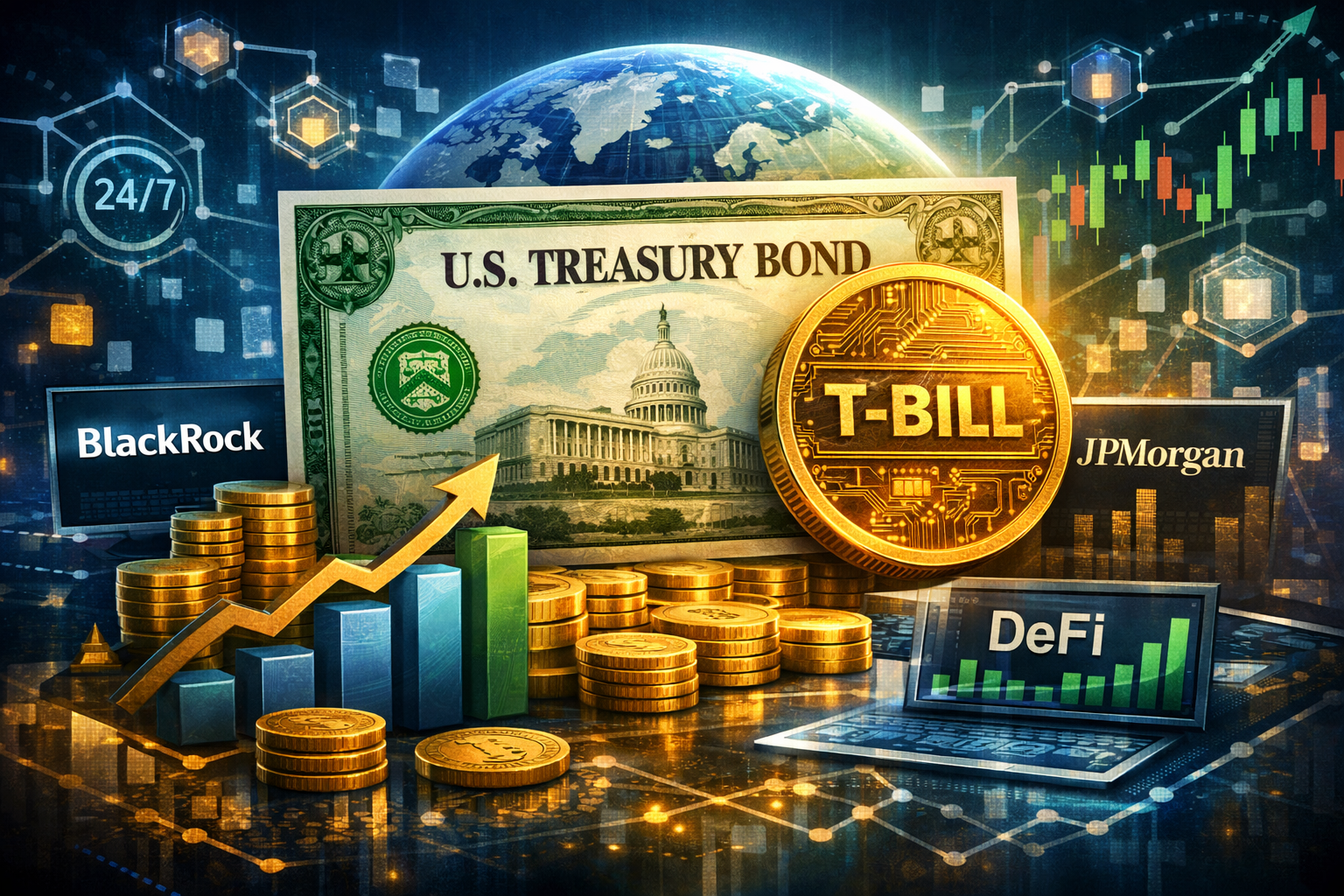

It was not long ago that decentralized finance (DeFi) was a completely crypto-native space, with staked Ethereum, wrapped Bitcoin, and algorithmic stablecoins. The vision was that DeFi could create its own collateral without relying on traditional methods. However, tokenized U.S. Treasury bills have become the new foundation of on-chain finance, exceeding $9 billion by the end of 2025.
This article explains how the tokenized Treasury bills became a cornerstone in the DeFi market.
Key Takeaways
- Tokenized Treasury bills surpassed $9 billion in assets by the end of 2025 as investors sought a stable, real-world yield on-chain.
- BlackRock, Franklin Templeton, and JPMorgan accelerated adoption by combining traditional fixed-income assets with blockchain settlement, custody, and compliance infrastructure.
- DeFi protocols now use tokenized Treasuries as core collateral and yield benchmarks, signaling a shift from crypto-native assets to real-world asset-backed foundations in decentralized finance.
The Rationale for Tokenized Treasury Bills Transformation
The growth of the tokenized Treasury market is both sudden and exponential. Between early 2024 and late 2025, the total assets under management across all issuers increased from $2 billion to $9 billion, a 350% rise in just over 18 months. Major factors responsible for this rapid development include:
- The interest rate cycle between 2023 and 2025 presented U.S. Treasury bills with attractive yields of between 4.5% and 5.2% per annum, when compared to the APYs offered by pure DeFi protocols. Investors seeking yield without smart contract risk found tokenized Treasury bills to be an attractive alternative.
- Blockchain infrastructure had reached a point where it could facilitate institutional-grade custody, regulatory compliance, and real-time settlement in a single product package. This was sufficient to attract some of the world’s largest asset managers to the market.
How Tokenized Treasury Bills Work
Here is the basic process of how tokenized treasury bills operate from issuance to yield:
- Asset acquisition: The issuer acquires short-term U.S. Treasury bills via conventional means and holds them in an accredited institution using a qualified custodian account.
- Token issuance: A corresponding number of digital tokens is issued on a blockchain. Each token represents a pro-rata interest in the fund or the underlying assets.
- Verification: Investors confirm their identity on the issuer’s platform. The BlackRock USD Institutional Digital Liquidity (BUIDL) fund, for instance, requires a $250,000 minimum and employs Securitize to onboard. Retail platforms, such as INX.one, permit smaller entry points after standard KYC verification.
- Yield distribution: The interest earned on the underlying Treasury bills is distributed to the token holders at the issuer’s discretion. For instance, Superstate’s USTB has price appreciation (the value of the token appreciates daily), whereas Franklin Templeton’s BENJI tokenizes shares of funds directly (the value of the shares includes the yield).
- Redemption: The tokens can be redeemed for cash or stablecoins via the issuer’s platform. The process is near-instant, unlike the T+2 cycles of traditional fixed income.
What Influence Does it Have on the Industry?
When BlackRock rolled out BUIDL in March 2024, it was a move that caught the attention of the entire industry. Quickly, the fund broke $1 billion in assets under management and eventually reached a peak of around $2.9 billion in mid-2025, accounting for over 40% of the total market. It is now accepted as collateral on Deribit and Crypto.com, extending its utility well beyond passive yield generation.
Franklin Templeton took a different approach with the introduction of its OnChain US Government Money Fund called BENJI. This tokenizes the shareholder register so that each BENJI token represents a single fund share, with on-chain documentation.
Ondo Finance and Superstate have catered to the DeFi-native market, building products that are more deeply integrated with lending protocols and automated strategies. Others include Circle, with its USDC yield offering, while OpenEden expands access to the asset class.
Why DeFi Protocols Are Embracing Treasury Bills
DeFi protocols, such as MakerDAO and Frax, have shifted their reserve collateral from crypto assets to Treasuries and repurchase agreements. This stabilizes the underlying assets and, in a high-interest rate regime, provides a source of yield that can be distributed to users.
Pendle Finance has built on-chain yield curves that reference tokenized Treasury rates, enabling traders to speculate or hedge against future rates with DeFi tools. Furthermore, JPMorgan launched a tokenized money market fund on Ethereum to leverage the benefits of 24/7 settlement and stablecoin infrastructure.
The effect of this is that DeFi’s monetary base now serves as a blend of stablecoin reserves and RWA-backed securities, with U.S. government debt at its core. Also, regulatory clarity provided by SEC Commissioner Hester Peirce on tokenized securities has encouraged asset managers to move from pilot programs to scaled products.
Possible Risks
Liquidity and maturity mismatches between the tokens and the underlying assets could pose a pressure situation during bulk redemption. The TBAC pointed out that the demand for Treasury bills, fueled by stablecoins, could pose a fire sale risk to the market during a run. BlackRock’s BUIDL itself experienced around $447 million in outflows in August 2025, a reminder that even the most successful product is not immune to capital rotation.
Smart contract risks, counterparty risks in custody models, and the secondary market liquidity of the products are also factors that investors need to evaluate carefully.
Bottom Line
Tokenized Treasury bills have transitioned from an experiment to infrastructure in less than two years. With assets of close to $10 billion, institutional issuers, regulatory support, and a strong DeFi ecosystem integration, this market has become a bridge between traditional fixed income markets and on-chain finance. Whether this will develop into an open financial system or just an efficient version of the current one will be determined by the level of interaction between issuers, regulators, and the DeFi ecosystem.