

- Ethereum’s staking share hit an all-time high at 31.4%, but analysts said supply-demand improvement is limited due to the structure of circulating supply, rising net supply, and mild inflation.
- Experts said downside pressure remains dominant for Ethereum around key price levels including $2,200 resistance, $1,900 support, and $1,750 support, and that even if a short-term rebound occurs, it is too early to call it a trend reversal.
- The altcoin market remains in a bearish trend amid factors such as total crypto market capitalization, downside pressure, the CLARITY Act, and weaker risk-asset appetite, and analysts said that even with short-term spikes, conditions for a broader expansion phase have not been met.
Forecast Trend Report by Period


With Middle East-driven geopolitical tensions and ongoing macro uncertainty, the altcoin market continues to face persistent downside pressure. Ethereum (ETH) is seeing limited upside momentum despite expectations for improved supply-demand dynamics. Experts said that even if a short-term rebound occurs, it is too early to view it as a trend reversal.
Ethereum staking hits an all-time high…despite expectations of shrinking float, supply-demand improvement remains limited
Ethereum is seeing growing expectations for a reduction in circulating supply as staking (crypto deposits) expands, but analysts say it is still too early to judge whether near-term supply-demand conditions will improve when considering on-chain indicators.
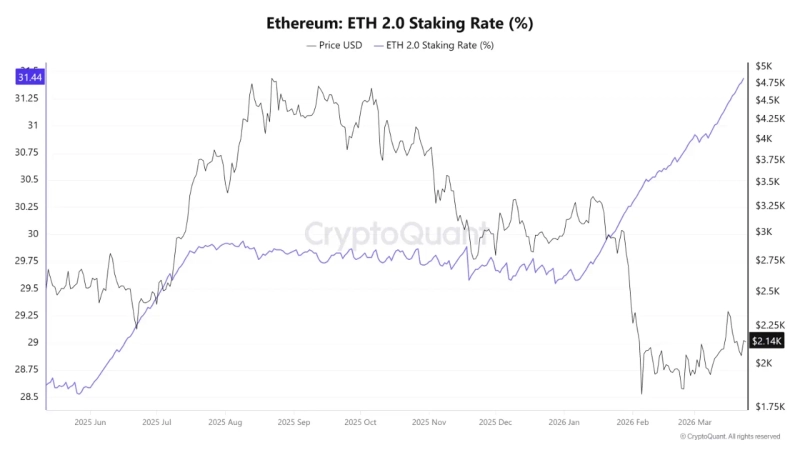
According to industry sources on the 28th, Ethereum’s staking share recently rose above 31.4%, setting a new record. Around 38.31 million ETH is currently locked in staking, meaning roughly one-third of total supply has moved out of immediately tradable liquidity. At the same time, holdings on major crypto exchanges have declined, prompting some to raise the possibility of a “supply shock” driven by a shrinking float.
However, some analyses note it is difficult to conclude that supply-demand conditions are improving, as issuance continues to exceed burn. According to Ultrasound Money, which tracks Ethereum blockchain data, Ethereum’s net supply increased by more than about 80,000 over the past 30 days; annualized, that implies a mild inflation rate of around 0.8%. The structure of rising total supply remains in place.
Even so, accumulation by large investors is continuing. BitMine, the world’s largest Ethereum treasury company, recently bought an additional 65,341 ETH over the past week, expanding total holdings to 4.66 million ETH. That equals about 3.86% of circulating supply. BitMine is maintaining a long-term accumulation strategy, deploying about 67% of its holdings into staking.
Tom Lee, chairman of BitMine, said, “The CLARITY Act, a crypto market structure bill, is making progress in Congress, and it could serve as a positive catalyst for Ethereum,” adding, “Ethereum is in the final stage of a ‘mini crypto winter’ (crypto downturn), and we have maintained our buying pace over the past three weeks.”

Meanwhile, from a longer-term perspective, undervaluation signals are being observed. Ethereum’s MVRV ratio has recently fallen below 0.8, with analyses saying it has reached a level similar to periods preceding major uptrends in the past. MVRV is an on-chain profitability metric that indicates the current price level relative to investors’ average purchase price, and it is used to gauge whether the broader market is overheated or undervalued.
“Ethereum rejected at $2,200 resistance…$1,900 support test possible”
Market experts said Ethereum could still be open to testing the $1,900 support level ahead of the $2,200 resistance zone.
Ayush Jindal, a NewsBTC researcher, said, “Ethereum failed to break above the $2,200 resistance and then turned lower,” adding, “If it fails to reclaim the near-term resistance around $2,135, additional downside pressure could persist.” He continued, “If the key support at $2,020 breaks, downside could open toward $1,980 and even $1,950,” while adding, “Conversely, if it breaks above the $2,135 resistance, there is room for a rebound toward a retest of $2,200 and the $2,245–$2,320 zone.”
Rakesh Upadhyay, a Cointelegraph researcher, said, “Ethereum has slipped below the near-term support at $2,044, with downside pressure appearing to intensify,” adding, “Buying interest is expected to emerge near $1,900, but if that level gives way, the door opens for a drop toward the $1,750 support.” He continued, “Conversely, if the price rebounds and breaks above $2,200, the bearish scenario would be invalidated, and room for further gains above $2,400 could expand.”
Ethereum was trading at $1,983, down 4.14% from the previous day, as of 11:40 a.m. on Binance’s USDT market (₩3.01 million on Upbit). Ethereum is down more than 30% so far this year, extending its bearish trend.
“Altcoin downside pressure intensifies…watch whether total market cap support holds”
Experts say the altcoin market is at an inflection point where direction will be decided around key support zones, and that even if a short-term rebound appears, it is difficult to definitively call it a trend reversal.
Alex Kuptsikevich, chief analyst at FxPro, said, “The total crypto market cap has moved back near its short-term support area and is testing whether it can hold,” adding, “With financial market instability persisting, crypto remains broadly vulnerable to selling pressure.” According to global crypto data site CoinMarketCap, total market capitalization has fallen to around $2.28 trillion, extending the near-term bearish move.
Crypto analyst Benjamin Cowen said, “In past U.S. midterm election years, the crypto market repeatedly showed a pattern of a March rebound after a February low, followed by renewed weakness in April,” adding, “It is necessary to keep in mind the possibility of a similar pattern next month as well.” He added, “Recently, risk-asset appetite has weakened across the board, prompting capital rotation,” and said, “Market structure, including altcoins, remains in a downside-dominant phase.”
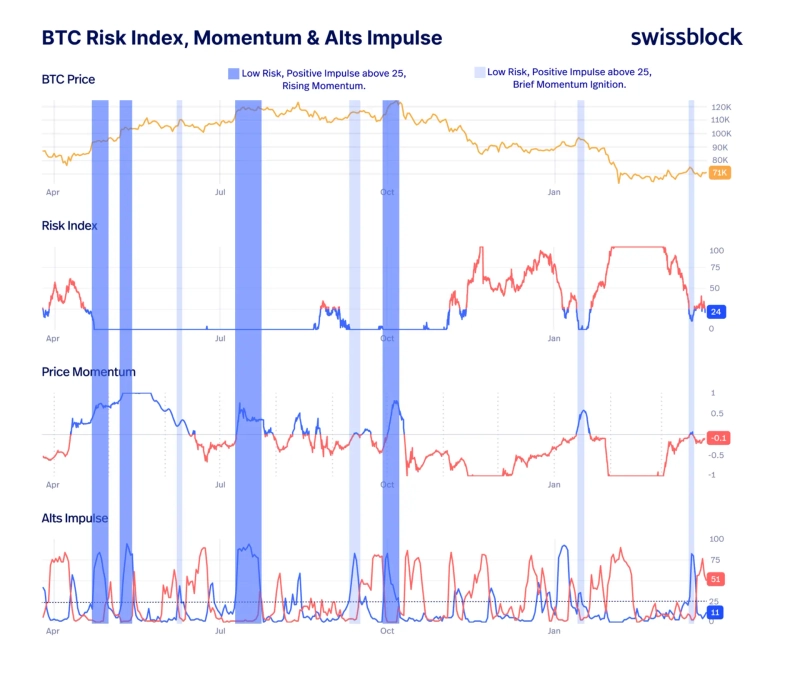
Middle East-driven geopolitical tensions and policy uncertainty are also acting as variables around the market’s bearish trend. In the U.S. Congress, the CLARITY Act, a crypto market structure bill, has gained bipartisan support and legislative discussions are progressing, but major issues remain, including stablecoin regulation and coordination of industry stakeholder interests. The bill is expected to support improved market liquidity by easing institutional uncertainty.
A pattern of repeated sharp short-term spikes and pullbacks is also appearing in some altcoins. Crypto strategist Michaël van de Poppe said, “In some altcoins, we are seeing prices revert back toward average levels after short-term surges.” He added, “While certain names are showing strong moves around specific narratives such as artificial intelligence (AI), it is difficult to extrapolate that into a broader market-wide uptrend.”
Kang Min-seung, Bloomingbit reporter minriver@bloomingbit.io