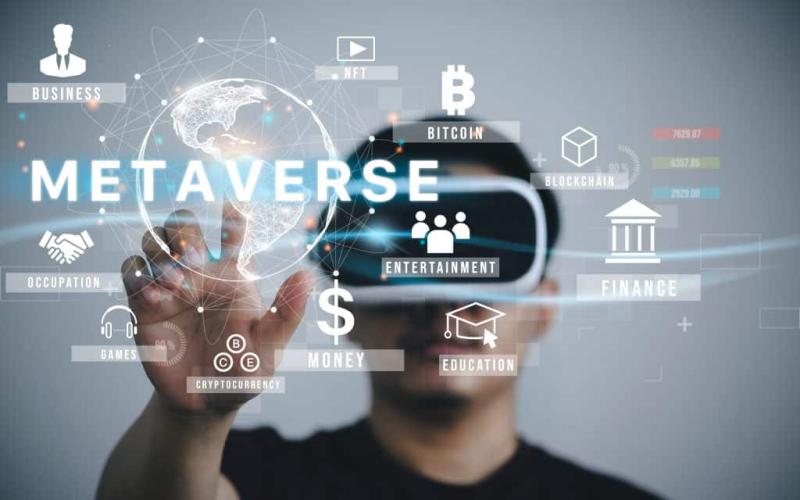

Metaverse Market
The global Metaverse Market is experiencing extraordinary growth as immersive digital environments reshape how people interact, work, shop, and socialize online. According to DataM Intelligence, the global metaverse market reached US$ 52.1 billion in 2022 and is expected to reach US$ 1,020.6 billion by 2031, growing at a CAGR of 45.5% during the forecast period 2024-2031. The rapid expansion of virtual worlds, extended reality technologies, and digital economies is transforming the metaverse into one of the most influential technological ecosystems of the next decade.
The metaverse refers to interconnected virtual environments where users interact with digital spaces and each other using avatars through technologies such as virtual reality (VR), augmented reality (AR), mixed reality (MR), artificial intelligence, blockchain, and high-speed connectivity. These immersive environments enable users to participate in activities such as gaming, social networking, digital commerce, education, remote work, and entertainment within persistent virtual worlds.
As organizations explore new ways to connect with consumers and employees in digital environments, the metaverse is rapidly evolving from a concept associated primarily with gaming into a comprehensive digital infrastructure supporting commerce, enterprise collaboration, and virtual experiences.
Request Executive Sample PDF: https://www.datamintelligence.com/download-sample/metaverse-market?rk
☛ Recent Developments:
✅ October 2025: Meta Platforms unveiled major upgrades to its metaverse ecosystem through enhancements to the Horizon Worlds platform. The update introduced advanced creator tools, AI-driven world-building capabilities, and improved cross-device compatibility, allowing developers and businesses to build immersive virtual environments more efficiently.
✅ September 2025: Microsoft expanded enterprise-focused metaverse solutions by integrating immersive collaboration features into Microsoft Mesh and Microsoft Teams. The update enables companies to conduct virtual meetings, training simulations, and collaborative design sessions in persistent 3D environments, accelerating the adoption of metaverse technologies in corporate settings.
✅ July 2025: Apple strengthened its position in the spatial computing ecosystem with updates to its mixed-reality platform supporting the Apple Vision Pro headset. The improvements focused on enhanced immersive experiences, enterprise collaboration tools, and developer frameworks for creating interactive metaverse applications.
✅ May 2025: Sony Group Corporation announced new immersive entertainment initiatives that integrate gaming, music, and virtual events into metaverse platforms. Leveraging its expertise in gaming through PlayStation VR2 technology, the company introduced advanced interactive experiences aimed at expanding digital entertainment ecosystems.
☛ Rapid Growth of Immersive Technologies Driving Market Expansion
One of the primary drivers of the metaverse market is the rapid advancement of immersive technologies, including virtual reality, augmented reality, and mixed reality devices. These technologies allow users to interact with digital environments in highly realistic ways, creating immersive experiences that go far beyond traditional internet interfaces.
Modern metaverse platforms rely heavily on advanced hardware such as VR headsets, AR glasses, and high-resolution displays to create realistic digital spaces. At the same time, sophisticated software tools enable developers to build detailed virtual environments, interactive avatars, and digital assets.
The increasing availability of high-performance graphics processing units (GPUs), cloud computing infrastructure, and 5G connectivity is further accelerating metaverse adoption. These technologies enable seamless rendering of complex virtual worlds while supporting real-time interactions between millions of users across global networks.
As immersive technology becomes more affordable and accessible, businesses across industries are exploring metaverse platforms to deliver new customer experiences and digital services.
☛ Gaming Industry as a Major Catalyst for Metaverse Adoption
The gaming industry remains one of the most influential drivers of the metaverse market. Online multiplayer games and virtual worlds already provide large-scale interactive environments where users socialize, collaborate, and create digital economies.
Gaming platforms are evolving into full metaverse ecosystems where players can purchase digital goods, attend virtual events, and interact with global communities in persistent online spaces. Game developers are integrating advanced game engines, 3D modeling tools, and blockchain technologies to create decentralized virtual economies where digital assets can be traded or owned by users.
The rise of user-generated content is also contributing significantly to the growth of the metaverse. Platforms that allow users to design virtual environments, create avatars, and develop digital products are encouraging new forms of digital entrepreneurship.
With billions of gamers worldwide and increasing investment from major technology companies, gaming continues to serve as the foundation for many metaverse platforms.
☛ Expanding Opportunities in Digital Commerce and Retail
Beyond entertainment, the metaverse is increasingly being adopted as a powerful platform for digital commerce and retail innovation. Virtual shopping environments allow consumers to browse products in immersive 3D stores, interact with virtual assistants, and experience products before purchasing them.
Retailers and global brands are experimenting with virtual showrooms, digital fashion, and branded experiences in the metaverse. Customers can explore products using avatars, attend virtual product launches, and interact with brands in entirely new ways.
Digital marketing and advertising are also evolving within metaverse environments. Brands can engage users through interactive campaigns, immersive storytelling, and personalized virtual experiences. These new marketing channels provide businesses with unique opportunities to build deeper customer engagement and brand loyalty.
As digital commerce continues to expand globally, the metaverse is expected to become an important platform for next-generation retail and marketing strategies.
Request Custom Intelligence Report: https://www.datamintelligence.com/customize/metaverse-market?rk
☛ vEnterprise Applications Transforming Workplace Collaboration
The metaverse is not limited to consumer applications; it is also gaining significant traction in enterprise environments. Businesses are increasingly adopting metaverse technologies to support remote collaboration, employee training, product design, and virtual meetings.
Virtual workspaces enable employees to interact in immersive digital offices, improving communication and collaboration among distributed teams. These environments can replicate real-world workplaces while offering advanced digital tools for brainstorming, presentations, and project management.
Training and simulation programs are another major enterprise application. Industries such as manufacturing, healthcare, and aviation are using virtual environments to train employees in realistic scenarios without the risks or costs associated with physical training environments.
Additionally, digital twins virtual replicas of physical assets are being integrated into metaverse platforms to support industrial monitoring, predictive maintenance, and operational optimization.
☛ Increasing Adoption in Education and Healthcare
Educational institutions are beginning to explore metaverse platforms as immersive learning environments that enhance student engagement and knowledge retention. Virtual classrooms allow students to participate in interactive simulations, laboratory experiments, and collaborative learning experiences regardless of geographical location.
For example, students studying medicine, engineering, or environmental science can use virtual environments to conduct complex experiments or explore simulations that would be difficult or expensive to replicate in traditional classrooms.
Healthcare is also exploring the potential of metaverse technologies. Virtual environments are being used for medical training, patient therapy, and rehabilitation programs. Surgeons and medical students can practice complex procedures in virtual operating rooms, while patients can participate in immersive therapy programs designed to support mental health and physical recovery.
These emerging applications highlight the metaverse’s potential to transform education and healthcare delivery systems.
☛ Competitive Landscape and Industry Innovation
The global metaverse market features intense competition among major technology companies, gaming developers, and software platform providers. Leading companies operating in the market include Microsoft, Sony, Meta, HTC, Google, Apple, Qualcomm, Samsung, Activision Blizzard, NetEase, Electronic Arts, Take-Two, Tencent, Nexon, Epic Games, Unity, Valve, Adobe, and HPE.
These companies are investing heavily in research and development to create advanced metaverse infrastructure, including immersive hardware, game engines, cloud platforms, and digital creation tools. Strategic partnerships between technology companies, content creators, and enterprises are accelerating innovation within the metaverse ecosystem.
Technology leaders are also working to develop interoperable platforms that allow users to move seamlessly between different virtual environments while maintaining ownership of digital assets.
☛ Market Segmentation Overview
The Metaverse Market is segmented based on component, platform, application, end-user, and region.
By component, the market includes hardware, software, and professional services. Hardware includes AR devices, VR devices, MR devices, and advanced display systems that enable immersive experiences. Software includes extended reality software, gaming engines, 3D mapping and modeling tools, metaverse platforms, and financial platforms. Professional services include vertical development, system integration, and strategy consulting services.
By platform, the market is categorized into desktop, mobile, and headset-based metaverse environments.
By application, the market includes gaming, online shopping, content creation and social media, events and conferences, digital marketing and advertising, testing and inspection, and other applications.
By end-user, the market serves consumer segments such as gaming and social media as well as live entertainment events. Commercial sectors include retail and e-commerce, education and corporate environments, travel and tourism, and real estate. Other key end users include industrial manufacturing and healthcare organizations.
Regionally, the market is analyzed across North America, Latin America, Europe, Asia-Pacific, the Middle East, and Africa.
Purchase Corporate License | Market Intelligence: https://www.datamintelligence.com/buy-now-page?report=metaverse-market?rk
☛ Strategic Outlook for the Metaverse Economy
The metaverse represents the next major evolution of the internet, often described as the transition from a two-dimensional web experience to a fully immersive three-dimensional digital world. As technologies such as extended reality, artificial intelligence, blockchain, and cloud computing continue to advance, the metaverse is expected to create entirely new economic opportunities.
Organizations that invest early in metaverse technologies will be well positioned to develop innovative digital services, immersive customer experiences, and collaborative virtual workplaces. These capabilities can significantly enhance engagement, productivity, and brand differentiation in an increasingly digital economy.
With strong investment from technology leaders and rapidly expanding applications across industries, the metaverse market is poised to become one of the most transformative technology sectors of the coming decade, reshaping how people interact, work, learn, and conduct business in digital environments.
Contact Us –
Company Name: DataM Intelligence
Contact Person: Sai Kiran
Email: Sai.k@datamintelligence.com
Phone: +1 877 441 4866
Website: https://www.datamintelligence.com
About Us –
DataM Intelligence is a Market Research and Consulting firm that provides end-to-end business solutions to organizations from Research to Consulting. We, at DataM Intelligence, leverage our top trademark trends, insights and developments to emancipate swift and astute solutions to clients like you. We encompass a multitude of syndicate reports and customized reports with a robust methodology.
Our research database features countless statistics and in-depth analyses across a wide range of 6300+ reports in 40+ domains creating business solutions for more than 200+ companies across 50+ countries; catering to the key business research needs that influence the growth trajectory of our vast clientele.
This release was published on openPR.