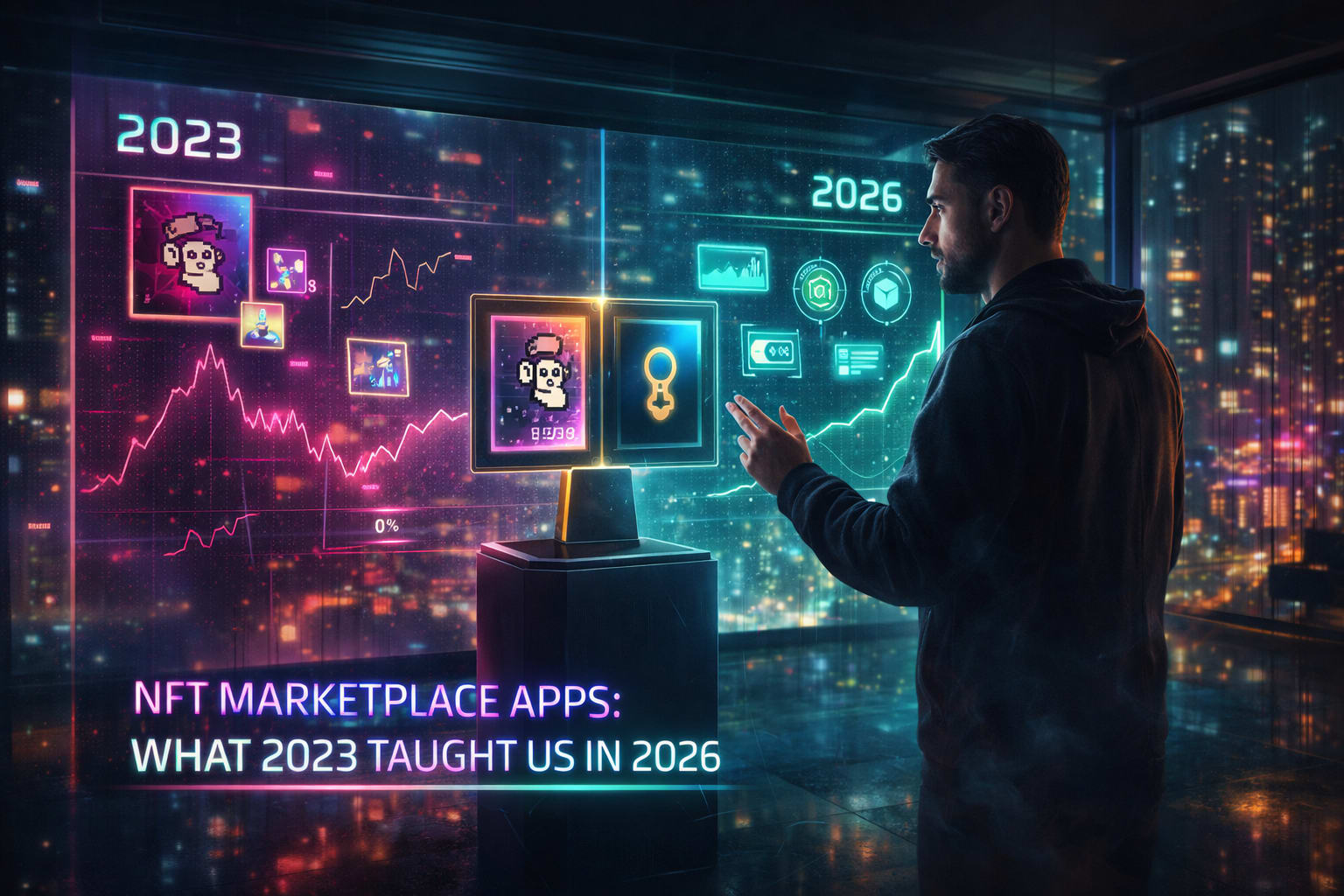

The blockchain landscape of 2026 looks very different today. It has changed since the volatile cycle of the early 2020s. For those building NFT Marketplace Apps, 2023 was a vital year. It served as a definitive “cleansing” period for the entire industry. This period fundamentally reshaped how we trade digital assets now. We have moved past the era of profile-picture (PFP) speculation. We are now in a phase of high-utility functionality. Cross-chain capability and legal compliance are now standard requirements. Marketplaces must now provide real-world value to survive.
This guide is for entrepreneurs and product managers. It also serves developers who need to understand recent structural shifts. We must analyze the failures and pivots of 2023. This allows us to navigate sophisticated marketplace requirements today. Enterprise-grade standards are now the baseline for any new platform.
The 2023 Pivot: From Hype to Infrastructure
In 2023, the NFT market saw a significant decline. Trading volume fell nearly 80% from its 2022 peak. This data comes from verified reports by DappRadar. Critics labeled this event the “death of NFTs” at the time. However, industry veterans saw it as a necessary market correction. It was actually the death of unproductive and speculative assets. This period taught us a very important lesson. Scarcity alone is not a sustainable business model. Value must be tied to access or ownership. It must also be tied to clear digital utility.
In 2026, NFT Marketplace Apps are more than art galleries. They now function as essential identity hubs for users. They serve as ticketing platforms and real-world asset (RWA) bridges. OpenSea dominated the market back in 2023. Today, we see fragmented and niche-specific marketplaces everywhere. This shift resulted from users demanding much lower fees. Users also wanted better curation and actual legal protection. They needed to know their digital purchases were secure.
Why 2023 Knowledge Matters in 2026
Understanding the 2023 correction is vital for success today. It established the “Survival Minimum” for all modern apps.
- Royalties: The 2023 debate over creator fees was intense. It led to the automated standards we use now. These are enforced directly by smart contracts today.
- UX Friction: Seed phrases used to be a major barrier. This led to the adoption of Account Abstraction. We now use the ERC-4337 technical standard. This makes crypto wallets feel like regular email accounts.
- Regulation: Early SEC inquiries in 2023 changed the landscape. They paved the way for MiCA compliance frameworks. MiCA stands for Markets in Crypto-Assets. It now governs European and global digital trade rules.
Core Framework: The Architecture of a 2026 Marketplace
Building a competitive platform now requires advanced strategy. You need more than just a simple minting engine. Successful NFT Marketplace Apps follow a three-tier logic. This structure ensures high scalability and user retention.
1. Hybrid On-Chain/Off-Chain Logic
Ownership records always stay on the blockchain for security. However, the discovery layers are often kept off-chain. This ensures the app remains fast and responsive. In 2026, “Lazy Minting” has become the default method. The NFT is not written to the blockchain immediately. It is only minted at the exact moment of purchase. This saves significant gas fees for the creators. It also reduces the upfront cost of launching a collection.
2. Multi-Chain Interoperability
A marketplace locked to one chain is a relic. Modern apps utilize advanced cross-chain protocols now. LayerZero and CCIP are two common examples. CCIP stands for Cross-Chain Interoperability Protocol. These tools allow a user on Polygon to buy assets. These assets might be hosted on the Avalanche chain. This happens without the user performing a manual bridge. The process is now seamless and invisible to users.
3. Fiat-to-NFT Onramps
The most successful apps in 2026 are very accessible. They allow users to buy assets with credit cards. Users can also use Apple Pay for their purchases. This abstracts away the “crypto” part for the user. Businesses often need help building these complex interfaces. Partnering with experts in Mobile App Development in Chicago is helpful. They provide the technical bridge for legacy financial systems. They also integrate the latest Web3 protocols effectively.
Real-World Examples
The biggest shift since 2023 is asset tokenization. We call these Real-World Assets or RWAs for short. NFT Marketplace Apps are moving into new sectors. They now handle real estate fractionalization and luxury goods. This brings blockchain security to physical objects.
Verified Example: Luxury Watch Authentication
A major Swiss watchmaker launched a marketplace in 2025. The NFT acts as a “Digital Twin” of the watch.
- The Problem: High fraud rates in the pre-owned market.
- The 2026 Solution: An NFT represents the certificate of authenticity. It also tracks the full service history of the watch.
- Outcome: Token-verified pieces saw a 30% value increase. They performed better than unverified watches on the market.
Hypothetical Example: Local Event Access
Consider a music festival using an NFT marketplace. They use NFTs for tickets instead of QR codes. A QR code can be screenshotted and stolen easily. A dynamic NFT ticket changes once it is scanned. This prevents double-entry at the festival gates. It also allows the festival to collect resale fees. They can take 5% from every secondary market sale.
Successful implementation in 2026 requires a step-by-step logic. You must first define the specific utility your token provides. This prevents the project from falling into a “utility vacuum.” Developers should then select a Layer 2 scaling solution. This ensures that transaction costs do not alienate your user base.
Next, you must integrate compliant onboarding flows. This involves setting up KYC and AML checks. KYC stands for Know Your Customer. AML stands for Anti-Money Laundering. These are no longer optional for apps handling fiat payments. Finally, ensure your smart contracts are audited by a reputable third party. This creates the trust needed for high-value asset trading.
AI Tools and Resources
Thirdweb — A full-stack development platform for Web3.
- Best for: Deploying smart contracts and front-ends quickly.
- Why it matters: It simplifies complex blockchain code into SDKs.
- Who should skip it: Teams requiring non-EVM custom architectures.
- 2026 status: It now has advanced Account Abstraction support.
0x Protocol — An open protocol for peer-to-peer exchange.
- Best for: Creating decentralized exchange features in apps.
- Why it matters: It provides deep liquidity for trade execution.
- Who should skip it: Simple platforms without auction or bidding.
- 2026 status: Optimized for Layer 2 scaling solutions today.
Chainlink Functions — Connects smart contracts to external APIs.
- Best for: Verifying real-world events for NFT releases.
- Why it matters: Essential for RWA marketplaces needing data.
- Who should skip it: Purely digital art or gaming platforms.
- 2026 status: The global standard for decentralized oracle services.
Risks, Trade-offs, and Limitations
Navigating the NFT space in 2026 has many pitfalls. The lessons of 2023 were very clear. Even funded projects fail if they ignore constraints. Legal and technical rules must be followed strictly.
When NFT Integration Fails: The “Utility Vacuum”
Many companies add NFT features without a clear reason. The blockchain is not always the best solution.
- Warning signs: Users ask why they need a wallet. They wonder why a regular login is not enough.
- Why it happens: The project is “tech-first” instead of “solution-first.” They use NFTs as a marketing gimmick only. This erodes the long-term project valuation because there is no fundamental demand.
- Alternative approach: Use a standard database for internal rewards. Only use NFTs if users must trade rewards openly on a secondary market.
Hidden Costs of Compliance
KYC requirements for NFT Marketplace Apps are now strict. Failure to implement this leads to serious problems. Payment processors may de-platform your entire app. Compliance officers are now a necessary business expense. Automated KYC software can be very expensive too. These costs can exceed the initial development budget. This often catches smaller startups off-guard.
Key Takeaways
- Utility is King: Stop thinking only about digital art. Start thinking about how the NFT provides access. If the NFT has no function, it will fail in the 2026 market.
- Abstract the Complexity: Users should not know what gas fees are. Use backend “paymasters” to cover these costs automatically for the end-user.
- Security First: Smart contract audits are no longer optional. Insurance providers now require proof of these audits. This follows high-profile exploits seen back in 2023.
- Think Local: The blockchain is a global technology. However, all regulations remain local and specific. Ensure your app respects the laws of your users’ specific jurisdiction.