
Quick overview
- Circle froze $12.6 million worth of Zama’s confidential USDC following a federal court ruling to blacklist the cUSDC smart contract.
- The lawsuit against Overnight Finance claims that its creator diverted over $15 million from the project’s treasury before a community vote.
- Zama’s CEO stated that over 99% of the funds in the confidential USDC contract came from the disputed deposit, and the protocol plans to temporarily cease services.
- The case raises questions about the role of privacy tools in stablecoin infrastructure and the implications of Circle’s blacklisting powers.
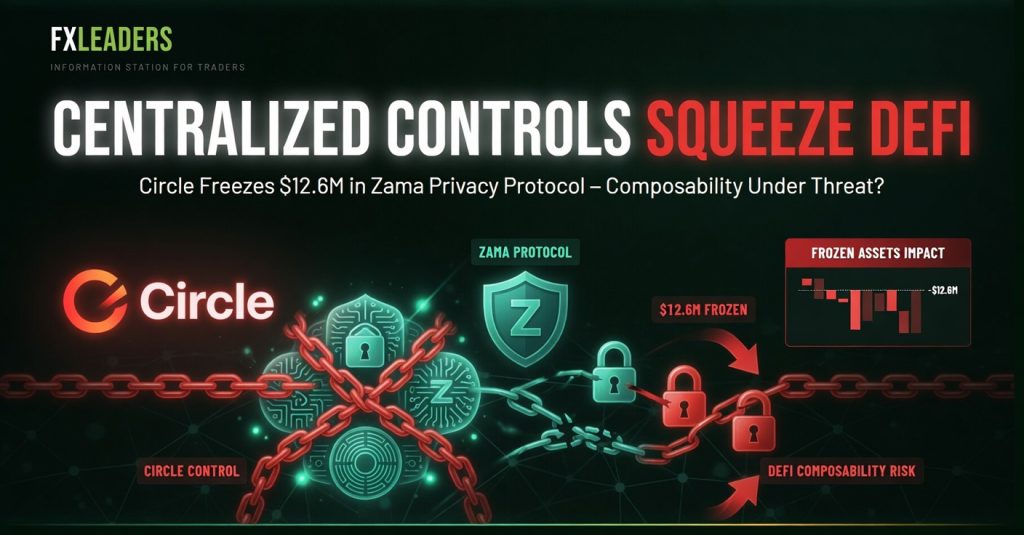
Circle froze $12.6 million worth of Zama’s confidential USDC following a federal court’s Friday night, May 29, 2026, ruling to blacklist Zama’s confidential USDC (cUSDC) smart contract. The freeze occurred Saturday morning, UTC. It is noteworthy that this protocol is not directly involved in this case.
A group of Overnight Finance (OVN) governance token holding funds filed suit in the U.S. District Court for the Northern District of California on May 28, 2026. The three funds that are suing Overnight claim its creator, Maxim Ermilov, diverted funds worth more than $15 million in the project’s shared treasury before the project’s community voted to liquidate and distribute tokens in the treasury to the protocol’s token holders.
Approximately $12.5 million of the alleged stolen funds, mostly USDC, were allegedly sent into Zama’s confidential USDC contract. Since confidential USDC is a wrapper that aggregates funds into a single contract, the blacklist affected the entire cUSDC pool instead of just the funds in question.
Zama Caught in Crossfire
The confidential USDC contract was caught in a crossfire of another case,” said Rand Hindi, CEO of Zama. He said that most of the funds in the contract (>99%) came from the disputed deposit, confirming he is confident in Zama’s cUSDC and cUSDT smart contracts as well as the cWETH smart contract. Zama added that it plans to temporarily cease the service until it can work to restore access to the protocol contract.
The protocol is a provider of infrastructure to third-party applications and is not a mixer and thus does not obscure the addresses of either the sender or the recipient, but obscures the balances and amounts in each account and each address, said the protocol.
Zama’s legal counsel is in touch with U.S. counsel and will be working on isolating the specific address to ensure the other participants have full access and to restore access as soon as possible.
Plaintiffs’ Background and Legal Strategy
The filing was made by two funds with a history of activist activism within crypto, including Patagon Management, which was able to freeze $35 million in assets in a similar case in 2023 regarding Spartacus DAO. The group wants to put an emergency freeze on the funds. They are also requesting that the court grant them leave to serve Ermilov by email and Discord.
The defendant has rejected the accusation and says the OVN token holders had no right to force the distribution of the OVN treasury assets, the assets in the wallets are personal funds and the ones of the OVN team, not the protocol treasury. He cited security concerns regarding the personal safety of himself, other participants, and crypto holders who have been recently kidnapped, among others, for moving the funds into a confidential USDC contract.
Broader Implications
The case also brings to light issues regarding the role of privacy tools alongside the centralized point of control in stablecoin infrastructure and continues to draw questions about the blacklisting powers of USDC, as Circle has been criticized for blacklisting funds too slowly in theft cases and too liberally in civil disputes.
It might also become an example to see how the USDC stablecoin protocol will handle the issue with a court-ordered freeze of the funds of multiple users and how this will affect users in other protocols. The date for a hearing on the restraining order will be Monday, June 1.
Bottom Line
The court ordered the freeze of Zama confidential USDC’s $12.6 million shows how Circle will still act as a chokepoint in the crypto ecosystem as it’s a centralized issuer. Although it makes sure that disputed assets are kept secure in an ongoing legal dispute, it also shows how the action can have far-reaching effects.
It may also make people wonder why Circle is allowed to freeze user’s assets in a civil dispute, not even a theft and, in this case, it also affects the user that is not involved in the original case at all.
The overnight case might also become a point of precedent in the crypto space and will likely be a point of contention in the legal dispute with the Overnight community. The case is likely to be resolved next Monday, when a hearing will take place.

Arslan Butt
Lead Markets Analyst – Multi-Asset (FX, Commodities, Crypto)
Arslan Butt serves as the Lead Commodities and Indices Analyst, bringing a wealth of expertise to the field. With an MBA in Behavioral Finance and active progress towards a Ph.D., Arslan possesses a deep understanding of market dynamics.
His professional journey includes a significant role as a senior analyst at a leading brokerage firm, complementing his extensive experience as a market analyst and day trader. Adept in educating others, Arslan has a commendable track record as an instructor and public speaker.
His incisive analyses, particularly within the realms of cryptocurrency and forex markets, are showcased across esteemed financial publications such as ForexCrunch, InsideBitcoins, and EconomyWatch, solidifying his reputation in the financial community.