
It is almost midnight at the close of 15th June 2026, and I am standing in the middle of a world that is supposed to be ending, not that anyone nearby seems all that concerned by the prospect.
In mundane reality, I am standing in my living room, trying not to bash my shins on the coffee table, with a £320 lump of plastic strapped to my head. Conceptually, though, I am in the metaverse—a virtual reality (VR) concept that, for much of the past decade, big tech promised us was the future.
Mark Zuckerberg was so convinced the metaverse was the next big thing that he renamed his company after it. Meta, as Facebook is now known, bet the farm on virtual reality, investing more than $80bn into metaverse-related ventures over the past five years alone—only to abruptly decide it wasn’t the future after all.
In March this year it was announced that Horizon Worlds, Meta’s flagship metaverse venture, would shut down its VR operations in June, continuing only as a mobile app. The announcement was quickly reversed, after a fashion, as Meta promised not to pull the plug on a service users had bought expensive headsets to access. Instead of a quick end, Horizon Worlds would die slowly—no longer maintained or updated, but still accessible to those who had already signed up.
That’s why I’m standing with a Meta Quest headset strapped to my head on 15th June. Are people going to mark the moment they staved off a virtual reality apocalypse? Is this the celebration scene at the end of the movie, when disaster is averted? Will the metaverse be full of cheering crowds?
The short answer was no: Meta has built a whole network of virtual reality worlds, almost all of them empty. The concept was glitzy: Meta itself would build a hub, which let you design and build your own VR avatar—initially, to much derision, without legs, although these were later added.
Users could then build their own themed worlds which anyone could explore, playing games, buying and selling virtual merchandise and chatting with other visitors. Meta promised it would host gigs, comedy clubs and more. Big brands—including Wendy’s, Mini, Cheetos, Fender and the NBA—were lured to build sponsored worlds. It would be a whole new way to experience the internet.
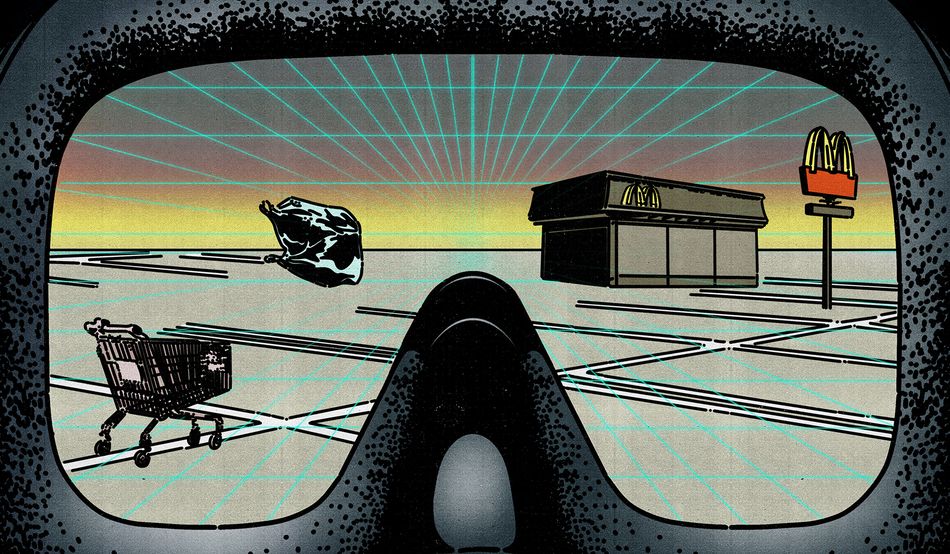
The busiest venue I can find in Horizon Worlds is Metdonald’s, a VR “parody” of the fast-food chain, with 29 people inside. I am teleported to a crude carpark with a decent facsimile of a McDonald’s restaurant inside it. The design encourages me to go through a drive thru.
When I get to the front, I hear the disembodied voices of American children trying to get a non-functional ordering screen to do something. “Five thousand hamburgers please,” one kid says repeatedly, before getting frustrated at another player standing on top of their car.
Another child tries to challenge me to play one of the games nearby, and is quickly annoyed when I can’t work out the controls well enough to do so. Meta spent tens of billions of dollars on building the future of the internet, and all it has to show for it is a handful of bored children in the parking lot of an offbrand drive-thru restaurant. Something clearly went very wrong here, but it’s not immediately clear what—or what that means for big tech’s ability to shape the future when it’s not what the rest of us want.
Virtual reality, or something like it, has been imagined as what’s “next” for almost as long as computers have existed. In the 1960s, when computers were still large enough to fill rooms, Ivan Sutherland, a senior official at the Advanced Research Projects Agency—the United States defence agency that helped to create the internet—said in a paper that “the ultimate display would, of course, be a room within which the computer can control the existence of matter.”
This idea, in which a computer could let us physically touch and manipulate virtual objects, is more akin to something like the Star Trek holodeck than anything achievable with today’s technology, let alone that of the 1960s. But the idea has run in parallel to science fiction throughout the 20th century.
The BBC science programme Tomorrow’s World featured virtual reality with increasing frequency throughout the 1980s and 1990s, promising it would be the future of architecture and design, then of shopping—pushing virtual trolleys through virtual malls—and then of gaming and recreation.
Internet philosopher and Grateful Dead lyricist John Perry Barlow considered other possibilities for VR in his 1990 essay, “Being in Nothingness”. “The real point of Virtual Reality, as with life itself, is contact,” he wrote. “Even if Virtual Reality turns out to provide the format for the ultimate pornographic film… it will serve us better as the ultimate telephone.”
The possibilities of virtual reality—a way of interacting with a digital world that filled our vision and felt nearly as “real” as the one outside—expanded in the online era, when it could be accompanied by the actual connection Barlow sought.
Out of this idea came the concept of the metaverse, which predated Facebook’s interest in the idea by years, if not decades. By the late 2010s, it had codified into a collection of properties detailed by author and metaverse advocate Matthew Ball (no relation).
A metaverse worthy of the name, Ball ruled, would need to be a persistent, connected digital world that people could dip into and out of at any time, and which would continue to change when a given user was offline. It should have no limit on users, a functioning economy, and be open to commerce, art, and creativity more broadly. When fully formed, it should merge the online and
offline worlds.
There are online games with some characteristics of a metaverse. World of Warcraft has a persistent online world that is more than 20 years old, and which has changed and grown over that time. Second Life and Eve Online have similar traits but, while they serve as precursors to a “true” metaverse, all of them fall short.
Zuckerberg has a good claim to being the first person to try to build the first full metaverse, with Horizon Worlds. His company would build the hardware and infrastructure, but anyone could build a world within his metaverse, people could trade and interact within it, and the metaverse would always be on.
Crucially, unlike the dreamers who went before him, Zuckerberg had the tens of billions of dollars that it would take to build something like this. It is easy to quote the figure of $80bn—the cumulative losses to date of Meta’s metaverse division—and move on without appreciating what an astronomical sum it is.
$80bn is enough to give £2,000 to every single household in the United Kingdom. It is nearly 10 years of the UK’s international aid budget. You could comfortably purchase every single club in the Premier League for such a sum, and have plenty of money left over. It could cover the UN’s humanitarian fundraising target for 2026—designed to support 87m desperate people worldwide—twice over.
Zuckerberg did not commit funding on this level out of some sense of charity. Had the metaverse won, the prize was commensurately huge: a chance to take a percentage of every transaction, like the Apple store does with apps but on a planetary scale. Meta was, by far, the company most committed to the idea of the metaverse, but it was far from the only one. Apple designed a top-specification VR headset selling for thousands of pounds, while Google and others battled to keep up.
History, though, is littered with the mistakes of major companies that bet on virtual reality too early, only to suffer extensive public humiliation and financial loss. In 1995, at the peak of its powers, Nintendo launched the Virtual Boy, a 3D system the company’s president promised “will transport game players into a ‘virtual utopia’ with sights and sounds unlike anything they’ve ever experienced”. It would, executives promised, sell three million units and 14m games cartridges in its first year alone.
In reality, the Virtual Boy was discontinued in Japan within six months of its launch, and worldwide in less than a year. It was critically panned and a sales flop. The reasons were manifold: it gave people eye strain and it was uncomfortable to wear a plastic box on your head. The graphics weren’t good enough to justify the cost and the overall experience was miserable. If virtual reality was the technology of tomorrow, then “tomorrow” had not yet arrived.
Judging by the public response to the metaverse in the 2020s, though, tomorrow might never arrive. It is still both uncool and uncomfortable to wear a large lump of plastic on the front of your face. Meta, like Nintendo, was widely panned for the poor quality of its VR graphics—although any computer small and light enough to wear on your face is always going to be underpowered.
Having screens inches away from our eyes to create a 3D effect still gives many of us eye strain and motion sickness, which is hardly an invitation to spend hours in a virtual world. Thirty years of technological advancement couldn’t reinvent the human eye, and has done little to change the limitations of size, weight and power that go with wearable technology.
In the end, Zuckerberg built it, and no one came. Just three months after the launch of Horizon Worlds, Meta confirmed that it had just 300,000 monthly users (compared to billions on Facebook). Within months, that had fallen by a third. The company has made thousands of layoffs in the past year as it refocuses its business on artificial intelligence, many of those jobs having been cut from the metaverse division for which the company is now named. Meta is unlikely to embarrass itself by changing its name yet again, but the VR future has once again been all but abandoned.
Metaverse advocates are keen to stress the idea was around before Zuckerberg took interest, and insist it will outlast him too. “The true metaverse is vast, complex, and multifaceted. I’ve been mapping it for years,” says Julian Reyes, the director of the Virtual Worlds Museum. “I invite you to write clearly about the term from its inception and not in how Zucky envisioned it. That was just his vision and it was deeply flawed.”
Reyes’s is clearly a sincerely held position, and true so far as the intellectual history of the metaverse goes. But on a practical level, Zuckerberg had $80bn to invest in the metaverse and got nowhere with it. No one else is, at present, offering to make anything like that investment. I follow up with Reyes to ask about the prospects for the metaverse without comparable financial backing. Answer comes there none.
All of them are now pronouncing with equal confidence that the future is, in fact, in artificial intelligence
The change of direction from the rest of the technology industry, though, has been so rapid that I feel like I’ve got some version of the bends. For years, CEOs and venture capitalists told us the future was the metaverse, which would definitely involve NFTs, the blockchain, virtual land and more. These would revolutionise how we work, how we socialise, even what it means to be a human, they said.
Almost overnight, all of them are now pronouncing with equal confidence that the future is, in fact, in artificial intelligence—and the story sounds familiar. Whether we like it or not, it will transform the world of work and how we socialise. Some argue it is already sentient, with a humanity of its own.
They seem to find no time for reflection on a future that didn’t come to pass, on all the predictions they got wrong. Instead, we move straight past that, investing hundreds of billions of dollars in artificial intelligence, betting our money—venture capitalists get their money from our pension funds, and we invest in big tech through them too—on their new vision for the future.
We are envisioned as the consumers who will make the economics of the future work, and we are ultimately the investors paying for it to come about, but no one seems to have bothered to ask us if it’s what we want. With artificial intelligence, the impression is that our opinions hardly matter: that, one way or another, AI is coming, and it’s better that we are in control of it than China.
But we weren’t consulted on the metaverse, either, and as it turned out that mattered a great deal more to the companies than to us. There are limits to how far big tech moguls can impose their vision of the future. Sometimes the winning move really is as simple as not playing the game.
Looked at this way, my visit to the virtual Metdonald’s drive thru feels less bleak. Yes, it’s a horribly designed, ultra-capitalistic space—a car park with no cars, for a restaurant that can sell no food, an earthly purgatory we have built for ourselves.
But its very emptiness is a human triumph of sorts, a reminder that we do still get to choose what shape the future will take. Collectively, we took a look at the metaverse, and with one voice we decided: not this.