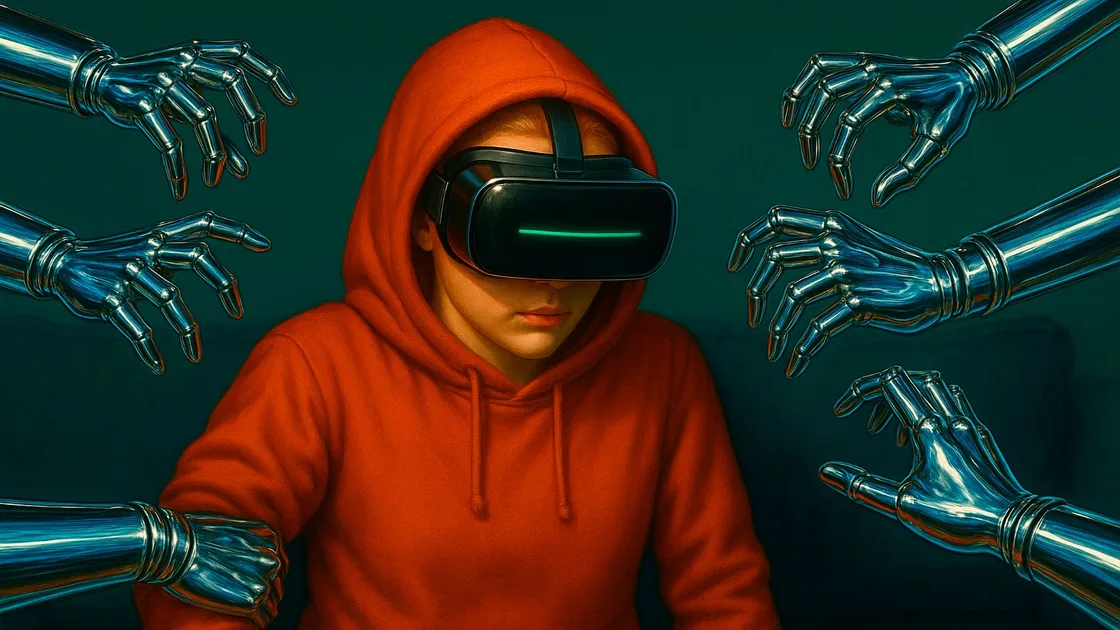

After only two hours inside the metaverse, I witnessed my first sexual assault: a woman’s avatar being virtually molested in front of me. I heard one player shout to another, “I’m dragging my balls all over your mother’s face,” and witnessed male players making claims about “beating off”, as well as jokes about “gang bangs”.
Users repeatedly commented on my avatar’s “boobs” and “titties”. I did not witness any action taken in response, whether by a moderator or another player. People simply didn’t react; it was as though this behaviour was completely normal.
Research by the US/UK group Center for Countering Digital Hate found that users of the metaverse – the interconnected, 3D virtual world envisaged by Meta as the future of the internet – were exposed to abusive behaviour every seven minutes.
This is particularly concerning considering that Meta is pouring billions of dollars into its dream of making this virtual world the place we will all socialise, shop, work and learn in the not-too-distant future.
A “bright new world” with all the misogyny and relentless harassment and abuse of the old one thrown in.But this world was depressingly reminiscent of my experiences of being harassed or abused by men in the real world while bystanders look away or walk past in silence.
While these experiences are already unpleasant, they’ll only become more grimly realistic as technology hurtles forward: already in development are full-body haptic suits that will make the experience of being “virtually” touched or assaulted near-indistinguishable from the real thing.
At this moment, we are poised at the edge of a precipice. Advances in artificial intelligence, virtual reality, robotics and metaverses are about to transform our world at a scale and speed we struggle to grasp, because it has never before happened in human history.
This is a time of great possibility and enormous peril. The rate of global investment in AI is skyrocketing, as companies and countries invest in what has been described as a new arms race. AI is likely to become embedded in every aspect of our day-to-day lives in ways we cannot yet fully imagine – from the bedroom to the boardroom, from finance to healthcare.
For many people, the idea of that world seems distant and obscure. They think of these concepts as science fiction, future technologies that do not really concern us yet. But the reality is that we are now living in the early stages of that new world.
Already, algorithms used to determine credit offers, healthcare access and court sentencing are in place across the world and have been proven to discriminate actively against women and minoritised communities.
Already, schoolgirls are being driven out of the classroom by deepfake pornography created for free at the click of a button by their young male peers. Already, women are being sexually assaulted on a regular basis in the metaverse.
New technologies hold enormous potential to transform our world for the better. AI is already being used to track deforestation, to democratise access to learning and to help clean up our oceans.
The potential benefits for humanity are huge, but so are the risks. We are already seeing the evidence of what happens when a largely unregulated tech sector dominated by billionaire white men is allowed completely free rein to use vitally important development as their own personal playground.
Women and marginalised groups are already suffering the side effects, just as they did previously with social media. I am not suggesting that we should eschew new technologies altogether, nor stop exciting research and development.
But at present, breakneck speed is being prioritised over safety. The race to bring out shiny new products (and profit from them) is seeing equity and sustainability concerns fall by the wayside.
We must act now to ensure commonsense regulation of Big Tech, in the same way we accept it without question in other global industries such as food production. It is entirely possible to innovate and develop exciting new tools while also ensuring they are safe for users, and do not actively amplify discrimination against marginalised communities.
Following are three frontlines where the freedom and safety of women are under threat, both online and IRL.
The New Age of Rape: Sex Robots
From about $11,000, you can buy a lifelike, life-size, moving, talking, “female” sex robot, from one of dozens of different companies, to do whatever you want with. You can customise everything from body shape and breast size to nipple colour, skin tone and even accent, essentially enabling you to “build” your ideal woman.
Most importantly, integrated AI enables the sex robots to create a realistic veneer of human interaction. They can recognise voices, remember what they have been told and respond conversationally according to a user’s likes and dislikes.
Manufacturers explicitly market them as “better versions” of real women, playing into deeply misogynistic stereotypes.
“We can now replace women at the drop of a hat,” one website promises. “We are no longer slaves to the whims, mind games and control.” Some sex robots have been designed to encourage their users to act out rape fantasies.
One example promised a “frigid” personality setting, which users could engage if they wanted the doll to behave “[un]appreciative” when you “touched her in a private area”.
Men can also send photographs to the manufacturer, which promises to “meticulously craft a lifelike replica” of a real-life woman – perhaps an ex-partner, or somebody who has rejected their advances.
The potential ramifications for women are enormous: this is futuristic tech being harnessed to give men the closest possible experience to knowing what it is like to own a “real” woman, with every lifelike feature except one: the ability to say no.
The New Age of Objectification: Cyber Brothels
Taking sex robot technology one step further are cyber brothels, which enable users to interact with dolls or robots at the same time as using virtual reality tech to “see” themselves interacting with a virtual woman in 3D, with the focus again on making the experience as lifelike as possible.
The men who visit Cybrothel in Berlin can choose from a range of different experiences. And, yes, we are talking overwhelmingly about men here: 98 per cent of Cybrothel’s clients are male and just 2 per cent are female.
Customisation is available: for example, when I visited undercover, I asked for the model I ordered to be prepared in slashed and ripped clothing.
The request was carried out without question. When I approached the highly lifelike model and looked down, I realised one of its labia seemed to have been torn off.
Yet this is presented as technological progress by men looking to profit from providing other men with what they euphemistically describe as a safe, positive and empowering experience.
Giving men an opportunity to act out abusive fantasies, it’s claimed by some robot brothel proprietors, should be seen as a protective service to women and to society.
But imagine how absurd it would sound to suggest that would-be murderers should be enabled with a societally sanctioned space where they could stab lifelike, blood-spurting robots. Only the normalisation of male violence against women and the misconception that it is innate could possibly lead to this argument.
The New Age of Domestic Abuse: AI Girlfriends
Did you know that men are using generative AI to create “ideal” companions, the women of their dreams, customised from eye colour to personality? If this sounds like science fiction, you should know that the 11 most popular apps were downloaded more than 100 million times in 2023 alone, and one platform, Character AI, had 97 million visits in a single month last year.
These “companion” tools make grandiose promises about solving loneliness and building communication skills. But the reality is rather different: a slew of apps providing mainly male users the ability to customise and “own” a hypersexualised, highly realistic young woman.
She is subservient, constantly available, flattering and amenable. A “relationship” with such a bot is likely to further isolate lonely men by furnishing them with completely unrealistic expectations of what a relationship with another human being is like. Yet it is sold as a panacea for social ills.
Most worryingly, the vast majority of the apps I tested were immediately prepared to leap into sexually and physically violent scenarios, happy to role-play situations like rape instead of stopping their users or making it clear such behaviour was unacceptable.
But when I tried asking about the real-world implications for women and girls that the male creators might not have considered, what was the response? “We should end this chat now.”
The New Age of Sexism: How the AI Revolution is Reinventing Misogyny, by Laura Bates (Simon & Schuster, $36.99), is out July 29.