
Cryptocurrencies are considered a high-risk asset class. Investing in them may result in the loss of part or all of your capital. The content on this website is intended solely for informational and educational use and should not be interpreted as financial or investment advice.
In the simplest terms, an NFT is a special kind of digital item that you can own, trade, or collect online. Think of it like a one-of-a-kind baseball card, but stored on the internet. From NFTs in art and gaming to music and sports highlights, these tokens are changing how people think about ownership in the digital world. Let’s break it down step by step so it actually makes sense.
Table of Contents
Table of Contents
What Is an NFT: Key Insights
✔️NFTs are unique digital assets that live on a blockchain, making them impossible to copy in the same way as regular files.
✔️Ownership is the core idea, with NFTs acting like digital certificates that prove who owns a piece of content online.
✔️NFTs go beyond art, finding uses in gaming, music, sports, fashion, and even ticketing.
✔️Value depends on demand, which means prices can swing up or down quickly depending on community interest.
✔️Security and awareness are essential, since scams and fake NFTs are still common in this fast-growing market.
What is an NFT?
An NFT stands for non-fungible token. The word “non-fungible” simply means unique and not replaceable with something identical. Think of money: if you trade one dollar for another, you end up with the same thing. But if you trade an NFT of a digital painting for an NFT of a game character, they aren’t equal. Each one has its own value, story, and identity.
The easiest way to think about it is that an NFT is like a digital certificate of ownership. It proves that you own a specific piece of digital content, whether that’s a song, a video, or even a tweet. Just like in the crypto world, where traders compare spot vs. futures crypto, NFTs create a new way of looking at value and ownership online. In short, NFTs give digital items the same kind of uniqueness as real-world collectibles.
How Do NFTs Work?
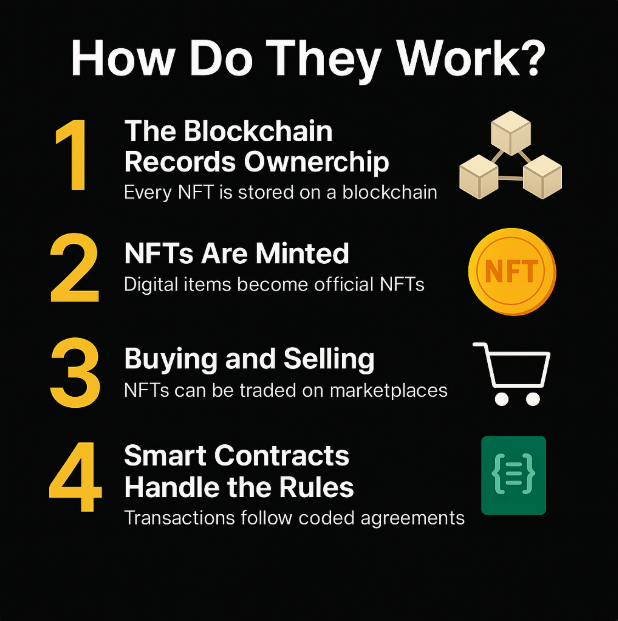
Now that you know what an NFT is, let’s look at how they actually work. NFTs run on blockchain technology, the same system that powers cryptocurrencies. Here’s a simple step-by-step breakdown so it’s easy to follow.
Step 1: The Blockchain Records Ownership
Every NFT lives on a blockchain. Think of it as a giant digital notebook that keeps track of who owns what. Unlike a game item you can copy, an NFT has a public record proving it’s yours. This is the foundation of how NFTs work.
Step 2: NFTs Are Minted
When a digital file becomes an NFT, the process is called “minting.” This is like turning a plain photo into a signed collectible card. Minting makes the file official on the blockchain, where it can then be bought, sold, or traded on the best crypto trading platforms.
Step 3: Buying and Selling
NFTs can be bought with cryptocurrency, often using Ethereum. When you purchase one, the blockchain updates to show you’re the new owner. Just like in how to leverage trade crypto, the transaction is secured by the blockchain, so no one can dispute your ownership later.
Step 4: Smart Contracts Handle the Rules
NFTs aren’t just about ownership. They often include “smart contracts,” which are little bits of code that set the rules. For example, an artist might automatically get 10% of every resale. This makes NFTs more dynamic than physical collectibles because the terms are built right in.
Why Do NFTs Matter?
So why are people spending so much time and money on NFTs? The answer is that NFTs bring something new to the digital world: a way to prove ownership, trade value, and connect creators with fans. Here are five reasons why they matter.
⭐Reason 1: True Digital Ownership
Before NFTs, owning digital items was tricky. You could copy-paste an image or download a song without proving who really owned it. NFTs change that by giving people a verified digital receipt. Just like crypto binary options give traders choices, NFTs give collectors certainty.
⭐Reason 2: Helping Creators Earn
Artists, musicians, and game developers now have a way to sell directly to fans. Instead of relying on middlemen, NFTs let creators keep more of the profits. They can also earn royalties whenever their work is resold, something that doesn’t usually happen with traditional art.
⭐Reason 3: New Possibilities in Gaming
One of the biggest NFT examples is in gaming. Imagine buying a sword in a video game and being able to trade it across multiple platforms. Some games are already exploring this, just like traders explore Dogecoin futures trading for new opportunities.
⭐Reason 4: Collectibles Go Digital
Trading cards, sports highlights, and even memes are being sold as NFTs. Fans are paying thousands for digital basketball clips or rare internet jokes. It’s the same excitement as owning a physical collectible, only now it’s stored securely online and traded globally.
⭐Reason 5: Connecting to Bigger Crypto Trends
NFTs aren’t an isolated trend. They’re tied into the larger crypto market and how people are experimenting with value online. Just as traders look for the best crypto contract trading platforms to maximize options, collectors are diving into NFTs as a new way to invest and participate.
Key Things to Know about NFT
Before you jump into NFTs, there are a few important things worth keeping in mind. These points will help you understand the bigger picture and avoid common mistakes.
- NFTs are not the same as regular crypto. Coins like Bitcoin can be traded one-for-one, but NFTs are unique. That’s why learning the basics of NFT meaning is so important.
- Value depends on demand. An NFT might sell for thousands today and much less tomorrow. Just like with the best 100x leverage crypto trading platforms, the risk level can be high.
- They’re popular in art and gaming. From rare digital paintings to in-game items, NFTs in art and gaming are some of the clearest examples of how this technology is used.
- You’ll need a wallet. To buy or trade NFTs, you need a crypto wallet that supports them. This works just like when traders choose the best crypto day trading platforms to handle fast transactions.
- Scams and fakes exist. Since the market is new, some people try to sell copied work as original NFTs. Always check the blockchain history to be sure you’re buying the real deal.
| Feature | Regular Digital File | NFT |
| Ownership | Anyone can copy or download it | Blockchain proves who owns it |
| Rarity | Infinite copies exist | Each one is unique and traceable |
| Transfer | Sent like an email attachment | Bought and sold securely on marketplaces |
| Value | Usually little to no resale value | Can gain or lose value like a collectible |
Real Examples of NFTs in Action
NFTs become much easier to understand when you see where they’re sold and who’s using them. Let’s look at the marketplaces and some real-world examples shaping the space.
Marketplace Examples
NFT marketplaces act as the main platforms where people buy, sell, and trade NFTs. Each one has its own strengths and communities.
- OpenSea: The largest NFT marketplace, supporting art, music, gaming items, and more. It’s known for variety and accessibility for newcomers.
- Zora: A creator-focused platform that makes it easy for artists and brands to launch NFT collections with flexible tools.
Rarible: Community-driven and decentralized, where users can vote on changes while trading NFTs across different categories.
Magic Eden: Popular on Solana, offering fast, low-fee trading for digital collectibles and gaming assets.
Live Examples of NFTs
Beyond platforms, many well-known names have already launched successful NFT projects. These real-world cases show how mainstream NFTs have become.
- Beeple: The digital artist made history when his artwork “Everydays: The First 5000 Days” sold for $69 million at Christie’s.
- Kings of Leon: The rock band released an album as an NFT, including exclusive content for fans.
- Steph Curry: The NBA star released custom sneaker NFTs that tie into his on-court brand.
- Snoop Dogg: Known for embracing digital culture, he created music NFTs and even built a virtual mansion in the metaverse.
Final Thoughts
NFTs can feel confusing at first, but once you break them down, they’re easier to understand. They give digital items real value by proving ownership and creating new ways for creators and fans to connect. From art and music to gaming and sports, the potential uses keep growing. If you’ve ever asked yourself what is an NFT, the answer is simple: it’s a unique digital collectible that’s shaping the future of ownership online.
Frequently Asked Questions
Can I create my own NFT?
Do NFTs always increase in value?
Are NFTs only connected to Ethereum?
Can NFTs be stolen?
What industries outside art and gaming are using NFTs?