
Enterprise Metaverse Market Summary
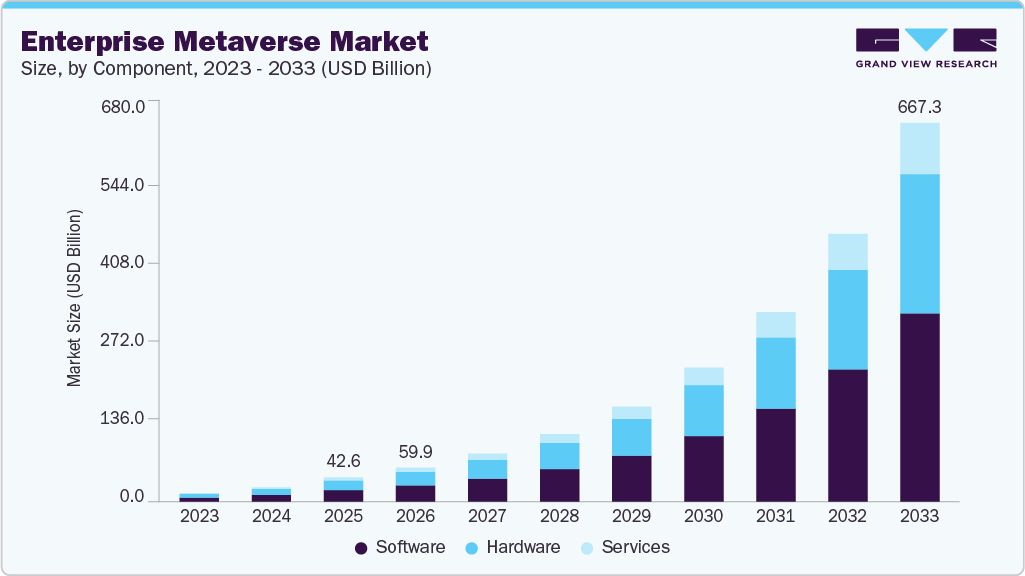
The global enterprise metaverse market size was estimated at USD 42.56 billion in 2025 and is projected to reach USD 667.34 billion by 2033, growing at a CAGR of 41.1% from 2026 to 2033. The market is experiencing steady growth driven by rapid enterprise digital transformation. Organizations are increasingly adopting immersive technologies such as AR, VR, and digital twins.
Key Market Trends & Insights
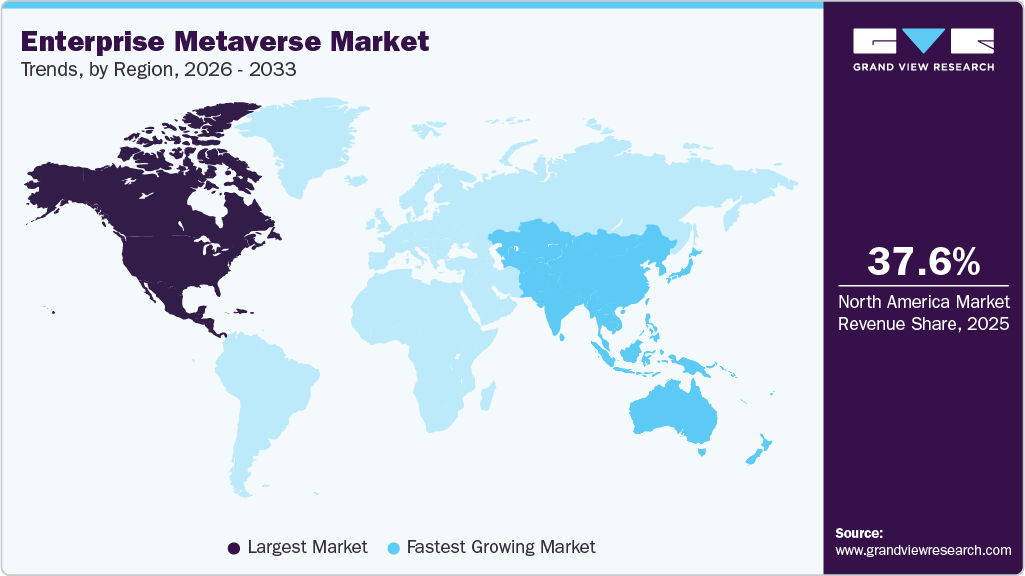
- The North Americaenterprise metaverse market held the largest global revenue share of 37.6% in 2025.
- The enterprise metaverse industry in the U.S. led North America with the largest revenue share in 2025.
- By component, the software segment led the market with the largest revenue share of 47.3% in 2025.
- By application, the training and simulation segment held the largest revenue share of 33.5% in 2025.
- By end use, the healthcare segment is expected to grow at the fastest CAGR of 45.2% from 2026 to 2033.
Market Size & Forecast
- 2025 Market Size: USD 42.56 Billion
- 2033 Projected Market Size: USD 667.34 Billion
- CAGR (2026-2033): 41.1%
- North America: Largest market in 2025
- Asia Pacific: Fastest market in 2025
These technologies are being used to improve collaboration, employee training, and operational efficiency. Enterprises are leveraging virtual environments to enhance productivity and decision-making. As digital adoption continues to rise, demand for enterprise metaverse solutions is expected to grow steadily. The increasing adoption of immersive, avatar-driven collaboration in the workplace is driving the enterprise metaverse market. Organizations are using 3D virtual environments for meetings, training, and events, boosting demand for collaboration platforms. Companies are expanding their use of spatial computing and digital identity solutions to enhance remote teamwork. Virtual experiences are improving productivity and employee engagement, encouraging wider enterprise adoption. This growth is creating opportunities for software, hardware, and service providers in the enterprise metaverse ecosystem. For instance, in December 2025, Microsoft launched Immersive Events in Teams as a generally available feature. This enables organizations to host 3D virtual environments where participants can interact as avatars for meetings, training sessions, and events.
Enterprises are increasingly using immersive virtual environments to enhance employee training and upskilling. Companies adopt these platforms for onboarding, compliance, and skills development programs. Employees can practice tasks safely and interactively in realistic 3D settings, improving engagement and knowledge retention. These environments also support remote and hybrid teams by replicating in-office collaboration and fostering team cohesion. Overall, this approach strengthens workforce capabilities, accelerates professional development, and drives enterprise metaverse adoption. For instance, in January 2024, Microsoft launched Microsoft Mesh, which became generally available within Microsoft Teams, providing mixed-reality collaboration. The platform enables enterprise users to collaborate in shared 3D virtual spaces for meetings, interactive training, and project work, enhancing communication and teamwork across remote and hybrid work environments.
The enterprise metaverse is increasingly applied to product visualization, design reviews, and marketing experiences. Teams can co-create in 3D, improving collaboration across locations. Virtual environments allow stakeholders to visualize prototypes before physical production. Companies can engage clients or partners in interactive settings, enhancing communication and feedback. Marketing campaigns within immersive spaces enable businesses to showcase products in engaging ways. This approach helps increase customer engagement and shorten sales cycles. Adoption is steadily growing as organizations focus on innovative and impactful customer experiences.
Component Insights
The Software segment dominated the global enterprise metaverse industry, accounting for a revenue share of 47.3% in 2025, showing its widespread use across enterprise applications. It supports collaboration, training, and product design platforms, enabling teams to work efficiently across geographies and improve overall productivity. The strong performance of software reflects its ability to create scalable, flexible virtual environments, enabling businesses to implement metaverse initiatives without the heavy physical infrastructure. Enterprises use these platforms to enhance employee engagement, streamline workflows, and accelerate project timelines, delivering clear operational benefits. Software remains the most significant contributor to revenue and adoption within the enterprise metaverse ecosystem.
The services segment is expected to grow over the forecast period. Services enable companies to customize platforms, optimize workflows, and provide training, ensuring smooth adoption across departments. They complement software by enhancing usability and maximizing operational efficiency. As enterprises focus on immersive collaboration, training, and marketing, the services segment is becoming an essential part of the market ecosystem. This trend indicates that enterprises are relying more on expertise and support to implement metaverse solutions successfully.
Application Insights
The training and simulation segment dominated the global enterprise metaverse market in 2025, due to widespread adoption across industries such as manufacturing, healthcare, and defense. Organizations increasingly use immersive virtual environments to deliver safe, repeatable, and cost-effective training for complex, high-risk operations. Virtual simulations helped reduce operational downtime and minimize safety incidents compared to traditional training methods. At the same time, the use of advanced technologies such as VR, AI, and digital twins improved realism and engagement in training programs. These tools allowed companies to track performance, assess skill gaps, and personalize learning experiences.
The marketing and advertising segment is growing steadily as companies seek more immersive and interactive ways to engage customers. Brands are using virtual environments to create experiential campaigns that allow users to interact with products before making purchase decisions. These experiences improve brand recall and customer engagement compared to traditional digital marketing channels. The rise of virtual showrooms, product launches, and branded events is further supporting adoption. Enterprises are also leveraging data from user interactions in virtual spaces to refine targeting and campaign effectiveness.
End Use Insights
Manufacturing dominated the enterprise metaverse industry in 2025, due to its strong need for efficiency, precision, and cost optimization. Manufacturers widely adopted virtual environments for process simulation, factory layout planning, and equipment testing before physical deployment. This approach reduced errors, material waste, and production downtime. The use of digital twins enabled real-time monitoring and optimization of production lines. Virtual training also helped upskill workers on complex machinery without disrupting operations. As a result, manufacturing emerged as the leading end-use segment by driving clear operational and financial benefits.
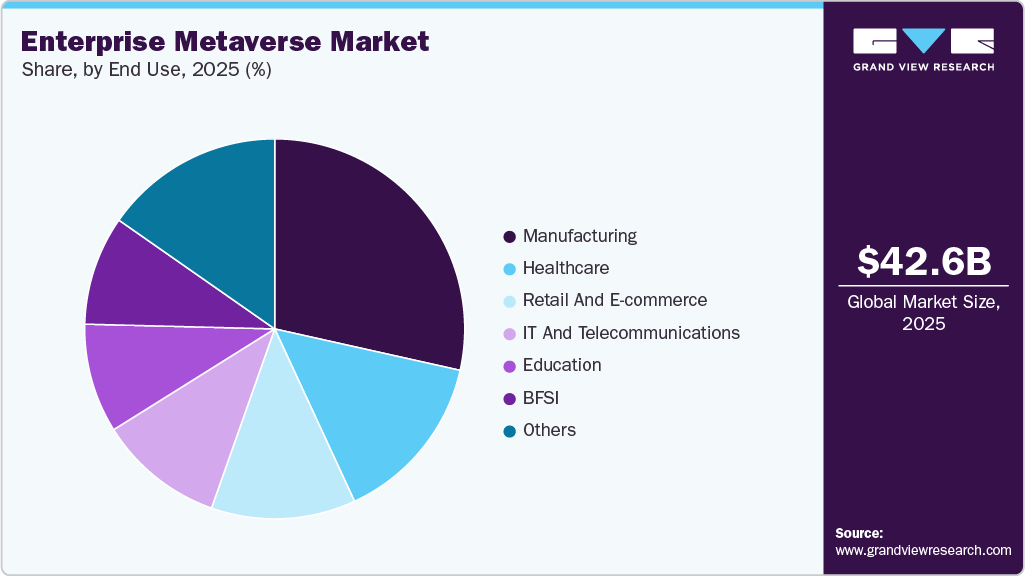
The healthcare segment is growing as providers increasingly adopt immersive technologies for training, treatment planning, and patient engagement. Virtual simulations are used to train medical professionals in complex procedures in a safe, controlled environment. Hospitals are also leveraging digital twins and 3D visualization for surgical planning and diagnostics. These tools help improve accuracy and reduce procedural risks. In addition, virtual environments support remote collaboration among clinicians and specialists. As healthcare systems focus on improving outcomes and efficiency, the adoption of metaverse-based solutions continues to rise.
Regional Insights
The North America enterprise metaverse market held the largest revenue share of 37.6% in 2025, due to early and widespread adoption of advanced digital technologies. The region is home to many leading technology companies and metaverse solution providers. Strong investments in AI, AR/VR, and cloud infrastructure enabled large-scale enterprise implementation. Industries such as IT, manufacturing, healthcare, and defense actively adopted immersive solutions to enhance productivity and operational efficiency. Supportive innovation ecosystems and high R&D spending further strengthened market growth.
U.S. Enterprise Metaverse Market Trends
The U.S. enterprise metaverse industry is growing, driven by early technology adoption and strong investments in immersive solutions. Enterprises widely use metaverse platforms for employee training, collaboration, and digital twin applications. The presence of major technology vendors accelerates innovation and commercialization. High spending on cloud, AI, and AR/VR infrastructure supports scalable deployments. Use cases across defense, healthcare, manufacturing, and IT services further strengthen demand.
Europe Enterprise Metaverse Market Trends
Europe’s enterprise metaverse industry is shaped by strong industrial and manufacturing adoption. Companies focus on virtual simulations, process optimization, and sustainability-driven efficiency improvements. The region shows growing use of digital twins for smart factories and infrastructure planning. Regulatory emphasis on data privacy encourages the development of secure, enterprise-grade metaverse solutions. Collaboration and training applications are also gaining traction across corporate and public sectors.
Asia Pacific Enterprise Metaverse Market Trends
The Asia Pacific enterprise metaverse industry is the fastest-growing globally, driven by rapid digital transformation across enterprises. Strong manufacturing expansion is driving demand for virtual training, simulation, and digital twin solutions. Governments in the region are actively supporting Industry 4.0 and smart factory initiatives. Increasing adoption of AR/VR technologies in education, healthcare, and retail is further accelerating growth. A large workforce and rising need for cost-efficient enterprise solutions also support market expansion.
Key Enterprise Metaverse Company Insights
Some of the key companies in the Enterprise Metaverse industry include Capgemini, Deloitte, Epic Games, Inc., IBM Corporation, Infosys Limited, Meta Platforms, and others. Organizations are focusing on increasing their customer base to gain a competitive edge in the industry. Therefore, key players are taking several strategic initiatives, such as mergers and acquisitions, and partnerships with other major companies.
-
IBM Corporation is advancing in the enterprise metaverse market by integrating immersive technologies with cloud, AI, and data platforms. The company focuses on virtual collaboration, digital workplaces, and immersive learning environments for large enterprises. IBM leverages AR/VR and 3D environments to enhance employee training, onboarding, and remote collaboration. Its enterprise metaverse efforts align closely with hybrid work models and secure, scalable business environments. IBM also supports enterprises in building customized virtual experiences tailored to specific business processes.
-
Infosys Limited is strengthening its presence in the enterprise metaverse industry through immersive digital experiences and virtual workplace solutions. The company supports enterprises in areas such as employee training, virtual collaboration, and customer engagement. Infosys combines AR/VR, cloud, and digital platforms to create scalable enterprise-focused metaverse environments. Its initiatives emphasize productivity, skill development, and experience-driven transformation. Infosys also collaborates with global clients to design industry-agnostic enterprise metaverse use cases.
Key Enterprise Metaverse Companies:
The following key companies have been profiled for this study on the enterprise metaverse market.
- Accenture
- Capgemini
- Deloitte
- Epic Games, Inc.
- IBM
- Infosys Limited
- Meta Platforms
- Microsoft
- Tata Consultancy Services (TCS)
- Unity Technologies
Recent Developments
-
In March 2024, Microsoft and NVIDIA Corporation expanded their partnership to integrate NVIDIA’s advanced AI, accelerated computing, and Omniverse technologies across Azure AI, Microsoft Azure, Microsoft Fabric, and Microsoft 365, enabling enterprises to build and deploy generative AI at scale. This partnership also enables industrial digitalization and immersive 3D digital twin use cases through NVIDIA Omniverse Cloud APIs on Azure, alongside enhancements to Microsoft Copilot powered by NVIDIA AI platforms.
-
In June 2023, Accenture and Microsoft expanded their long-standing partnership to help organizations responsibly adopt and scale generative AI using Microsoft Azure, Azure OpenAI Service, and Microsoft 365 Copilot across enterprise functions. The partnership focuses on industry-specific AI solutions spanning financial services, healthcare, supply chain, security, and customer operations to drive productivity, efficiency, and business transformation.
Enterprise Metaverse Market Report Scope
|
Report Attribute
|
Details
|
|
Market size value in 2026
|
USD 59.87 billion
|
|
Revenue forecast in 2033
|
USD 667.34 billion
|
|
Growth rate
|
CAGR of 41.1% from 2026 to 2033
|
|
Base year for estimation
|
2025
|
|
Historical data
|
2021 – 2024
|
|
Forecast period
|
2026 – 2033
|
|
Quantitative units
|
Revenue in USD million/billion and CAGR from 2026 to 2033
|
|
Report coverage
|
Revenue forecast, company ranking, competitive landscape, growth factors, and trends
|
|
Segments covered
|
Component, application, end use, region
|
|
Regional scope
|
North America; Europe; Asia Pacific; Latin America; MEA
|
|
Country scope
|
U.S.; Canada; Mexico; UK; Germany; France; China; Japan; India; South Korea; Australia; Brazil; KSA; UAE; South Africa
|
|
Key companies profiled
|
Accenture; Capgemini; Deloitte; Epic Games, Inc.; IBM; Infosys Limited; Meta Platforms; Microsoft; Tata Consultancy Services (TCS); Unity Technologies
|
|
Customization scope
|
Free report customization (equivalent up to 8 analysts working days) with purchase. Addition or alteration to country, regional & segment scope.
|
|
Pricing and purchase options
|
Avail customized purchase options to meet your exact research needs. Explore purchase options
|
Global Enterprise Metaverse Market Report Segmentation
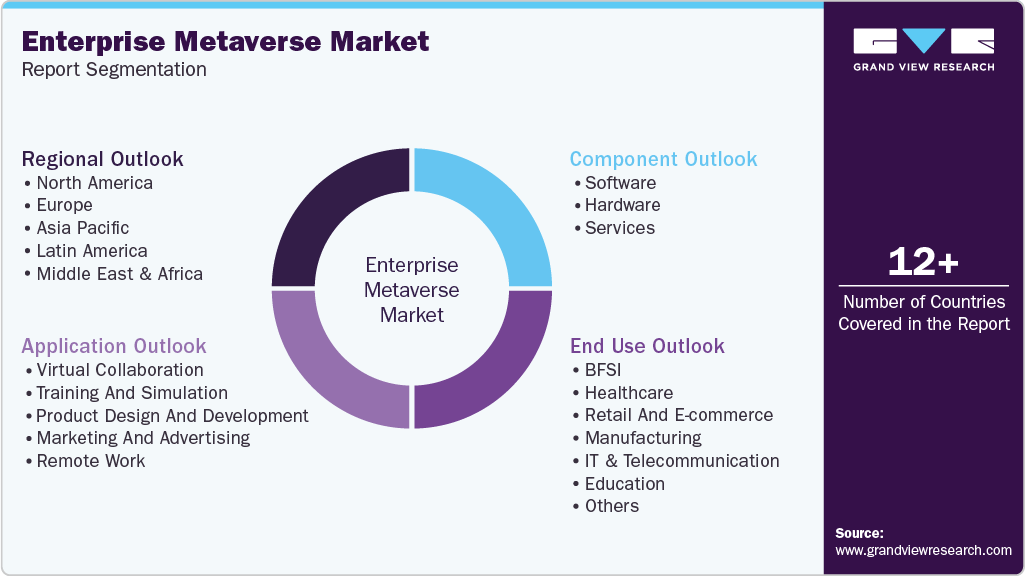
This report forecasts revenue growth at the global, regional, and country levels and provides an analysis of the latest industry trends in each of the sub-segments from 2021 to 2033. For this study, Grand View Research has segmented the global enterprise metaverse market report based on component, application, end use, and region.
-
Component Outlook (Revenue, USD Million, 2021 – 2033)
-
Software
-
Hardware
-
Services
-
-
Application Outlook (Revenue, USD Million, 2021 – 2033)
-
End Use Outlook (Revenue, USD Million, 2021 – 2033)
-
BFSI
-
Healthcare
-
Retail and E-commerce
-
Manufacturing
-
IT & Telecommunication
-
Education
-
Others
-
-
Regional Outlook (Revenue, USD Million, 2021 – 2033)
Frequently Asked Questions About This Report
b. The global enterprise metaverse market size was estimated at USD 42.56 billion in 2025 and is expected to reach USD 59.87 billion in 2026.
b. The global enterprise metaverse market is expected to grow at a compound annual growth rate of 41.1% from 2026 to 2033 to reach USD 667.34 billion by 2033.
b. North America dominated the enterprise metaverse market with a share of 37.6% in 2025. This is attributable to the region’s advanced digital infrastructure, high enterprise adoption of emerging technologies, and strong presence of key metaverse solution providers.
b. Some key players operating in the enterprise metaverse market include Accenture, Capgemini, Deloitte, Epic Games, Inc., IBM Corporation, Infosys Limited, Meta Platforms, Microsoft, Tata Consultancy Services (TCS), Unity Technologies
b. Key factors driving the market growth include increasing enterprise adoption of immersive technologies, rising demand for virtual collaboration and training solutions, and continuous innovations in augmented and virtual reality platforms.