
Europe Music NFT Market Report Summary
The Europe music NFT market was valued at USD 233.67 million in 2025, is estimated to reach USD 283.89 million in 2026, and is projected to reach USD 1,346.86 million by 2034, growing at a CAGR of 21.48% during the forecast period. The growth of the Europe music NFT market is driven by increasing adoption of blockchain technology in the music industry, rising interest in digital ownership of music assets, and the growing popularity of decentralized platforms that allow artists to monetize their work directly. Music NFTs enable musicians and creators to sell digital music assets such as songs, albums, and exclusive content while maintaining ownership rights and earning royalties from secondary sales. The expansion of digital collectibles, fan engagement platforms, and blockchain based music distribution models is further accelerating the growth of the music NFT market across Europe.
Key Market Trends
- Increasing adoption of blockchain technology by artists and music platforms to distribute and monetize digital music content.
- Growing popularity of exclusive digital music collectibles, limited edition releases, and fan engagement tokens.
- Rising interest among independent artists in decentralized platforms that allow direct monetization without traditional intermediaries.
- Expansion of NFT marketplaces and music focused blockchain platforms supporting the creation and trading of music NFTs.
- Increasing integration of NFTs with virtual events, metaverse experiences, and fan membership ecosystems.
Segmental Insights
- Based on NFT type, the single track NFTs segment held the largest share of the Europe music NFT market and accounted for 37.3% of the regional market share in 2025. The popularity of this segment is attributed to the increasing demand for unique digital music releases where individual tracks are sold as exclusive collectibles to fans and investors.
- Based on market participant type, the musicians and artists segment dominated the Europe music NFT market and captured 44.7% of the regional market share in 2025. Independent artists and musicians are increasingly adopting NFT platforms to distribute music directly to audiences, generate revenue, and maintain greater control over intellectual property.
- Based on monetization model, the direct sales model segment held the largest share of the Europe music NFT market and accounted for 51.5% of the regional market share in 2025. This model allows creators to sell digital music assets directly to buyers through NFT marketplaces without intermediaries, ensuring greater revenue transparency and ownership control.
Regional Insights
- The Europe music NFT market is witnessing rapid growth across several countries due to increasing adoption of blockchain based digital assets and expanding creator economies.
- The United Kingdom accounted for the largest share of the Europe music NFT market and held 26.2% of the regional market share in 2025. The country’s strong digital music industry, growing blockchain innovation ecosystem, and active community of independent artists are key factors supporting the growth of music NFTs.
- Other European countries are also experiencing increasing participation in the music NFT ecosystem supported by growing digital creator communities, expanding NFT marketplaces, and rising interest in blockchain based digital collectibles.
Competitive Landscape
The Europe music NFT market is highly competitive with the presence of NFT marketplaces, blockchain technology providers, and specialized music NFT platforms. Companies are focusing on developing creator friendly platforms, enabling royalty tracking, and enhancing digital ownership mechanisms through blockchain technology. Strategic collaborations between artists, music labels, and technology companies are helping expand the adoption of music NFTs across the European digital music ecosystem. Prominent players in the Europe music NFT market include Audius, Royal, OpenSea, Rarible, SuperRare Labs Inc., Mintable Pte. Ltd., Opulous Songs Ltd, Zora Labs Inc., Blockparty Inc., Arpeggi Labs Inc., TuneGO Inc., Gemini Trust Co. LLC, Ozone Networks Inc., and Superlogic Inc.
Europe Music NFT Market Size
The Europe music NFT market size was valued at USD 233.67 million in 2025 and is projected to reach USD 1,346.86 million by 2034 from USD 283.89 million in 2026, growing at a CAGR of 21.48%.
Music NFT represents a transformative digital ecosystem where musical compositions, recordings, albums, and associated intellectual property rights are tokenized as unique non fungible assets on blockchain networks. This domain redefines the relationship between artists and audiences by enabling direct ownership, verifiable provenance, and programmable royalty distributions through smart contracts, effectively bypassing traditional intermediaries. The scope extends beyond simple collectibles to include utility tokens that grant access to exclusive concerts, backstage experiences, and governance rights within artist communities. According to the European Union Intellectual Property Office, the registration of digital assets and the legal framework surrounding crypto assets have gained significant traction following the implementation of the Markets in Crypto Assets regulation, which is providing a clearer operational landscape for creators. As per Eurostat, internet usage among individuals in the European Union was widespread in 2024, which is creating a vast digitally literate population capable of engaging with web three technologies. According to the European Commission, the creative and cultural sectors contribute meaningfully to the European Union gross domestic product, which is indicating the economic significance of modernizing revenue streams for artists. Furthermore, according to the International Confederation of Societies of Authors and Composers, European songwriters collected substantial royalties in 2023, yet many independent artists struggle with delayed payments, a gap that music non-fungible tokens aim to bridge through instant settlement mechanisms. This evolving landscape positions music non-fungible tokens not merely as speculative instruments but as fundamental tools for financial inclusion and artistic autonomy across the continent.
MARKET DRIVERS
Direct Artist Revenue Generation and Elimination of Intermediary Friction
The urgent need for artists to reclaim financial control and eliminate the substantial revenue leakage caused by traditional streaming models and intermediary layers is one of the key factors propelling the growth of the Europe music NFT market. According to the Independent Music Companies Association, independent labels and artists in Europe often receive a small share of the revenue generated by their streams on major platforms, with the remainder absorbed by distributors, labels, and service providers. As per the European Composer and Songwriter Alliance, the average per stream payout on dominant streaming services is very low, which is requiring millions of plays to generate a sustainable income, which forces many talented musicians to abandon their careers. Music non fungible tokens disrupt this dynamic by allowing creators to sell their work directly to fans, which is retaining up to 90% of the primary sale proceeds and securing automatic royalty splits via smart contracts for every secondary market transaction. According to the European Central Bank, instant settlement capabilities inherent in blockchain technology can reduce payment cycles significantly, which is providing crucial cash flow for independent operators. Furthermore, the ability to program perpetual royalties ensures that artists benefit from the appreciation of their work over time, a feature absent in traditional copyright licensing. These economic imperative drives widespread adoption as European musicians seek viable alternatives to an industry structure that has historically marginalized independent talent, which is making direct monetization through non fungible tokens a critical survival strategy.
Enhanced Fan Engagement and Exclusive Community Access Models
The shifting expectations of European music consumers toward deeper, more interactive relationships with artists is fuelling the expansion of the Europe music NFT market. According to the International Federation of the Phonographic Industry, many music fans in Europe expressed a desire to support artists directly and gain access to exclusive content beyond standard streaming offerings. As per YouGov research, younger demographics in key markets like the United Kingdom, Germany, and France are increasingly willing to purchase digital assets that confer status, community membership, or unique experiences such as virtual meet and greets and limited-edition merchandise. Music non fungible tokens facilitate this by acting as access keys to private online communities, presale ticket opportunities, and unreleased demo tracks, transforming passive listeners into active stakeholders. As per the European Live Music Association, the post pandemic era has seen a surge in demand for hybrid physical and digital experiences, which non fungible tokens can seamlessly bridge through verifiable ownership credentials. Furthermore, the gamification of fandom through collectible assets allows artists to build loyal ecosystems where fans are incentivized to promote the music to increase the value of their holdings. This evolution from transactional consumption to relational ownership creates a robust demand base, as fans seek meaningful connection and tangible benefits that traditional streaming subscriptions cannot provide, which is fuelling the growth of the music non fungible token economy.
MARKET RESTRAINTS
Regulatory Uncertainty and Complex Compliance Frameworks
The ambiguous regulatory landscape regarding the classification of non-fungible tokens and the stringent compliance requirements under European financial laws are hampering the expansion of the Europe music NFT market. According to the European Securities and Markets Authority, the distinction between utility tokens, security tokens, and pure collectibles remains complex, creating legal uncertainty for music projects that may inadvertently trigger securities regulations if their tokens offer profit sharing or governance rights. As per the European Commission, the implementation of the Markets in Crypto Assets regulation, while providing a framework, imposes heavy reporting and authorization burdens on issuers, which can be prohibitive for independent artists and small labels lacking legal resources. The General Data Protection Regulation presents another layer of complexity, as the immutable nature of blockchain conflicts with the right to erasure, which is raising concerns about storing personal data of fans and artists on public ledgers. The European Data Protection Board emphasizes that any processing of personal information on blockchain networks must strictly adhere to privacy principles, necessitating costly technical solutions like zero knowledge proofs. Furthermore, varying national interpretations of tax laws regarding digital asset transactions across European member states create a fragmented compliance environment that discourages cross border initiatives. This regulatory friction increases the cost of entry and operational risk, which is causing many potential market participants to hesitate or abandon projects until clearer guidelines and standardized compliance tools become available across the single market.
Environmental Concerns and Energy Consumption Perceptions
Persistent concerns regarding the environmental impact of blockchain technologies, particularly those utilizing proof of work consensus mechanisms, pose a substantial reputational and ethical restraint on the Europe music NFT market. According to the European Environment Agency, the European Union has committed to aggressive climate neutrality targets under the European Green Deal, which is making energy intensive technologies subject to intense public and regulatory scrutiny. As per the University of Cambridge, although the shift toward proof of stake networks has reduced energy consumption significantly, public perception often lags, with many European consumers and artists associating all non-fungible tokens with high carbon footprints. According to the European Climate Foundation, cultural sectors are under pressure to demonstrate sustainability, which is leading some prominent European musicians to publicly reject non fungible token projects due to fears of greenwashing accusations. This sentiment is amplified by media coverage that frequently highlights the energy usage of early blockchain networks without distinguishing between different consensus protocols. Consequently, artists risk alienating their fan base and damaging their brand image by engaging with perceived environmentally harmful technologies. The lack of widespread awareness regarding eco-friendly blockchain alternatives like layer two solutions or proof of stake chains further exacerbates this resistance. Until the industry successfully communicates its sustainability advancements and achieves recognized green certifications, environmental concerns will continue to dampen enthusiasm and slow the rate of adoption among environmentally conscious European stakeholders.
MARKET OPPORTUNITIES
Integration with Metaverse Platforms and Immersive Virtual Concerts
The rapid development of metaverse ecosystems and virtual reality environments across Europe provides a promising opportunity for the Europe music NFT market. According to the European Extended Reality Association, the market for virtual and augmented reality technologies in Europe is projected to grow substantially, with increasing investment in persistent digital worlds where social interaction and entertainment converge. As per PwC analysis, virtual concerts and events have emerged as a significant revenue stream, with non-fungible tokens enabling the sale of virtual land, exclusive avatar accessories, and ticketed access to live performances within these digital spaces. Music non fungible tokens can function as interoperable assets that allow fans to display their collection in virtual galleries or use them as entry passes to restricted areas in metaverse venues, creating new monetization avenues beyond physical touring. The European Commission’s support for digital innovation hubs fosters the development of such platforms, encouraging collaboration between tech firms and creative industries. Furthermore, the ability to host global audiences without geographical constraints allows European artists to expand their reach exponentially while reducing the carbon footprint associated with international travel. The integration of spatial audio and haptic feedback technologies enhances the realism of these events, which is making non fungible token-based attendance highly desirable. As the boundary between physical and digital reality blurs, music non fungible tokens will become essential credentials for participation in the next generation of live entertainment, which is unlocking vast economic potential.
Revolutionizing Royalty Financing and Intellectual Property Liquidity
The emergence of fractionalized ownership and royalty financing models powered by music non fungible tokens offers a groundbreaking opportunity in the Europe music NFT market. According to the European Investment Bank, there is a growing interest in alternative asset classes among European investors, and music royalties represent a stable, uncorrelated revenue stream that can be tokenized and traded on secondary markets. As per Deloitte insights, fractionalizing high value catalogues through non fungible tokens allows independent artists to raise capital by selling a percentage of future streaming revenues directly to fans, which is bypassing traditional predatory advance deals from major labels. This model empowers artists to retain creative control while accessing immediate funding for production and marketing. According to the European Crowdfunding Network, regulatory frameworks are evolving to accommodate such investment structures, provided they comply with investor protection standards. Furthermore, the transparency of blockchain ledgers ensures that all royalty distributions are visible and auditable, building trust between artists and investors. This liquidity mechanism also enables fans to profit from the success of artists they support, aligning incentives and fostering deeper loyalty. As the market matures, specialized platforms for trading music royalty tokens could emerge, creating a dynamic secondary market that values musical IP more accurately and efficiently than ever before, which is fundamentally reshaping the economics of the European music industry.
MARKET CHALLENGES
Technical Complexity and User Experience Barriers
The steep learning curve associated with blockchain technology and the cumbersome user experience of managing digital wallets and private keys is challenging the growth of the Europe music NFT market. According to Eurostat, while internet penetration is high, digital literacy regarding specific web three technologies remains low among the general population, with many users finding the process of setting up a wallet, purchasing cryptocurrency, and executing transactions intimidating and prone to error. As per the European Consumer Organisation, the risk of losing funds due to lost private keys or falling victim to phishing scams is a significant deterrent for non-technical fans who simply wish to support their favourite artists. The fragmentation of blockchain networks also creates confusion, as users must navigate different chains, gas fees, and bridge protocols to interact with various music platforms. The International Organization for Standardization notes that the lack of intuitive interfaces and seamless fiat on ramps complicates the entry process, limiting the addressable market to crypto natives. Furthermore, the irreversibility of blockchain transactions means that mistakes cannot be easily undone, creating anxiety for casual users. Until the industry develops abstracted layers that hide the underlying complexity and offer familiar login methods like social authentication or biometric verification, the technical barrier will remain a critical bottleneck preventing mass market participation and limiting the scalability of music non fungible token ecosystems.
Market Volatility and Speculative Behavior Undermining Artistic Value
The inherent volatility of cryptocurrency markets and the prevalence of speculative trading behaviours are further challenging the regional market expansion. According to the European Systemic Risk Board, the correlation between non fungible token prices and broader crypto asset fluctuations exposes artists and collectors to substantial financial risk, where the value of a music token can plummet overnight due to market sentiment rather than the artistic merit of the work. As per the European Securities and Markets Authority, the presence of wash trading and market manipulation in the nascent non fungible token space undermines trust and distorts price discovery, which is making it difficult for genuine artists to establish fair valuations for their creations. This speculative environment often attracts short term flippers rather than true fans, leading to boom-and-bust cycles that can damage artist reputations and discourage sustained engagement. The European Central Bank warns that such volatility contradicts the goal of creating stable income streams for musicians, as revenue becomes unpredictable and dependent on market hype. Furthermore, the perception of music non fungible tokens as purely financial instruments rather than cultural artifacts risks alienating the core music community who value art over profit. Addressing this challenge requires the development of stabilization mechanisms, better education on long-term holding and a cultural shift within the community to prioritize artistic value over quick gains, lest the market collapses under the weight of its own speculation.
REPORT COVERAGE
|
REPORT METRIC |
DETAILS |
|
Market Size Available |
2025 to 2034 |
|
Base Year |
2025 |
|
Forecast Period |
2026 to 2034 |
|
CAGR |
21.48% |
|
Segments Covered |
By NFT Types, Market Participant Type, Monetization Model, Platform Type, and Region |
|
Various Analyses Covered |
Global, Regional, & Country Level Analysis; Segment-Level Analysis; DROC, PESTLE Analysis; Porter’s Five Forces Analysis; Competitive Landscape; Analyst Overview of Investment Opportunities |
|
Regions Covered |
UK, France, Spain, Germany, Italy, Russia, Sweden, Denmark, Switzerland, Netherlands, Turkey, and the Czech Republic |
|
Market Leaders Profiled |
Audius, Royal, OpenSea, Rarible, SuperRare Labs Inc., Mintable Pte. Ltd., Opulous Songs Ltd, Zora Labs Inc., Blockparty Inc., Arpeggi Labs Inc., TuneGO Inc., Gemini Trust Co. LLC, Ozone Networks Inc., and Superlogic Inc |
SEGMENTAL ANALYSIS
By NFT Types Insights
The single-track NFTs segment dominated the market by holding 37.3% of the European market share in 2025. The dominance of single-track NFTs segment in the European market is attributed to the lower price point and higher accessibility of individual songs compared to full albums or exclusive rights, which is allowing a broader base of fans to participate in ownership. The format aligns perfectly with modern consumption habits where singles often drive viral trends and streaming numbers more effectively than full-length albums. The lower financial barrier to entry that enables mass participation from European music fans who may be hesitant to invest large sums in unproven digital assets is also supporting the expansion of the single-track NFT segment in the European market. According to the International Federation of the Phonographic Industry, music single NFTs in Europe are generally priced lower than album bundles or exclusive rights, which often limit their audience to high-net-worth collectors. As per YouGov research, many European music consumers aged 18 to 34 express willingness to purchase digital memorabilia when priced affordably, but this interest declines for higher-priced items. This price sensitivity makes single tracks the ideal entry point for new collectors, driving high transaction volumes. Furthermore, the ability to purchase specific favourite songs allows fans to curate personalized collections without committing to an entire artist discography. According to the European Consumer Organisation, micro-transactions are increasingly preferred in the digital economy, reflecting a shift toward frequent, low-value purchases rather than infrequent large investments. This democratization of access ensures that single tracks remain the most liquid and widely traded asset class within the music NFT ecosystem.
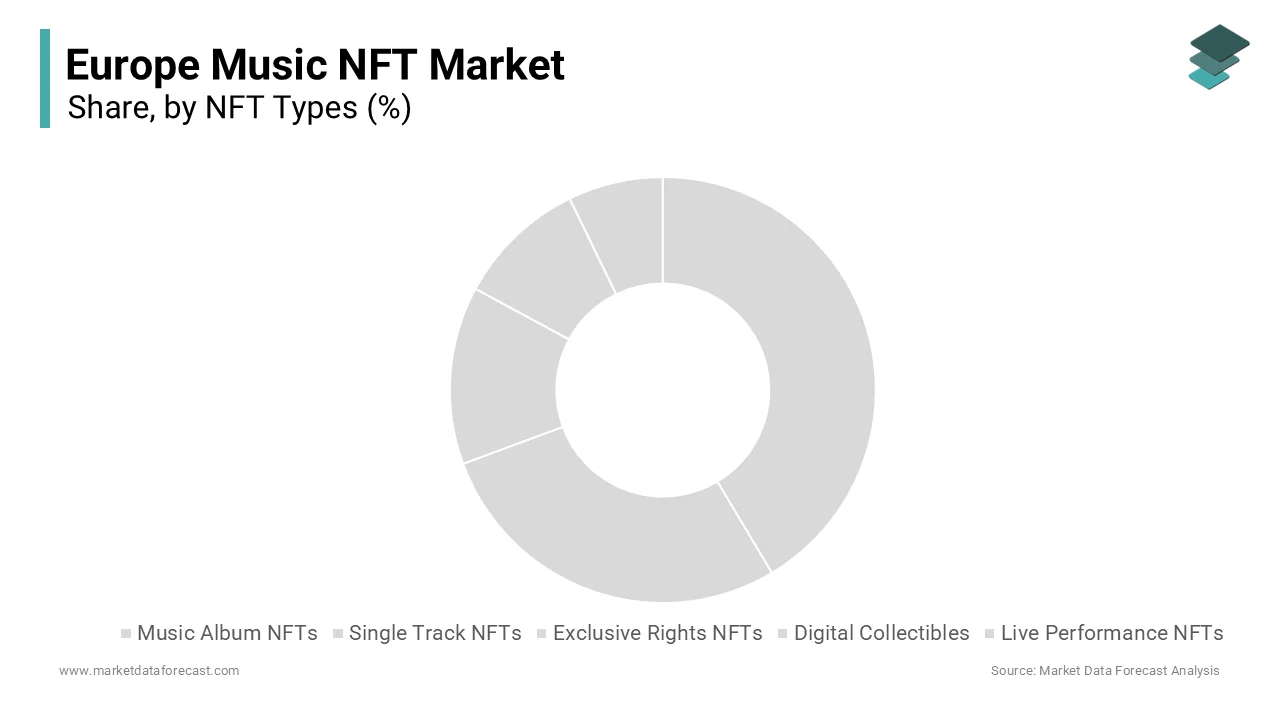
The live performance NFTs segment is anticipated to register a CAGR of 30.3% over the forecast period in the European market owing to the post-pandemic resurgence of live events, the integration of hybrid physical-digital experiences, and the desire of fans to own verifiable memories of concerts. The explosive recovery of the live music sector in Europe following the pandemic has created a fertile ground for live performance NFTs, which serve as digital souvenirs and proof of attendance for concerts and festivals. According to the European Live Music Association, ticket sales for live events in Europe have surpassed pre-pandemic levels, generating a massive audience base eager for commemorative assets. As per Pollstar data, major European festivals like Glastonbury and Tomorrowland have begun experimenting with NFT drop campaigns that offer exclusive content to attendees, driving significant interest in this segment. These NFTs often include high-quality video recordings of specific performances, backstage footage, or digital posters that capture the unique energy of a live show. The European Commission’s support for the cultural and creative sectors has encouraged organizers to adopt innovative digital tools to enhance fan engagement. Furthermore, the rise of hybrid events, where physical concerts are streamed globally, allows artists to mint NFTs for remote viewers, expanding the potential market beyond venue capacity. This convergence of robust live event attendance and digital innovation ensures that live performance NFTs will grow at an unprecedented rate as fans seek tangible connections to their most memorable musical experiences.
By Market Participant Type Insights
The musicians and artists segment led the market by capturing 44.7% of the European market share in 2025 due to the direct economic incentives for independent creators to bypass traditional intermediaries and the growing availability of user-friendly minting platforms tailored for individual artists. The compelling economic advantage of selling directly to fans that allows them to retain a significantly larger portion of revenue compared to traditional streaming or label deals is further contributing to the dominance of musicians and artists segment in the European market. According to the Independent Music Companies Association, independent artists in Europe typically retain only a small share of streaming revenues after distributor and label cuts, whereas music NFT sales enable them to keep up to 90% of the primary sale proceeds. As per the European Composer and Songwriter Alliance, the ability to program perpetual royalties into smart contracts ensures that artists earn a percentage of every secondary market transaction, which is creating a sustainable long-term income stream. As per the European Central Bank, instant settlement via blockchain eliminates the months-long payment delays common in the traditional industry, which is providing vital cash flow for touring and production. Furthermore, the direct relationship fostered by NFT sales allows artists to gather first-party data on their most dedicated fans, enabling targeted marketing and community building. This profound shift in economic power dynamics ensures that individual creators remain the most active and influential participants in the market.
The record labels segment is poised to grow at a CAGR of 28.2% in the European music NFT market during the forecast period owing to major labels recognizing the strategic necessity of integrating NFTs into their catalog monetization strategies and the influx of institutional capital into curated music IP projects. Major and independent record labels are aggressively entering the music NFT space to unlock new revenue streams from their extensive back catalogs and to extend their brands into the realm of digital collectibles. According to Billboard, several major labels including Universal Music Group and Sony Music Entertainment have launched dedicated web three divisions to manage NFT releases for their top-tier artists, signaling an institutional shift. As per PwC analysis, labels see NFTs as a way to revitalize older catalog tracks by releasing limited edition remastered versions or exclusive visualizers, tapping into nostalgia while appealing to new generations of collectors. The European Intellectual Property Office notes that labels possess the legal frameworks and rights management expertise necessary to navigate complex licensing issues, giving them a competitive edge over individual artists in launching high-value projects. Furthermore, labels are leveraging their marketing muscle to promote NFT drops to massive global audiences, ensuring higher sales volumes. The ability to bundle NFTs with physical merchandise, vinyl pressings, and tour packages creates comprehensive product offerings that maximize revenue per fan. This strategic pivot from viewing NFTs as a niche experiment to a core business pillar ensures that record labels will drive significant growth as they scale operations and integrate blockchain technology into their standard release cycles.
By Monetization Model Insights
The direct sales model segment accounted for 51.5% of the European market share in 2025. The leading position of direct sale segment in the European market is attributed to the simplicity of the transaction, the immediate liquidity it provides to artists, and the clear value proposition for fans purchasing a specific digital asset. The immediate access to capital it provides artists, which is eliminating the waiting periods associated with royalty distributions and subscription payouts is further boosting the expansion of the direct sales model segment in the regional market. According to the European Central Bank, direct sales of NFTs settle almost instantly on the blockchain, which is allowing artists to receive funds quickly and is critical for funding ongoing projects and touring expenses. As per the Independent Music Companies Association, the straightforward nature of buying a specific item for a fixed price or via auction resonates with consumers who prefer transparent, one-time transactions over recurring commitments. This model mimics traditional retail behaviours, which is making it easily understandable for the general public who may be confused by complex royalty sharing or subscription terms. As per the European Consumer Organisation, clarity in pricing and ownership rights is a key factor in consumer trust, and direct sales offer the highest level of transparency. Furthermore, the ability to set scarcity through limited editions creates urgency and drives quick sales volumes. The psychological satisfaction of owning a unique item immediately upon purchase reinforces this model’s popularity. This combination of financial immediacy for creators and transactional clarity for buyers ensures that direct sales remain the cornerstone of music NFT monetization.
The royalty payments model segment is estimated to register a promising CAGR of 30.5% over the forecast period in this regional market owing to the innovative concept of fractional ownership, the desire of fans to share in artist success, and the technological capability of smart contracts to automate complex distribution. The rise of fractional ownership models, where fans can purchase shares of future royalty streams via NFTs, is the primary catalyst for the explosive growth of the royalty payments segment. According to the European Investment Bank, there is a growing appetite among retail investors for alternative assets, and music royalties are increasingly seen as attractive opportunities. As per Deloitte insights, platforms enabling the tokenization of royalty rights allow fans to invest small amounts in the future earnings of their favorite songs, effectively turning listeners into stakeholders. The European Securities and Markets Authority notes that regulatory frameworks are adapting to accommodate these micro-investment structures, provided they meet investor protection standards. The psychological shift from passive consumption to active investment fosters a deeper connection between fans and artists, as supporters are financially incentivized to promote the music. Furthermore, the transparency of blockchain ledgers ensures that all royalty distributions are visible and auditable, building trust in the system. As more artists adopt this model to raise capital without losing creative control, the volume of royalty-based NFT transactions will surge, driving exceptional growth rates.
REGIONAL ANALYSIS
United Kingdom Music NFT Market Analysis
The United Kingdom dominated the music NFT market in Europe in 2025 with 26.2% of the regional market share. The UK is serving as a global hub for music innovation and fintech convergence. The nation’s status is defined by its vibrant independent music scene, a sophisticated investor base, and a regulatory environment that, while cautious, provides clarity for digital asset ventures. According to UK Music, the wider music industry contributed significantly to the UK economy, providing a robust foundation for experimentation with new monetization models like NFTs. As per the Financial Conduct Authority, the UK has been proactive in defining crypto asset regulations, giving businesses the confidence to launch compliant NFT platforms. The presence of major record labels and a high concentration of tech startups in London fosters a collaborative ecosystem where music and blockchain technologies intersect. The British public’s high adoption rate of digital payments and openness to collectible culture further drive demand. Furthermore, government initiatives like the Creative Industries Council actively support the exploration of web three technologies to maintain the UK’s competitive edge. This unique blend of musical heritage, financial sophistication, and regulatory progress ensures the UK remains the primary engine of growth and innovation for the music NFT sector in Europe.
Germany Music NFT Market Analysis
Germany was a promising regional segment in the European music NFT market in 2025. Factors such as a strong electronic music culture, a robust legal framework for intellectual property, and a growing community of crypto enthusiasts are driving the German music NFT market. Historically known for its rigorous adherence to copyright laws, the German market is seeing a transformation as artists and labels explore blockchain solutions to manage rights more efficiently. According to the German Music Industry Association, Germany is the largest music market in Europe by revenue, creating a massive potential user base for NFT initiatives. As per Bitkom, the German digital association, a notable portion of the population owns cryptocurrency, providing a ready-made audience for music NFT purchases. The country’s thriving techno and electronic scenes in cities like Berlin are at the forefront of adopting NFTs for ticketing and exclusive content releases. The Federal Ministry of Justice has been working on updating civil codes to recognize digital assets, reducing legal uncertainty for creators. Furthermore, the strong presence of manufacturing and engineering firms is leading to innovations in the underlying blockchain infrastructure supporting these markets. This combination of market size, technical expertise, and a culturally progressive music scene propels Germany’s significant role in the regional landscape.
France Music NFT Market Analysis
France is expected to exhibit a prominent CAGR in the European music NFT market during the forecast period due to a state-led push toward digital sovereignty, a rich cultural heritage, and a burgeoning startup ecosystem focused on creative technologies. The French market is notable for its strong emphasis on protecting artist rights, which aligns well with the provenance tracking capabilities of NFTs. According to the National Centre for Music, the French government has allocated substantial funds to support the digitization of the cultural sector, including pilot projects for NFT-based royalty distribution. As per France Digitale, the country hosts a vibrant community of web three startups that are building specialized platforms for music creators. The popularity of festivals and live events in France provides ample opportunities for integrating live performance NFTs. The Autorité des Marchés Financiers has established a clear regime for digital asset service providers, fostering a secure environment for investment. Furthermore, the French luxury and fashion sectors are increasingly collaborating with musicians on NFT collections, bridging different creative industries. This supportive policy environment, combined with a deep appreciation for arts and culture, ensures France remains a critical pillar of the European music NFT ecosystem.
Sweden Music NFT Market Analysis
Sweden is anticipated to record a notable share of the European music NFT market during the forecast period due to its status as a global music export powerhouse and a leader in digital innovation. The Swedish market is characterized by a high density of successful music producers and songwriters who are early adopters of new technologies to maximize their earnings. According to the Swedish Performing Rights Society, music exports from Sweden have reached record highs, creating a strong incentive for rights holders to explore efficient blockchain-based collection methods. As per the Swedish Innovation Agency, the government actively supports tech startups through grants and incubators, many of which are focused on the intersection of music and blockchain. The population’s high digital literacy and trust in online transactions facilitate rapid adoption of NFT platforms. Furthermore, Stockholm’s reputation as a tech hub attracts international talent and investment, fostering a cosmopolitan environment for music tech experimentation. The success of Swedish artists in global markets encourages them to pioneer NFT strategies that are then adopted domestically. This synergy between musical success and technological prowess positions Sweden as a key innovator and growth market in the region.
Netherlands Music NFT Market Analysis
The Netherlands is estimated to witness a healthy CAGR in the European music NFT market during the forecast period. The Dutch market is characterized by a forward-thinking regulatory approach, a high concentration of tech-savvy consumers, and a deep integration of music into the national identity. According to Statistics Netherlands, the country has one of the highest rates of internet penetration and digital payment usage in Europe, creating an ideal infrastructure for NFT transactions. As per the Dutch Association of Copyright Law, legal frameworks are evolving to accommodate smart contracts, providing clarity for artists and collectors. The prominence of major dance music festivals like Amsterdam Dance Event serves as a testing ground for NFT ticketing and exclusive content drops. The Netherlands’ strategic location as a logistics and digital gateway to Europe facilitates cross-border collaborations and platform launches. Furthermore, the strong presence of blockchain development firms in Amsterdam supports the technical backbone of the music NFT ecosystem. This combination of cultural relevance, digital readiness, and regulatory openness ensures that the Netherlands punches above its weight in influencing trends and driving adoption in the European music NFT market.
COMPETITIVE LANDSCAPE
The competition in the Europe music non fungible token market is intensely dynamic characterized by a complex interplay between major record labels independent artist collectives and specialized technology startups. Traditional music giants leverage their extensive catalogs and established artist relationships to launch high profile token releases that attract mainstream attention and significant capital. Independent platforms differentiate themselves through niche community building and lower fee structures that appeal to emerging artists seeking greater autonomy and higher profit margins. Technology firms utilize their blockchain expertise to offer superior user experiences and robust security features that build trust among collectors and investors. Regulatory frameworks regarding digital assets and copyright laws have lowered barriers for innovation fostering an environment where transparency and artist rights become key competitive differentiators. Companies constantly vie for market share by offering unique utility such as exclusive concert access or voting rights on creative decisions. The landscape sees frequent collaborations as labels partner with tech firms to combine content prowess with technical infrastructure ensuring seamless integration of non-fungible tokens into existing music consumption habits across diverse European demographics.
KEY MARKET PLAYERS
Some of the notable key players in the Europe music NFT market are
- Audius
- Royal
- OpenSea
- Rarible
- SuperRare Labs Inc.
- Mintable Pte. Ltd.
- Opulous Songs Ltd
- Zora Labs Inc.
- Blockparty Inc.
- Arpeggi Labs Inc.
- TuneGO Inc.
- Gemini Trust Co. LLC
- Ozone Networks Inc.
- Superlogic Inc.
Top Players in the Market
- Universal Music Group operates as a global powerhouse in the music industry and has become a pivotal force in the European music non fungible token landscape through strategic digital initiatives. The company actively partners with leading blockchain platforms to tokenize exclusive content from its vast roster of European artists, ranging from pop stars to classical musicians. Universal Music Group recently strengthened its market position by launching dedicated web three divisions that focus on creating immersive fan experiences and verifying intellectual property rights on distributed ledgers. Its global contribution remains significant as it sets industry standards for royalty distribution and copyright management using smart contracts. The firm continues to invest heavily in educational programs for artists to navigate the digital asset space safely. By bridging traditional music licensing with decentralized technologies, Universal Music Group ensures that creators retain more value while offering fans unique ownership opportunities across international markets.
- Sony Music Entertainment stands as a premier innovator in the Europe music non fungible token sector by leveraging its extensive catalog and technological expertise to drive adoption. The company has forged alliances with major cryptocurrency exchanges and metaverse developers to release limited edition digital collectibles and virtual concert experiences for European audiences. Sony Music Entertainment recently enhanced its market presence by integrating blockchain verification tools into its internal rights management systems to ensure transparent royalty payments for songwriters. It plays a vital role globally by pioneering hybrid physical and digital product launches that appeal to diverse consumer bases. The group continuously explores new use cases such as fractional ownership of music rights to democratize investment opportunities. Through these forward-thinking actions, Sony Music Entertainment empowers artists to monetize their work directly while fostering deeper connections with fans through verifiable digital assets and interactive community engagement models.
- Warner Music Group functions as a leading advocate for artist empowerment in the Europe music non fungible token market through its aggressive expansion into web three technologies. The company delivers innovative solutions by partnering with gaming platforms and social media networks to embed music tokens within interactive environments. Warner Music Group recently accelerated its strategy by acquiring stakes in specialized blockchain startups that focus on sustainable minting practices and user-friendly wallet interfaces. It contributes significantly to the global market by championing environmental sustainability within the digital asset space and promoting eco-friendly consensus mechanisms. The firm remains committed to developing proprietary tools that simplify the creation and trading of music assets for independent labels. By prioritizing artist education and infrastructure development, Warner Music Group facilitates a seamless transition to decentralized economies where creators maintain control over their intellectual property and revenue streams.
Top Strategies Used by Key Market Participants
Key players in the Europe music non fungible token market primarily employ strategic partnerships with blockchain infrastructure providers to ensure scalable and environmentally sustainable minting processes for digital assets. Companies frequently pursue collaborations with metaverse developers and gaming studios to create immersive virtual experiences that integrate music tokens as functional items within digital worlds. Another dominant strategy involves heavy investment in artist education programs and user-friendly platforms that lower technical barriers for creators seeking to tokenize their work. Market participants also focus on developing hybrid physical and digital product bundles that combine vinyl records or merchandise with exclusive non fungible token access codes. Furthermore, firms actively engage with regulatory bodies to shape favorable policies regarding digital asset classification and intellectual property rights protection. Expanding into fractional ownership models allows these entities to attract institutional investors and retail fans alike by offering shares of future royalty streams thereby diversifying revenue sources and increasing market liquidity.
MARKET SEGMENTATION
This research report on the European music NFT market has been segmented and sub-segmented based on categories.
By NFT Types
- Music Album NFTs
- Single Track NFTs
- Exclusive Rights NFTs
- Digital Collectibles
- Live Performance NFTs
By Market Participant Type
- Musicians and Artists
- Record Labels
- Streaming Platforms
- Art Collectors
- Investors
By Monetization Model
- Direct Sales
- Royalty Payments
- Subscription Models
- Crowdfunding
- Merchandise Integration
By Platform Type
- Music Specific Marketplaces
- General NFT Marketplaces
- Social Media Platforms
- Decentralized Platforms
- Augmented Reality Platforms
By Country
- UK
- France
- Spain
- Germany
- Italy
- Russia
- Sweden
- Denmark
- Switzerland
- Netherlands
- Turkey
- Czech Republic
- Rest of Europe