
The Incrypted editorial team has prepared another edition of our digest covering the key events in AI and Web3 this week. In it, we will tell you about cryptoasset price swings, the resignation of “crypto czar” David Sacks, Tether’s first full audit by a Big Four firm, the shutdown of Sora, and a leak about Anthropic’s new model called Mythos.
Top News
Bitcoin News
- How did the asset’s price change?
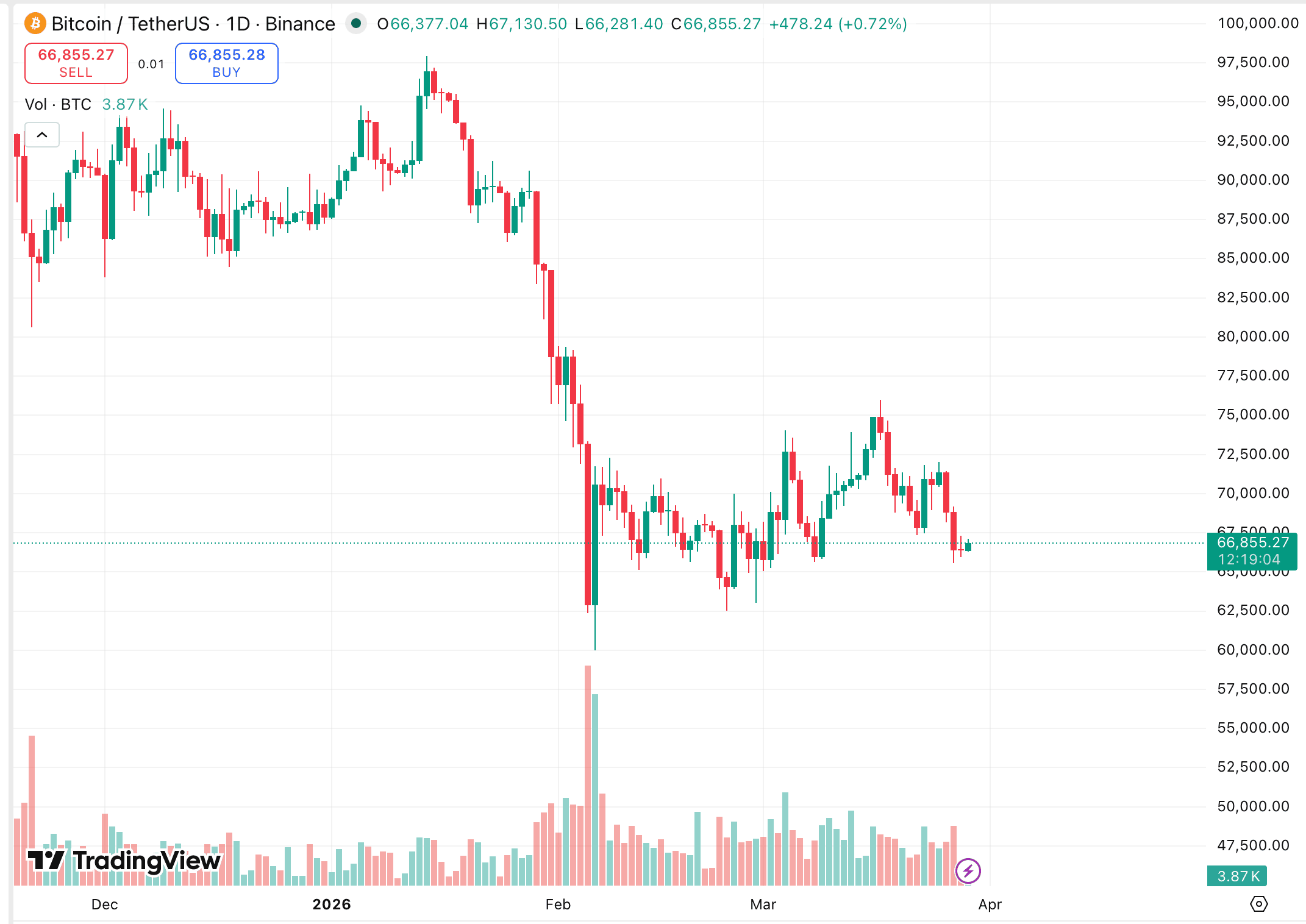
Between March 23 and March 29, 2026, bitcoin saw heightened volatility. The key drivers were the geopolitical situation, as well as mixed statements from U.S. President Donald Trump.
Before the week opened, the head of state issued Iran a harsh ultimatum, triggering capital outflows from high-risk positions. Bitcoin fell below $69,000.
The next day, he reported allegedly productive talks, which led to a rebound. Trump then declared victory in the war, which again pushed markets higher. The asset broke above $71,000 but failed to hold the level.
On March 27, it collapsed below $66,300. This triggered a wave of liquidations and panic among traders.
At the time of writing, bitcoin is trading at $66,855:
Bitcoin showed positive momentum amid a correction in gold. The precious metal posted a decline, falling for 10 consecutive days and losing about 27% from its January peak. This drove the bitcoin-to-gold ratio up from 12 ounces to 16.
The asset’s midweek rally was supported by inflows of institutional capital. Between March 16 and March 20, 2026, net inflows totaled more than $95 million.
CryptoQuant experts noted that the pace of bitcoin accumulation by whales has hit its highest level in 11 years. This points to a large-scale reallocation of capital and aggressive buying, potentially amplifying volatility.
According to Bloomberg analysts, bitcoin’s late-week drop was driven by the expiration of $14 billion in options. Traders showed a tendency to open more defensive positions ahead of the weekend.
Amid high volatility, Wintermute experts outlined several scenarios for bitcoin, taking into account the US and Israel’s war against Iran. In a bearish scenario, the asset could fall to the $60,000 zone for an extended period, while in a bullish one — implying de-escalation — it could rise to $80,000.
At the same time, some experts take a more optimistic view of what is happening. JPMorgan Chase noted that bitcoin has become a kind of “safe haven,” leaving both gold and silver behind.
- The situation in the mining sector
According to Checkonchain data, miners’ losses as of the end of March 2026 reached $14,000 per bitcoin mined. The worsening situation in the sector is being driven by rising energy prices, which are also being affected by the war in the Middle East. As a result, about 20% of companies are operating at a loss.
In addition, according to CoinShares, the fourth quarter of 2025 was the worst period for miners since the Bitcoin network’s halving in April 2024. Analysts also noted that counterparties are shifting from this sector into the AI space.
Against this backdrop, reports emerged that MARA, a major miner of the leading cryptocurrency, sold 15,133 BTC worth about $1 billion for a bond repurchase program. The decision was aimed at increasing financial flexibility, but the community viewed it as a worrying signal.
- Strategy still believes in bitcoin
Strategy announced an expansion of its capital-raising program, increasing the potential funding volume to $42 billion. The company plans to use the proceeds for further bitcoin purchases and to strengthen its balance sheet.
To do so, the company intends to increase the issuance of Class A shares and Series STRC preferred shares.
Altcoin News
Like bitcoin, this asset also saw volatility, though without such pronounced spikes. On March 25, against the backdrop of high-profile geopolitical statements by the U.S. president, the market posted a solid rebound. Riding the positive momentum, Ethereum broke above $2,150.
However, by March 27, the price collapsed below the psychological $2,000 level. Like bitcoin, the asset proved highly sensitive to the geopolitical factor.
As of writing, Ethereum is trading at $2,005:

Capital outflows from spot Ethereum exchange-traded funds only worsened this dynamic. From March 16 to March 20, 2026, they totaled $59.94 million.
Large holders also rushed to sell off their positions. In particular, an Ethereum ICO participant sold more than 11,500 ETH for $23 million this week.
- Ethereum Foundation unveiled a new L2 vision
The Ethereum Foundation, which supports the development of the blockchain of the same name, published a note on layer-2 solutions. It lays out a new vision of such networks as providers of unique products and services that complement the base layer.
- Solana Foundation unveiled a new privacy model for institutions
The organization is confident that classic blockchain transparency is no longer enough to drive mass adoption among large businesses. That is why Solana is rolling out a flexible privacy spectrum with four levels. Corporate clients will now be able to choose what exactly to hide: transfer amounts, the identities of deal participants, or even conceal all information using zero-knowledge cryptography.
- TAO token surged more than 150% in 40 days — experts named the reasons behind the rally
Since mid-February 2026, the TAO token from the Bittensor project has risen by more than 150%. The asset’s price broke above $360, before partially pulling back. Santiment analysts link the move to heightened interest in the artificial intelligence narrative and a rotation of capital into the decentralized machine learning segment.
Project News
- Balancer co-founder announced the shutdown of Balancer Labs after an exploit
In November 2025, the Balancer protocol suffered an exploit, with damages estimated at $128 million. Despite this, the project remained profitable. Over the past three months, it generated $1 million in fees on an annualized basis.
However, Balancer co-founder Fernando Martinelli still decided to gradually wind down Balancer Labs. The project itself will continue operating with support from Balancer DAO.
- Kalshi and Polymarket introduced additional measures to counter insider trading
This comes amid heightened scrutiny of the sector in the US. The measures mentioned include stricter monitoring of suspicious activity and betting restrictions for some users.
- ICE invested $600 million in Polymarket
This is part of the platform’s equity fundraising round. In October 2025, ICE already invested $1 billion in Polymarket. The company also plans to buy $40 million worth of the platform’s shares from existing holders.
- Monthly trading volume on prediction markets exceeded $20 billion
This follows from a report by experts at TRM Labs. They also analyzed which markets are in the highest demand and ranked users by strategy and capital inflows. According to the report, geopolitics became the sector’s main growth driver, pushing bets on crypto events further into the background.
Crypto Regulation
- Media: Coinbase opposed the US Senate’s stablecoin compromise
This week, a new version of the crypto market structure bill (CLARITY) from the US Senate Banking Committee leaked to the press. It is being pushed by Thom Tillis and Angela Alsobrooks. The document includes a number of restrictions on paying rewards to stablecoin holders, including a full ban on accruing interest on account balances.
According to media reports, Coinbase, which had previously criticized another version of the bill, also came out against the new one.
Notably, amid rumors of significant restrictions in the new version of the CLARITY Act, Circle shares, the issuer of USDC, fell.
- Media: Trump’s initiative on crypto assets in retirement plans cleared a key approval stage
The president added the option to invest retirement savings in crypto assets and a number of other markets via an executive order back in 2025. According to Bloomberg, the initiative received final approval, which may mean it will take effect soon. The US retirement savings market is estimated at $12 trillion.
- A bill was introduced in Congress to ban officials from betting on prediction markets
It was authored by House members Nikki Budzinski and Adrian Smith. The bill would ban the president, vice president, a number of senior officials, and their family members from betting on political events and government decisions.
- David Sacks stepped down as the Trump administration’s “crypto czar” — what’s next?
David Sacks is leaving his role as the White House adviser on cryptocurrencies and artificial intelligence and is moving to a new position in the Trump administration. He will take the post of co-chair of the President’s Council of Advisors on Science and Technology (PCAST).
Notably, the president has also convened top Silicon Valley heavyweights in this same body to develop unified federal rules, including Meta’s Mark Zuckerberg, Nvidia’s Jensen Huang, and Oracle’s Larry Ellison. Sacks himself says the move is not a demotion, but an expansion of his influence over quantum computing and AI infrastructure.
AI News
- Elon Musk unveiled Terafab: Tesla and SpaceX will build a mega-factory for AI chips
On March 22, the entrepreneur announced the launch of the large-scale Terafab project. According to Musk, the new site will be a “factory of advanced technologies” capable of producing and testing various types of chips. He stressed that the current pace of development in the semiconductor industry does not match future demand for computing power.
Notably, this week reports also emerged that SpaceX, another Musk company, will file for an initial public offering (IPO) by the end of March 2026, with a valuation of up to $1.75 trillion.
- Zuckerberg developed an AI agent to co-manage Meta — WSJ
Meta CEO Mark Zuckerberg has developed a personal AI agent that helps run the company and make decisions in his capacity as CEO. According to sources, the tool is already being used in test mode and can replace some communications with employees, the WSJ reports.
- The AGI era: Nvidia chief says artificial general intelligence has been achieved
Nvidia CEO Jensen Huang said that, in his view, humanity has already reached the level of artificial general intelligence (AGI). The term is typically used to describe neural networks capable of thinking and performing any tasks at a human level, or even better.
On a podcast, Huang noted that modern autonomous agents are already capable of independently creating technology companies with billion-dollar revenue. However, the businessman acknowledged that such AI solutions still do not demonstrate long-term resilience and often lose effectiveness after a few months.
- OpenAI plans to double its headcount to 8,000 employees by the end of 2026 — media
OpenAI plans to nearly double its workforce by the end of 2026. The Financial Times (FT) reported this, citing sources familiar with the company’s plans.
According to them, headcount is expected to grow from about 4,500 to 8,000 people. The move is aimed at speeding up the rollout of its products in the enterprise market and narrowing the gap with rival Anthropic in the fight for a market worth hundreds of billions of dollars, the report said.
- OpenAI announced the shutdown of the Sora app
According to the press, the company is winding down the project to reallocate resources to the new Spud model and other priority areas. Despite massive hype at launch, the product proved too expensive to maintain and showed no clear commercial prospects.
Notably, the Walt Disney team learned about the wind-down of Sora just 30 minutes after a working meeting with OpenAI. The shutdown also means the collapse of a $1 billion deal that was supposed to use Disney characters to create videos.
- Court questioned the Pentagon’s decision to put Anthropic on a “blacklist”
The company was added as a “potential supply chain risk.” Anthropic filed a lawsuit in an attempt to challenge the decision, as it effectively bars the Department of Defense, its contractors, and other agencies from using the firm’s products and services.
U.S. District Judge Rita Lin said during the hearing that the Pentagon’s actions “look like an attempt to undermine Anthropic’s position.” She also emphasized that the situation resembles punishment for the company’s public statements about the risks of using AI in the military.
- Agents of chaos: OpenClaw AI is prone to “panic” and self-destruction — report
Researchers at Northeastern University identified vulnerabilities in the behavior of OpenClaw’s AI agents. During the experiment, they found that such systems can be manipulated, show signs of “guilt,” and even sabotage their own performance.
- BlackRock CEO said the world needs more plumbers and electricians in the AI era
Larry Fink believes the US has “gone too far” in steering young people into college, producing economists, lawyers, and programmers. He thinks AI will replace most office workers, so the world needs more skilled trades.
- Mythos: Anthropic accidentally leaked data about a new model
This week, around 3,000 Anthropic files ended up online by accident. Among them was a draft blog post about a new model, Mythos, which outperforms every solution the firm has released so far. The model is already being tested by a limited group of Anthropic clients.
Tether Hired a Big Four Firm for Its First Full Audit
On March 24, 2026, Tether, the issuer of USDT, announced it will conduct the first full audit of its financial statements and reserves. It later emerged that the company signed an agreement with KPMG, the smallest firm in the so-called Big Four.
The audit, apparently, is needed to continue talks on a $20 billion round, which, until it is completed, was put “on pause.”
Trump and the “TACO moment”: experts point to a likely de-escalation in the Middle East
This week, a Deutche Bank expert presented a Pressure Index that factors in four variables and shows when President Trump is ready to back off aggressive rhetoric.
According to it, and taking into account a number of other metrics, the White House will soften its statements toward Iran in the near term, which will likely lead to de-escalation and reduced pressure on markets.
Other News
The following events also took place this week:
- the number of job openings in the crypto industry collapsed by 80% amid the AI boom and the market downturn;
- Sam Bankman-Fried’s parents gave their first interview;
- in Spain, authorities arrested a suspect in the case involving the kidnapping of a Ledger co-founder;
- BlackRock’s CEO said there is a crisis in access to investments and a new phase of tokenization;
- media: an SEC official resigned after conflicts with leadership over Trump’s inner circle;
- WSJ: the NYSE partnered with Securitize to trade tokenized securities;
- the FSB called stablecoins one of the main risks for developing countries;
- Bernstein analysts set a price target for Strategy shares and said bitcoin’s day has passed;
- prediction market users lose more than sports bettors, report says;
- more than 50% of traders on pump.fun posted losses in March;
- the MilkyWay protocol team announced an asset migration and the shutdown of its L1;
- a court approved a class action lawsuit against Nvidia over the concealment of more than $1 billion in crypto revenue;
- Predator spyware hacked the smartphones of Greek ministers and journalists, media report;
- in Australia, regulators fined a Binance unit $6.9 million.
What’s New at Incrypted?
Articles and Interviews
On March 23, the site published an article from the now-traditional Not Financial Advice section. It brings together the key market trends, as well as events that could affect the price of specific assets and the broader trend overall.

In a separate piece, we took an in-depth look at the Stitch tool update from Google Labs. It is an AI agent that turns a text prompt into a full-fledged design project.

The AI section of the site also published a guide to Claude Code Channels, which, at the time of writing, makes it possible to control the neural network via Telegram and Discord.

Readers with an Incrypted Plus subscription can access an article on the specifics of tokenomics across different projects.

We also prepared a review of the new Uni-1 model from Luma Labs.

In addition, you will find an in-depth article on NEAR on the site. It lays out a view of what is happening with the project right now and where it is headed.

Airdrops
Guides and activities:
Updates:
In Addition:
- We compiled a single roundup of the key investments in blockchain, crypto assets, and AI from last week.
- We regularly update the Incrypted crypto calendar, where you will find plenty of interesting events and announcements.