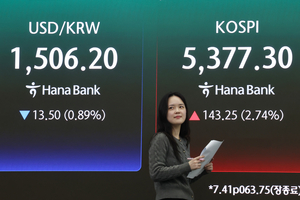

Kospi volatility hits 22.6% in March, topping Bitcoin’s 16.8% and triggering three circuit breakers
South Korean equities are exhibiting volatility more typical of speculative assets, raising concerns about underlying structural weaknesses in the market.
Data from the Korea Exchange shows that market stabilization measures were triggered at an unusually high frequency in March. Circuit breakers were activated three times — twice on the Kospi and once on the Kosdaq — marking the first such occurrence since the COVID-19 pandemic. The turbulence has carried into April, with a sell-side sidecar triggered on the Kosdaq on April 2.
The magnitude of the swings has exceeded that of major global markets. The Kospi and Kodsaq recorded monthly volatility of 22.6 percent and 28.4 percent in March, respectively, compared with 8.1 percent for the S&P 500 and 7.4 percent for Japan’s Nikkei 225. Bitcoin, often viewed as a proxy for speculative trading, showed relatively milder fluctuations of 16.8 percent over the same period.
At a glance, Korea’s real economy appears resilient. The Ministry of Trade, Industry and Energy said exports topped $80 billion in March, with semiconductors alone accounting for $36 billion, far exceeding expectations.
However, analysts say these headline figures mask a deeper structural imbalance. While export volumes are rising, the economy remains heavily concentrated in a single sector.
“The concentration is extreme. Semiconductors account for 38.1 percent of total exports, and just two companies — Samsung Electronics and SK hynix — make up nearly 40 percent of the Kospi’s market capitalization,” said Kim Seok-hwan, a senior analyst at Mirae Asset Securities. He noted that this level of concentration exceeds that of the so-called Magnificent 7 — the group of dominant US tech stocks including Apple, Microsoft, Nvidia, Amazon, Alphabet, Meta and Tesla that have driven much of the S&P 500’s gains.
This lack of diversification has amplified the market’s sensitivity to external shocks.
The escalation of tensions in the Middle East acted as a catalyst for a sharp wave of profit-taking. After the Kospi surged nearly 50 percent since late last year, foreign investors moved quickly to lock in gains as geopolitical risks intensified.
Korea’s low energy self-sufficiency further compounded the impact. Rising oil prices fed into broader market anxiety, triggering abrupt swings in equities.
The result has been a significant outflow of foreign capital. About 60 trillion won ($40 billion) exited the market in the first quarter, including roughly 40 trillion won in March alone.
Despite solid corporate earnings, foreign investors have taken a cautious stance, citing concerns over the market’s vulnerability to external shocks and limited capacity to absorb volatility.
“For global funds, these frequent trading halts are becoming an ‘exit trap,’” Kim said, referring to periods when liquidity dries up, making it difficult to sell positions at desired prices or on time.
“As long as the economy remains overly reliant on a single sector, this kind of volatility is likely to persist,” he added.
Analysts warn that without broader diversification, the Korean equity market risks being perceived as a high-beta, event-driven market — more akin to speculative assets than a stable investment destination.
By Choi Yeon-jae (ch0221@heraldcorp.com)