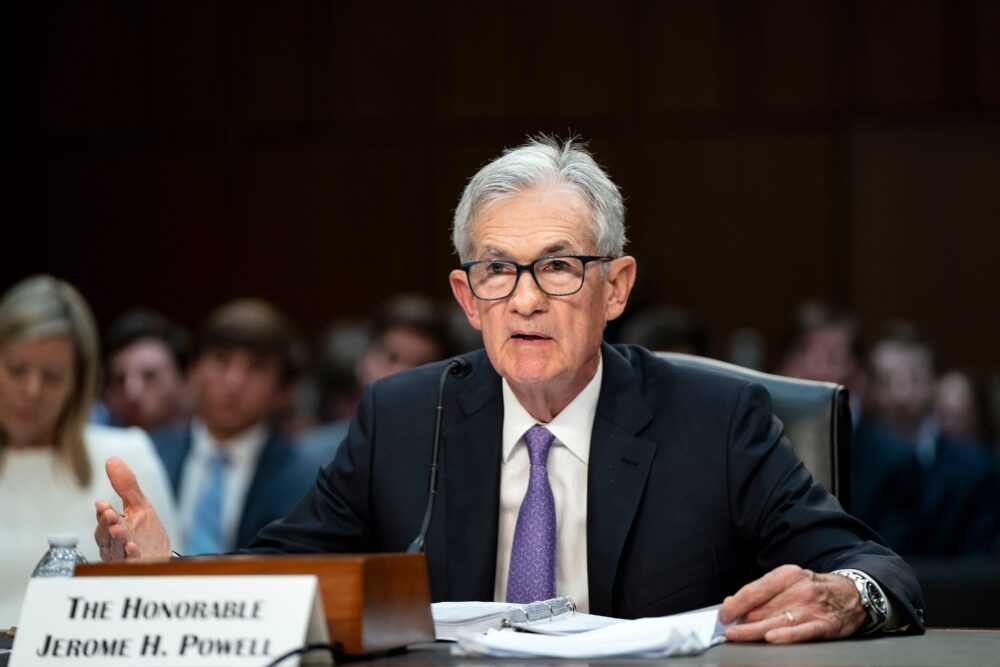

Forget the headline that “a crypto-friendly Fed chair is bullish for DeFi.” On May 15, 2026, Jerome Powell hands the Federal Reserve gavel to Kevin Warsh — a former governor with more than $100 million in disclosed digital-asset holdings and a 2021 line that “if you’re under 40, Bitcoin is your new gold.” Crypto Twitter has spent four months pricing this in as a tailwind. The actual transmission mechanism is more complicated, and almost certainly more bearish in the short run.
Two structural facts have been buried under the personality coverage. First, Powell announced on April 29 that he will stay on the Board of Governors until 2028 — the first chair to do so since Marriner Eccles in 1948 — citing Trump’s legal pressure on the Fed as having “left me no choice.” Second, Warsh’s stated framework is “practical monetarism,” meaning faster balance-sheet runoff rather than the lower policy rate Trump publicly demands. Liquidity, not Bitcoin endorsements, is what moves DeFi total value locked. And in the first six months under Warsh, liquidity is more likely to compress than expand.
For DeFi yields, stablecoin issuers, and the brokers and custodians that intermediate between them, that compression is the story. The Powell-to-Warsh handoff isn’t a policy pivot — it’s a slower, more politically contested liquidity reset, and it lands on a DeFi market still digesting a $13 billion TVL drawdown from the late-April KelpDAO exploit.
Key Facts
- Powell’s chairmanship ends May 15, 2026; his Board of Governors term runs until January 2028 — CNBC, April 29, 2026
- Final FOMC under Powell voted 8–4 to hold rates at 3.50–3.75%, the most dissents since October 1992 — Federal Reserve, April 29, 2026
- Bitcoin fell roughly 2% to $76,000 after the meeting; market-implied odds of a 2026 rate cut collapsed from ~25% to 1% — Decrypt, April 30, 2026
- Stablecoin market cap reached $317 billion as of April 6, 2026 (USDT $188B, USDC $79B) — DefiLlama, April 2026
- DeFi TVL fell from $99.5B to $86.3B in two days after the KelpDAO exploit on April 18–19 — CoinDesk, April 19, 2026
- Warsh disclosed $100M+ in crypto holdings across Bitwise, Electric Capital, Polychain, Polymarket, Solana, Optimism, dYdX, and Bitcoin Lightning startup Flashnet — The Block, April 14, 2026
- Senate Banking Committee cleared Warsh on April 29; full Senate vote expected the week of May 11 — CNBC, April 26, 2026
What’s Actually Happening — and Why “Powell Stays” Changes the Math
Having tracked Fed transitions since the King-to-Carney handoff at the Bank of England in 2013, the pattern is consistent: markets misprice the institutional drag in the first six months. The new chair gets the headlines; the existing committee delivers the votes. Warsh is walking into a building where four regional presidents and one governor just dissented against the outgoing chair — a signal that the FOMC is already fragmented, and that any “Warsh pivot party,” as The Block dubbed it, is going to need more than a confirmation vote to materialise.
Powell’s decision to remain on the seven-member Board of Governors is the most underappreciated variable. As a governor he keeps a permanent FOMC vote and retains supervisory authority over Fed Master Account decisions, large-bank crypto custody policy, and the implementation of stablecoin oversight under the GENIUS Act. That portfolio matters more for DeFi market structure than the headline rate. Powell already used it to remove “reputation risk” as grounds for denying master accounts to crypto-adjacent banks, a policy shift FinanceFeeds flagged when the Fed ended its 2023 “novel activities” oversight regime. Those institutional choices outlast a single chairmanship.
The mechanics of Warsh’s “practical monetarism” deserve attention. In Senate testimony on April 21, Warsh stuck to the line that the Fed should let its $6.6 trillion balance sheet shrink faster while resisting Trump’s demand for an immediate rate cut. Faster runoff drains bank reserves, tightens repo conditions, and — crucially for digital assets — reduces the pool of dollar liquidity that ultimately backs stablecoin reserves and DeFi collateral. As Powell put it in his final press conference: “This is my last press conference as chair. First, I want to congratulate Kevin Warsh on his advancement out of the Senate Banking Committee this morning.” The graciousness was real; the policy continuity question was not resolved.
Protocol and Industry Response — Who’s Actually Doing What
Stablecoin issuers have moved fastest, and they have to. Circle’s exposure is unusually direct: T-bill interest accounted for roughly 95% of its Q4 2025 revenue, and the yield it earns on USDC reserves dropped nearly 0.7 percentage points year-on-year, according to DLNews. A Warsh administration that resists rate cuts is, paradoxically, the better outcome for Circle’s near-term P&L — even though Circle’s leadership has lobbied publicly for the regulatory clarity Warsh’s chairmanship is expected to accelerate.
Tether took a different path. In January 2026 it launched USAT, a federally regulated dollar-pegged stablecoin designed to operate inside the GENIUS Act perimeter, while keeping its $188 billion offshore USDT supply intact. The strategy treats Warsh’s confirmation as a forcing function: get a US-compliant product into the market before bank-stablecoin entrants leverage the FDIC’s bank-stablecoin rulemaking to capture institutional flow. Senior US bank executives have privately briefed FinanceFeeds that they expect at least four large depositories to file for permitted-issuer status before the registration window closes.
DeFi protocols are responding to a different problem set. Aave’s $26.18 billion TVL made it the largest protocol on April 17, but the KelpDAO exploit two days later crashed Aave’s TVL by $6.6 billion and the AAVE token fell 16% as attackers used $292 million in stolen rsETH as collateral on Aave V3, per CoinDesk. A coalition of DeFi protocols has now proposed a coordinated reimbursement plan. The relevant point for the macro story: DeFi’s largest lender is rebuilding its reserve assumptions just as the Fed is about to tighten the dollar liquidity those reserves are denominated in. Coinbase Institutional’s Q1 2026 outlook, published before the FOMC, framed this exact tension as the “fresh footing” question — meaning the asset class has to prove it can compound TVL without the loose-money tailwind of 2024–25.
Hyperliquid’s response is the clearest tell on industry positioning. The protocol launched a $29 million policy centre in Washington — a number that would have been unthinkable for a single DeFi venue eighteen months ago — and is openly working to shape how Warsh’s Fed engages with on-chain derivatives. When testing Hyperliquid’s perpetuals in Q1, the latency and depth profile already rivalled centralised venues; what was missing was regulatory cover, and that is precisely what the lobbying spend is trying to procure.
Market Impact and Data Analysis
The most useful synthesis combines two data sets that nobody pairs in the same chart. The Federal Reserve’s own April 8 staff note found that stablecoin issuers now hold enough Treasury bills that “marginal demand from stablecoin reserves has become a non-trivial input to the front-end curve” — language the Fed itself published at federalreserve.gov. Combine that with DefiLlama’s stablecoin tracker showing aggregate supply at $317 billion, and the implication is that the Fed’s next chair is, for the first time, presiding over a balance-sheet runoff in which a $300+ billion private buyer of T-bills exists outside the banking system. Warsh has never had to think about that as a governor in the 2006–2011 period. Powell barely had to think about it until 2023. It is now a load-bearing piece of the dollar plumbing.
Bitcoin’s reaction to the April 29 FOMC tells the same story in faster timeframe. BTC fell roughly 2% to $76,000 within hours, as the market-implied probability of a 2026 rate cut collapsed from ~25% to 1%, according to CME FedWatch data summarised by Decrypt. ETH and SOL each fell more than BTC. The narrative that a “crypto-literate” Warsh would deliver an immediate liquidity gift is now demonstrably wrong. The market repriced inside a single press conference.
The cross-industry parallel here is the Bank of England under Mark Carney in 2013–14. Carney arrived with explicit forward-guidance enthusiasm and a reputation as the most market-friendly central banker in the G7. Sterling-denominated risk assets rallied for ten weeks, then sold off for nine months as the underlying liquidity reality reasserted itself. Crypto markets pricing Warsh as a uniformly bullish catalyst are running the same trade with worse risk management.
| Policy area | Powell stance | Warsh stance |
|---|---|---|
| Balance sheet | Gradual runoff, ~$95B/month cap | Faster runoff under “practical monetarism” |
| Forward guidance | Regular, dot-plot driven | Reduce communication, no fixed paths |
| Stablecoin oversight | “Same risks, same regulation” | Industry-engaged; held stakes in payment infra |
| Retail CBDC | Open under Congressional authority | Opposed; conflicts with “American privacy values” |
| Bank-crypto activity | No reputation-risk barrier | Expected to maintain Powell-era posture |
Regulatory Landscape and the Real Tension
The push-pull between innovation and oversight is concentrated in three live workstreams. First, the GENIUS Act registration window opened on April 1, 2026, when Treasury and the OCC began accepting applications from issuers seeking Permitted Payment Stablecoin Issuer status — covered in detail by FinanceFeeds when the Treasury commenced the GENIUS rollout. Second, the FDIC’s April rulemaking sets bank-like compliance bars for issuers, including 1:1 backing in liquid assets, two-business-day redemption rights, and monthly disclosures. Third, the CLARITY Act sits stalled in the Senate after Warsh’s hearing absorbed the Banking Committee’s calendar in late April.
The conflict-of-interest question is the genuine wild card. Warsh’s disclosed holdings span more than 20 crypto-adjacent ventures — DeFi lending, decentralised derivatives, Layer 1s, Layer 2s, prediction markets, and Bitcoin Lightning infrastructure. Federal ethics rules typically require a one-year cooling-off period for matters that directly affect recent financial interests. With the Fed chairing or co-chairing virtually every consequential US digital-asset rulemaking — bank custody, master accounts, GENIUS implementation, wholesale CBDC scoping — the recusal map alone could shape policy outcomes. Senator Elizabeth Warren raised this directly in committee; Warsh’s response was that he would divest “the majority” of holdings and recuse where required.
European context matters too. MiCA’s stablecoin provisions are now eighteen months old, and the ECB’s wholesale CBDC pilot — which Warsh has spoken approvingly of — is creating a regulatory benchmark the US will be compared against. UK and Singapore frameworks are converging on the same direction. A Warsh Fed that resists retail CBDC while accelerating wholesale settlement infrastructure could finally close the cross-border gap on tokenised deposits, a workstream that has stalled under Powell despite favourable rhetoric.
For brokers and institutional platforms, the most consequential near-term shift is on the supervision side. The SEC’s Reg Crypto framework, the SEC-CFTC Memorandum of Understanding from March 11, and the Fed’s evolving bank-crypto posture together determine whether US-licensed venues can host the same DeFi-derived products that already trade offshore. Warsh’s presence as chair changes how the Fed contributes to that triangulation; Powell’s continuing seat on the board changes how slowly any contribution moves.
What Happens Next — Three Predictions With Causal Reasoning
Prediction one: a “Warsh confirmation rally” in crypto majors that fades inside three weeks. The pattern is well-trodden — Carney 2013, Lagarde 2019, Bailey 2020. New central-bank chiefs get a sentiment bid, then the underlying liquidity stance reasserts itself. With the FOMC dot plot signalling no 2026 cuts and Warsh on record favouring faster QT, the second-derivative trade is short — not because Warsh is hostile to crypto, but because his preferred policy mix is dollar-positive in the short term. Expect the bid to peak somewhere between the Senate confirmation vote (expected week of May 11) and the June FOMC.
Prediction two: stablecoin issuance accelerates from $317B toward $400B by year-end. The combination of GENIUS Act registration, FDIC bank-stablecoin rules, and Warsh’s stated comfort with payment-stablecoin infrastructure removes the last regulatory overhang for US institutional issuance. Expect at least three large US banks to apply for PPSI status before the registration window closes, and for at least one Wall Street name to launch a permitted dollar-pegged token by Q4. The bottleneck shifts from policy to distribution.
Prediction three: DeFi TVL ranges between $85B and $130B for the rest of 2026, with composition rotating toward institutional-grade venues. The KelpDAO drawdown exposed structural risk at the largest DeFi lender, and a tightening dollar liquidity environment will keep yields compressed. But the same regulatory clarity that constrains aggressive new TVL growth will favour protocols that can demonstrate institutional-grade controls — which is why Hyperliquid’s policy spend, Aave’s reimbursement coalition, and the GENIUS-aligned stablecoin issuers are all positioning for the same rotation. The next twelve months belong to the protocols that look least like the 2021 vintage and most like regulated market infrastructure.
Powell’s exit isn’t the start of a new crypto era. It’s the slow-motion reset of the macro stack that DeFi has been built on top of — and the new occupant of the chair will have less freedom than markets currently believe.
Frequently Asked Questions
When does Jerome Powell’s term as Fed chair officially end?
Powell’s term as chair ends on May 15, 2026. However, his term as a member of the Board of Governors runs until January 2028, and on April 29, 2026 he announced he will remain on the board — making him the first former Fed chair to do so since 1948.
Who is replacing Powell as Federal Reserve chair?
Former Fed Governor Kevin Warsh, nominated by President Trump on January 30, 2026, and advanced by the Senate Banking Committee on April 29. The full Senate confirmation vote is expected the week of May 11, 2026, allowing Warsh to take office before the May 15 deadline.
Is Kevin Warsh actually pro-crypto?
Warsh has disclosed more than $100 million in digital-asset investments spanning Bitwise, Electric Capital, Polychain, Polymarket, Solana, dYdX, and Bitcoin Lightning startup Flashnet, and he said in 2021 that “if you’re under 40, Bitcoin is your new gold.” However, his stated monetary framework — “practical monetarism” with faster balance-sheet runoff — is dollar-positive and represents a near-term liquidity headwind for crypto and DeFi, regardless of his personal views on Bitcoin.
What does Powell’s exit mean for stablecoins under the GENIUS Act?
The GENIUS Act registration window opened April 1, 2026, and Powell’s continuation on the Board of Governors means policy continuity in implementation. Issuers like Circle, Tether (via USAT), and incoming bank applicants are racing for Permitted Payment Stablecoin Issuer status. Warsh’s chairmanship is unlikely to change the substance of GENIUS implementation but may accelerate adjacent rulemaking on bank custody and wholesale settlement.
How did crypto markets react to Powell’s final FOMC meeting?
Bitcoin fell roughly 2% to $76,000 in the hours after the April 29 FOMC decision, with ETH and SOL falling more sharply. Market-implied odds of a 2026 rate cut collapsed from approximately 25% to 1% as four FOMC members dissented in favour of holding rates higher — the most dissents at a single meeting since October 1992.
Will Warsh push for a US central bank digital currency (CBDC)?
No retail CBDC. Warsh has publicly opposed a retail digital dollar, calling it “a poor policy choice that conflicts with American values of privacy and financial independence.” He has shown openness to a wholesale digital dollar for institutional settlement, which aligns with the direction the ECB and Bank of England are already moving.