Introduction: The Pain Point That Every AI Model User Face
The AI subscription treadmill is spinning out of control. Anthropic released Claude Opus 4.7 on April 16, 2026, OpenAI shipped GPT-5.5 on April 23, and DeepSeek dropped V4 on April 24. Each launch makes yesterday’s subscription a sunk cost. This fatigue has fueled AI relay stations promising one API key for every model, yet most suffer from opaque routing, data harvesting, and downgrade scams.
For readers who want to learn more background information, the below are the recommended readings:
-
“Claude Mythos Security” reveals how frontier AI models now discover hundreds of software vulnerabilities at unprecedented speed.
-
“Crypto AI Threat” examines whether advanced security AI poses systemic risks to blockchain.
-
“Self-Learning Agent” breaks down the leap from reactive LLMs to autonomous, goal-pursuing systems defining the next phase of AI.
What Is the AI Relay Station Market and Why Is It in Chaos?
The third-party AI relay station market is riddled with fraud that costs users money, compromises data privacy, and degrades model quality. Because these platforms sit between users and official model APIs, bad actors have developed three common scams: model adulteration, prompt data harvesting, and silent downgrading.
Model adulteration occurs when relay operators substitute cheaper or weaker models for the premium versions users paid to access. A customer requesting Claude Opus 4.7 may unknowingly receive output from Claude Sonnet or a distilled open-source model, with no visible way to verify the difference. According to industry discussions highlighted during B.AI’s April 2026 launch, this substitution is widespread among unregulated aggregators that lack transparent routing logs.
Data reselling represents a second, more insidious threat. Relay stations intercept every prompt and every model response passing through their servers. Unscrupulous operators package these conversations into training datasets and sell them to model developers or data brokers, monetizing user intellectual property without consent. For crypto traders, developers, and researchers who paste proprietary strategies or sensitive code into AI chat interfaces, this leakage creates existential confidentiality risks.
Silent downgrading completes the triad of abuse. Relay platforms often launch with genuine API connections to attract early adopters, then gradually shift traffic to lower-tier models or rate-limited endpoints to protect margins. Because most users lack technical tools to fingerprint model responses, this degradation goes undetected for weeks or months. These practices have eroded trust in AI aggregators and created demand for a transparent, verifiable alternative — which is precisely the gap B.AI was designed to fill.
What Is B.AI and How Does It Work?
At its simplest, B.AI functions as a unified gateway. Users obtain one API key and gain access to multiple frontier models without maintaining separate accounts, billing relationships, or interface switches. The platform handles intelligent routing, automatically selecting the most cost-effective or capable model for a given request. Payments settle on-chain, meaning users can fund usage with cryptocurrency rather than credit cards, bypassing regional restrictions and identity requirements entirely .
How Does B.AI’s Agent Infrastructure Differ from Traditional AI Aggregators?
B.AI grants every AI agent two things no traditional relay station provides — a verifiable on-chain identity and an autonomous payment capability — enabling machine-to-machine commerce without human intermediaries.
The first pillar is identity through the ERC-8004 protocol. Ratified in January 2026, ERC-8004 establishes a trust and identity layer for autonomous AI agents on Ethereum . Within its first month of mainnet deployment, more than 45,000 AI agents had registered across multiple blockchains . Under this standard, each agent receives an independent on-chain address that records behavior, reputation, and credentials. Agents can cryptographically verify one another without binding to any human account or centralized registry. This creates a permissionless trust network where software entities can prove their history and capabilities to potential counterparties.
The second pillar is autonomous payment through the x402 protocol. Developed by Coinbase and released as open source in 2025, x402 revives the HTTP 402 “Payment Required” status code for instant stablecoin settlements . When an agent requests a paid service, the server responds with a 402 code and payment terms. The agent then authorizes settlement from its own wallet — pre-loaded with USDC — and gains access within approximately two seconds . The protocol processes over 75 million transactions monthly with $24 million in volume across Base, Solana, Ethereum, and Polygon, charging zero protocol fees beyond minimal blockchain gas costs .
Together, these protocols enable a fundamental shift in human-AI relations. Previously, an AI agent could execute tasks but required human accounts, credit cards, and manual approvals to access paid services. Under B.AI’s architecture, agents carry their own credentials and their own wallets, paying for computes, APIs, and even services from other agents at machine speed, 24 hours a day . Humans evolve from operators to supervisors — setting boundaries rather than executing every transaction.
What Is BAIclaw and Why Does the Justin Sun Perspective Skill Matter?
BAIclaw is B.AI’s flagship AI assistant that combines OpenClaw-based GUI automation with a proprietary skill distilling Justin Sun’s strategic thinking framework into an executable module. Unlike command-line AI agents that intimidate non-technical users, BAIclaw offers a visual interface for managing settings, deploying agents, and automating workflows across six major communication platforms including Telegram and Discord.
The assistant supports real-time switching between global top-tier models and enables multi-agent collaboration with independent memory management. For crypto-native users, BAIclaw ships with over 55 built-in skills that execute complex on-chain operations through natural language commands — from DEX swaps and contract trading to multi-signature wallet management — without requiring users to write code.
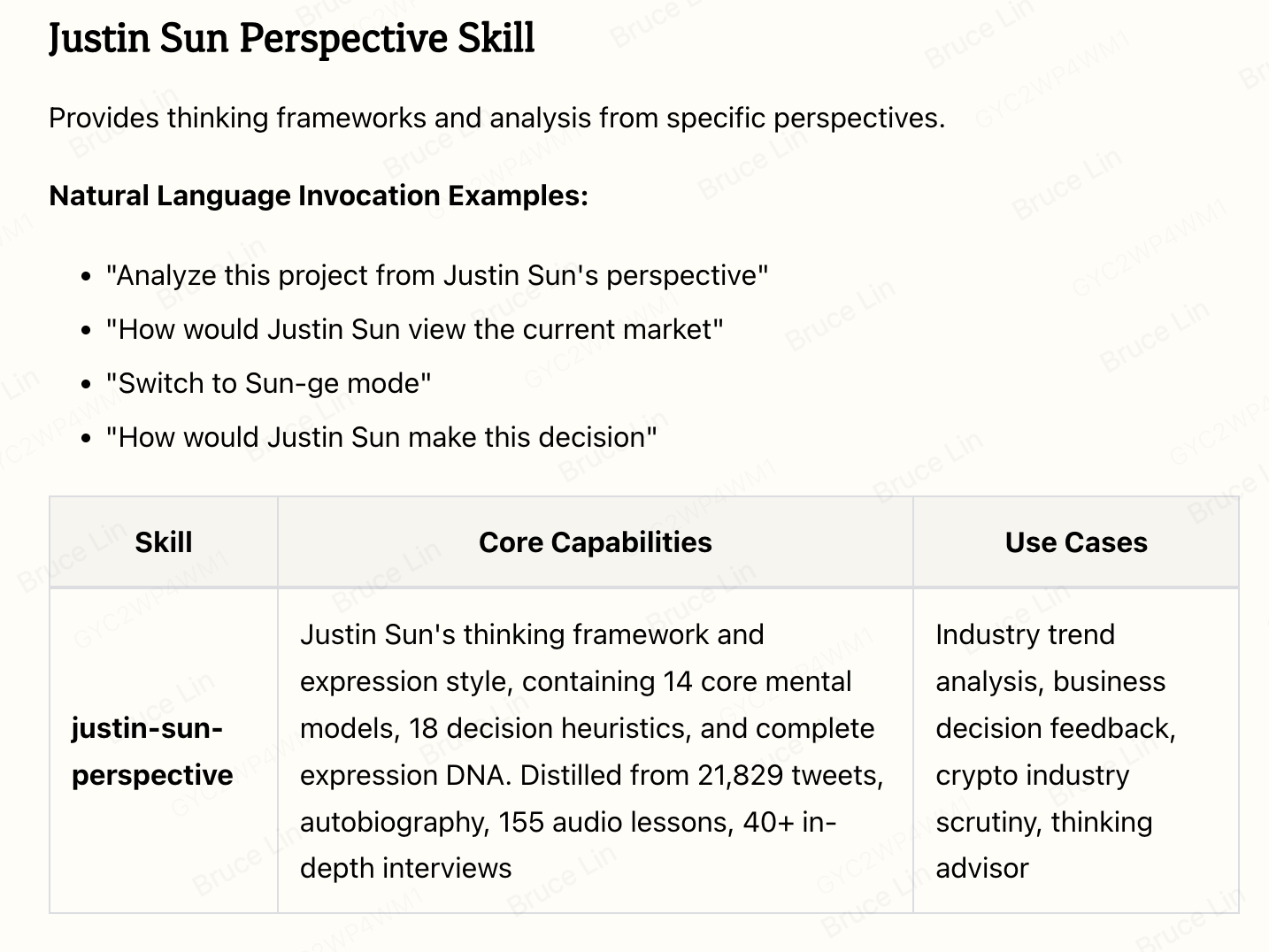
The standout feature is the Justin Sun Perspective Skill, launched May 1, 2026, as the “Sun Ge Brain” module. This skill captures Sun’s decision-making DNA by distilling 14 core mental models, 18 decision heuristics, and his complete expression style from 21,829 tweets, his autobiography, 155 audio lessons, and more than 40 in-depth interviews. Users can invoke the skill with natural language prompts such as “analyze this project from Justin Sun’s perspective” or “switch to Sun-ge mode”. Use cases include industry trend analysis, business decision feedback, crypto project scrutiny, and strategic thinking advisory. For traders and developers navigating volatile markets, this effectively embeds a seasoned crypto founder’s pattern-recognition system directly into the agent’s reasoning layer.
How Does B.AI Connect to Web4 and the Autonomous Machine Economy?
This vision directly addresses the structural contradiction that B.AI’s founders identified: modern AI agents possess “super brains” but lack bank accounts, trapping them inside chat dialogs and preventing them from participating in real economic cycles. By giving agents independent 8004 identities and x402 payment capability, B.AI cuts the “financial umbilical cord” that has kept AI dependent on human sponsorship.
The implications extend beyond convenience. In a Web4 economy, an AI agent could autonomously research market conditions, hire a secondary agent to execute trades, pay for analytics APIs, and compensate a third agent for risk assessment — all at machine speed, 24 hours a day, with every transaction verifiable on-chain. TRON’s blockchain provides the settlement backbone for this economy: as of April 2026, the network hosts over $86 billion in USDT circulation, processes massive daily transaction volumes, and maintains more than 375 million user accounts. This liquidity depth makes TRON a practical settlement layer for high-frequency, low-value agent transactions that traditional banking rails cannot support.
Should You Use B.AI for AI Model Access and Agent Development?
B.AI offers a compelling value proposition for crypto-native users, developers building autonomous agents, and traders seeking anonymous access to frontier models without subscription lock-in.
If your priority is simple API aggregation with transparent pricing, B.AI’s single-key access to Claude Opus 4.7, GPT variants, Gemini, and other models eliminates the administrative overhead of managing multiple provider accounts . The crypto-native settlement layer means users in regions with restricted access to traditional payment rails can still utilize top-tier AI capabilities without identity verification.
For developers, B.AI’s integration of ERC-8004 and x402 protocols provides ready-made infrastructure for building agents that can transact autonomously . Rather than constructing identity and payment systems from scratch, developers can deploy agents that inherit on-chain credentials and wallet capabilities through B.AI’s modular stack. The BAIclaw application demonstrates how these primitives combine into a production-ready agent capable of financial operations, social integration, and persistent memory .
Traders and analysts may find particular value in the Justin Sun Perspective Skill, which offers a structured framework for crypto-specific decision-making that generic models do not replicate . However, users should weigh the benefits of anonymity and agent infrastructure against the maturity of the platform and the inherent risks of entrusting operations to autonomous systems.
For those already active in the crypto ecosystem, B.AI represents a logical intersection of two dominant technology trends — frontier AI and permissionless finance — accessible through a unified interface.
Conclusion
The AI model landscape is moving too fast for static subscriptions to remain viable. Claude Opus 4.7, GPT-5.4, and DeepSeek V4 arrived within weeks of each other in April 2026, each raising the bar for coding and reasoning . In this environment, users need flexible access rather than vendor lock-in. B.AI addresses this by aggregating frontier models behind a single API key while solving the privacy and payment friction that plague traditional relay stations.
Where B.AI truly differentiates itself is in agent infrastructure. By integrating ERC-8004 for on-chain identity and x402 for autonomous payments, the platform enables AI agents to operate as independent economic actors without human intermediaries . The BAIclaw application demonstrates how these protocols combine into a 24/7 autonomous agent capable of model switching and complex financial operations .
This architecture aligns with the emerging Web4 vision of a machine-driven internet where AI agents outnumber human users and conduct their own economic activity . Whether that future arrives as collaboration or autonomous replacement remains debated . What is certain is that the infrastructure enabling it is being deployed today, and B.AI sits at the intersection of these trends.
FAQs
What is B.AI and who created it?
B.AI is a blockchain-powered AI relay station founded with Justin Sun, founder of TRON, serving as strategic advisor. It provides anonymous, crypto-settled access to Claude, GPT, Gemini, and other large language models through a single API key, while integrating protocols for autonomous AI agent identity and payments .
How does B.AI prevent model downgrade scams common in other relay stations?
B.AI connects directly to official APIs with zero tampering, and Justin Sun has publicly committed to transparent routing . The platform’s blockchain-based settlement creates an auditable record of which models were accessed, making silent downgrades more detectable than on opaque centralized platforms.
What is the x402 protocol and why does it matter for AI agents?
x402 is an open-source payment protocol developed by Coinbase that enables AI agents to pay for services automatically using stablecoins like USDC. It processes over 75 million transactions monthly with settlements in approximately two seconds, eliminating the need for credit cards, API keys, or human approval .
What is ERC-8004 and how does it help AI agents?
ERC-8004 is an Ethereum standard ratified in January 2026 that creates a decentralized trust and identity layer for AI agents. It gives agents portable on-chain identity, reputation tracking, and cryptographic verification capabilities without requiring human accounts or centralized registries .
Is B.AI only useful for crypto traders, or can regular developers benefit too?
While crypto-native features like anonymous payments and autonomous agent wallets appeal strongly to blockchain users, any developer building AI agents can benefit from B.AI’s unified API access and pre-built infrastructure for agent identity and settlement. The platform reduces the engineering overhead of enabling agents to transact independently .