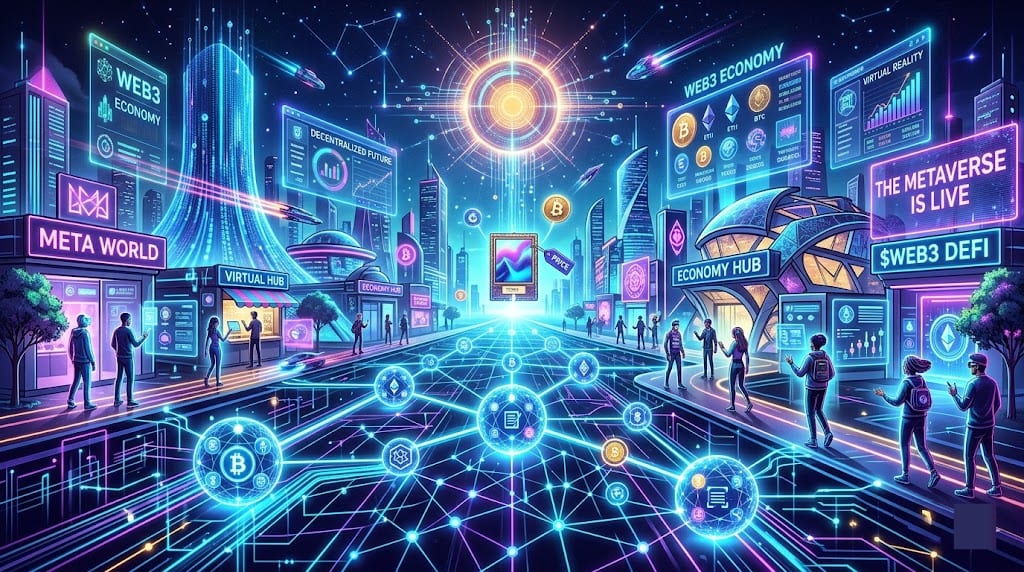

The internet is evolving once again. There were static pages in Web1 and interactive, platform-driven sites in Web2. Now there is a new phase called Web3. At the same time, the concept of the metaverse is gaining momentum, promising immersive digital worlds where people can work, socialize, and transact. Together, Web3 and the metaverse are laying the foundation for what could become the next digital economy.
Unlike traditional systems dominated by centralized corporations, Web3 emphasizes decentralization, ownership, and transparency. Combined with the immersive experiences of the metaverse, it opens up entirely new possibilities for how value is created and exchanged in digital spaces.
What Is Web3?
Web3 refers to a decentralized version of the internet built on blockchain technology. Instead of relying on centralized platforms to manage data and interactions, Web3 allows users to control their own assets and identities.
Blockchain networks like Ethereum play a crucial role in this ecosystem. They enable smart contracts, which automate transactions and ensure trust without intermediaries. This means users can interact directly with each other, reducing reliance on centralized services.
Key features of Web3 include:
- User ownership of data and digital assets
- Transparent and secure transactions
- Permissionless access for anyone with an internet connection
These characteristics make Web3 a powerful foundation for building decentralized digital economies.
Understanding the Metaverse
The metaverse is a collective virtual space where users can interact through digital avatars in immersive environments. It combines elements of virtual reality (VR), augmented reality (AR), and the internet to create persistent digital worlds.
In the metaverse, users can:
- Attend events and socialize
- Buy and sell virtual goods
- Work and collaborate remotely
- Create and monetize content
While the concept has existed in various forms for years, recent advancements in technology have brought it closer to reality. However, without Web3, much of the metaverse would still be controlled by centralized entities.
How Web3 Powers the Metaverse Economy
Web3 introduces true ownership into the metaverse. Through blockchain technology, users can own digital assets such as virtual land, avatars, and collectibles in the form of NFTs (non-fungible tokens). In other words, assets are not tied to a single platform; they belong to the user and can be freely traded or moved.
Cryptocurrencies serve as the primary medium of exchange in these digital worlds, enabling seamless transactions across borders. Smart contracts automate processes such as payments, royalties, and asset transfers, creating a self-sustaining economy.
This decentralized approach allows creators to monetize their work directly, reducing dependence on intermediaries and opening up new revenue streams.
Real-World Applications of the Metaverse Economy
The combination of Web3 and the metaverse is already being applied across various industries. In gaming, players can own in-game assets and trade them in open marketplaces. Virtual real estate platforms allow users to buy, sell, and develop digital land, creating entirely new forms of investment.
Brands and businesses are also entering the metaverse to engage with audiences in innovative ways. From virtual storefronts to immersive marketing experiences, companies are exploring how to build their presence in these digital environments.
Education and remote work are also being transformed, with virtual classrooms and offices offering more interactive and engaging experiences.
Market Trends and Digital Assets
As the metaverse economy grows, so does interest in the tokens and projects that support it. Investors are increasingly analyzing trends and exploring opportunities through discussions like solaxy price prediction.
Interest in solaxy price prediction reflects the broader curiosity about how emerging blockchain projects might contribute to the development of decentralized ecosystems. Factors such as adoption, technological innovation, and user engagement play a significant role in determining the value of these assets.
While price predictions can offer insights into potential market movements, they should be approached with caution. The crypto market is highly volatile, and long-term success depends on real utility and adoption rather than speculation alone.
Challenges Facing Web3 and the Metaverse
Despite their potential, Web3 and the metaverse face several challenges. Scalability remains a key issue, as blockchain networks must handle large volumes of transactions efficiently. High costs and slow processing times can hinder user experience.
Another challenge is accessibility. Advanced hardware like VR headsets and the technical complexity of blockchain technology can limit adoption among mainstream users. Security is also a concern, as decentralized systems require users to take responsibility for their assets.
Regulatory uncertainty further complicates the landscape, as governments work to establish rules for digital assets and virtual economies.
Conclusion
Web3 and the metaverse are redefining what is possible in the digital world. There will be a new type of economy where users have more control and ownership. This is being built by combining decentralization with immersive virtual experiences.
While discussions like solaxy price prediction highlight the investment potential of this space, the real impact lies in how these technologies transform industries and empower individuals. As adoption grows and challenges are addressed, Web3 and the metaverse are set to play a central role in shaping the future of the internet and the global economy.