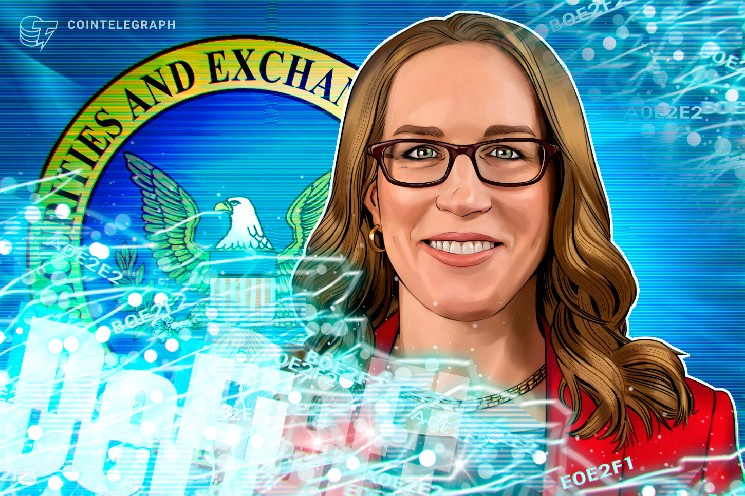

US Securities and Exchange Commission (SEC) Commissioner Hester Peirce said that publishing open-source code should not subject software developers to federal securities regulations, weighing in on a longstanding debate over developer liability in decentralized finance.
Speaking Tuesday at the IC3 Blockchain Camp at Princeton University, Peirce said developers who publish blockchain and DeFi code should not automatically be treated as securities intermediaries merely because others use their software.
“Many blockchain projects involve publishing open-source software, which is generally a protected activity under the First Amendment,” Peirce said.
She said that decentralized protocols can operate without traditional intermediaries and that responsibility for securities law violations should generally rest with the individuals who engage in unlawful conduct.
Source: CoinMarketCap
Peirce, a longtime advocate for clearer crypto regulations, warned against applying rules designed for centralized financial institutions to decentralized blockchain networks.
“The SEC’s rulebook is full of intermediaries: brokers, dealers, exchanges, clearinghouses, transfer agents, investment advisers and investment companies,” she said. “As a result, we see the crypto world teaming with brokers, dealers, exchanges, clearinghouses, transfer agents, investment advisers, and investment companies.”
However, she questioned whether those rules should extend to blockchain infrastructure itself, noting that distributed networks are used for a wide range of purposes beyond securities transactions.
Aligns with broader regulatory shift
Peirce’s remarks align with the SEC’s broader shift away from what Chair Paul Atkins has described as “regulation by enforcement.” Since its formation, the regulator’s Crypto Task Force has been examining how existing securities laws should apply to digital assets and decentralized systems.
The comments also come weeks after SEC staff issued guidance addressing broker-dealer registration requirements for certain user interfaces. The guidance suggested that some front-end websites and software interfaces that merely provide access to decentralized protocols may not fall within the traditional definition of a broker.
At the same time, the SEC has signaled that digital assets and blockchain technology will remain a key focus over the coming years. In its draft Strategic Plan through fiscal 2030, the agency highlighted blockchain and crypto assets as technologies with the potential to reshape financial markets.
“Blockchain and crypto asset technologies have the potential to revolutionize America’s financial infrastructure,” the SEC’s draft plan said.