
Tuesday June 23rd 2026
Worlds Oldest Football found in the bedchamber of Mary Queen of Scots
Written by Midlothian View Reporter, Liam Eunson
On first inspection, this round and unassuming artefact belies its fascinating history.
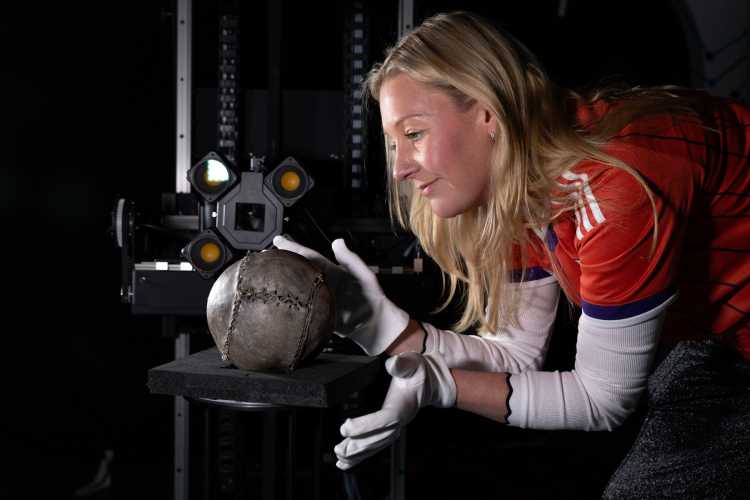
At nearly 500 years old, the world’s oldest football was discovered in the bedchamber of Mary, Queen of Scots, at Stirling Castle.
Normally, it has a permanent home at The Stirling Smith Art Gallery & Museum. But tomorrow (24 June 2026), it will make an appearance at the Scotland v Brazil game in Miami, on its first visit to the USA.
However, in another first, before leaving for America it stopped off at the University of Glasgow to allow world-leading 3D content creators begin the process of scanning the football to create a digital version in the metaverse.
Using advanced photogrammetry and digital artistry, University of Glasgow 3D content specialists Conor Fraser and Ben Morris have begun capturing the football to support the creation of a museum quality digital twin.
Dating from around 1540, the original football is roughly the size of a small melon, far smaller than today’s World Cup balls. In virtual reality, however, it can be scaled up or explored in extreme close‑up, allowing users to examine the scuffed leather surface and intricate stitching in remarkable detail.
Cutting‑edge workflows for heritage visualisation developed by researchers at the University’s Realities and Immersion Glasgow centre (RIG), together with the Wonder platform developed by University spin-out Infinite Muse, is helping transform how audiences can experience cultural heritage. Fragile objects like the football, which must be preserved behind glass, can instead be handled, enlarged and explored in immersive digital environments. Through this work, the University’s 3D artists are producing highly realistic virtual models that open up collections to global audiences, revealing extraordinary detail and offering new ways to connect with objects rarely seen up close.
The Wonder virtual reality platform was developed through the Museums in the Metaverse project as part of the UK Government’s Innovation Accelerator programme. The project was established to make good on the great economic promise of this technology for the cultural heritage sector and its audiences.
This latest football related artefact comes just weeks after the creation of a ‘The Treasures of Scottish Football: A Virtual Reality Experience’ at the Scottish Football Museum at Hampden, Glasgow, which tells the story of the history of football in Scotland.
Professor Pauline Mackay, Co-Director of RIG and a Co-Founder of Infinite Muse, said: “What’s extraordinary about the work we are undertaking at the University of Glasgow is the level of detail we can now capture and reproduce digitally. Immersive technologies now enable people to interact with unique heritage items like the world’s oldest football and explore every stitch and every repair, deepening our understanding of the object’s history and significance.
“This opens up possibilities for museums and visitors to engage with Cultural Heritage in exciting new ways, expanding access to unique heritage collections for wider, even global, audiences.”
Conor Fraser, Lead 3D Optimisation Technician, based at the University’s Advanced Research Centre (ARC), said: “Using advanced photogrammetry and digital artistry, we’re creating 3D models so precise and lifelike that they are being recognised as world-leading in the field of Cultural Heritage Visualisation.
“This allows people to engage and explore objects in entirely new ways, experiencing them in incredible detail as if they were holding them in their hands, and interacting with them in a different way to real life.”
Kirstie Campbell, the Assistant Director of The Stirling Smith Art Gallery & Museum, who accompanied the football to the University for its initial scanning, said: “It was fascinating to see the football starting its journey into the metaverse. Although we are a small museum, we care for objects of global significance like the world’s oldest football and this process really brings home the potential of new technology to share them far more widely around the world.
“As the football takes its place on a global stage at the FIFA World Cup, it’s exciting to know its story will soon be experienced in entirely new ways by audiences around the world.”
Faroque Hussain, Honorary Consul of Brazil (KPM) in Glasgow, played a key role in initiating the concept of bringing the world’s oldest football into the metaverse.
Tweet
Share on Facebook
Support Midlothian View from as little as £1. It only takes a minute. Thank you.